Mobile AR markers: the latency problem
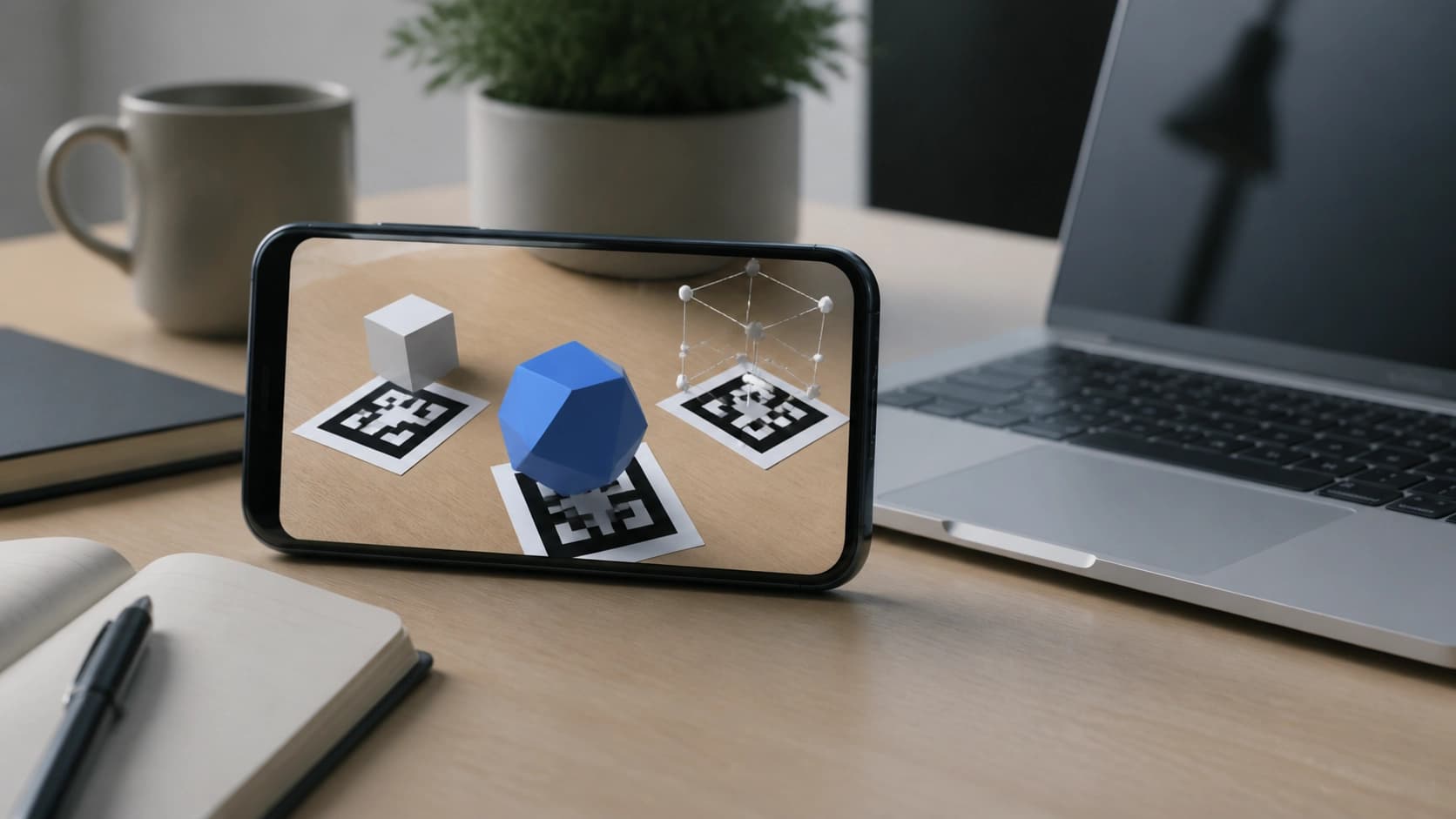
Augmented reality on smartphones often hits a performance ceiling. To understand where exactly a virtual object is located, the app needs to quickly recognize special markers — ArUco markers. These square images with a high-contrast pattern serve as reference points for the camera, and the faster the algorithm finds them, the more natural the final scene looks. On a PC with a powerful processor, this is usually not a problem, but on mobile devices, processing the video stream can lead to noticeable pauses.
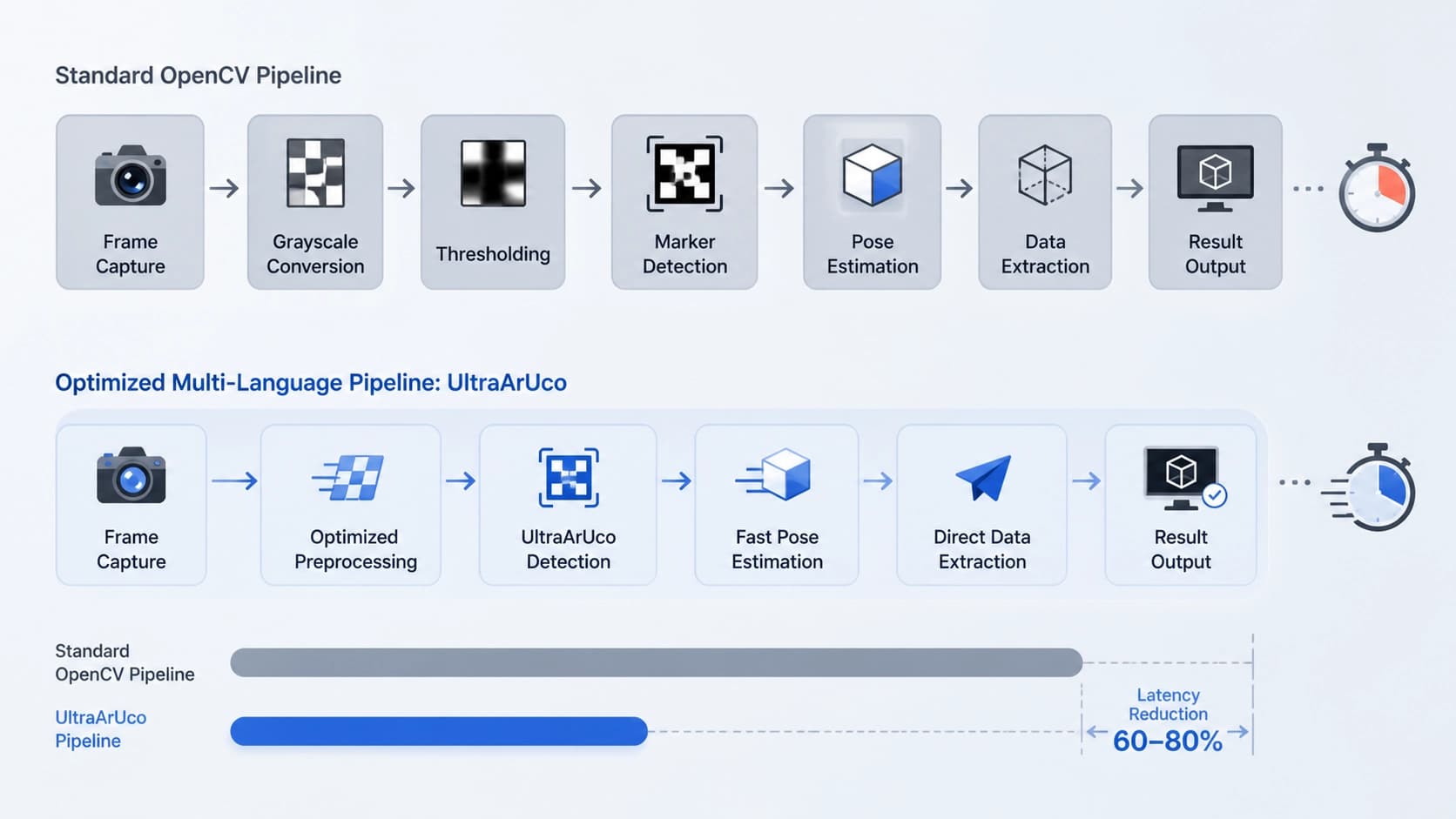
The UltraArUco project aims to address exactly this. The solution is described as a lightweight toolkit with support for multiple programming languages and a ready-made environment for AR applications. In a comparative test against a typical OpenCV-based implementation, the authors achieved a sixfold reduction in per-frame processing time — without losing recognition accuracy. This makes it possible to embed more responsive AR scenarios even into applications running on modest hardware.
How it works
The main secret behind the speedup is not exotic algorithms, but a dedicated multilingual layer that is carefully optimized and removes redundant intermediate operations that arise when passing data between different environments. The UltraArUco authors structured the pipeline so that the video stream is processed with minimal overhead. This also simplifies integration: the library can be plugged into projects in different programming languages without sacrificing speed for development convenience.
Such multilingual support is especially important for mobile AR products. Typically, the client side is written in Kotlin or Swift, while analysis tools and server components use Python or C++. If the library can work with all these environments without extra "translators," teams can build prototypes more easily and rarely need to rewrite existing modules. UltraArUco makes this scenario part of its architecture while maintaining high frame-processing speed.
Distributed architecture
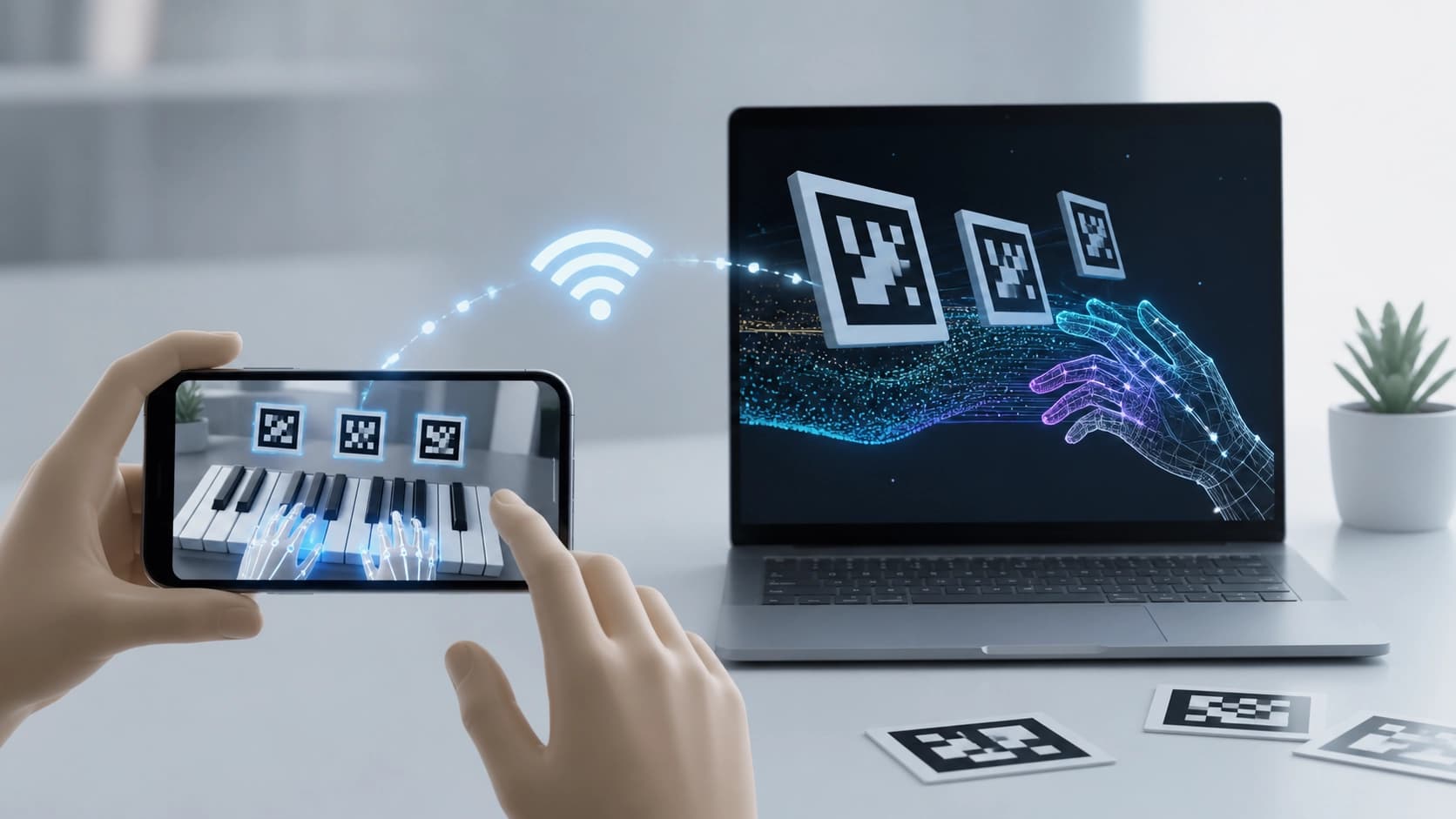
The UltraArUco authors abandoned the idea of performing all computations solely on the smartphone. Instead, they use a load-distribution scheme: devices communicate over Wi-Fi, the mobile part acts as a camera, and the computer handles visualization and part of the data processing. This separation reduces the load on the phone's processor and battery, so the system remains functional even on less powerful mobile devices.
Interestingly, this approach is useful not only for performance. The user can see the result simultaneously on the smartphone screen and on the PC monitor — which is convenient for educational or presentation scenarios. Developers do not need to maintain several isolated versions of the program: recognition and output logic are managed from a single point. The framework handles coordination between devices, removing the need for manual configuration of low-level network details.
The mobile piano test
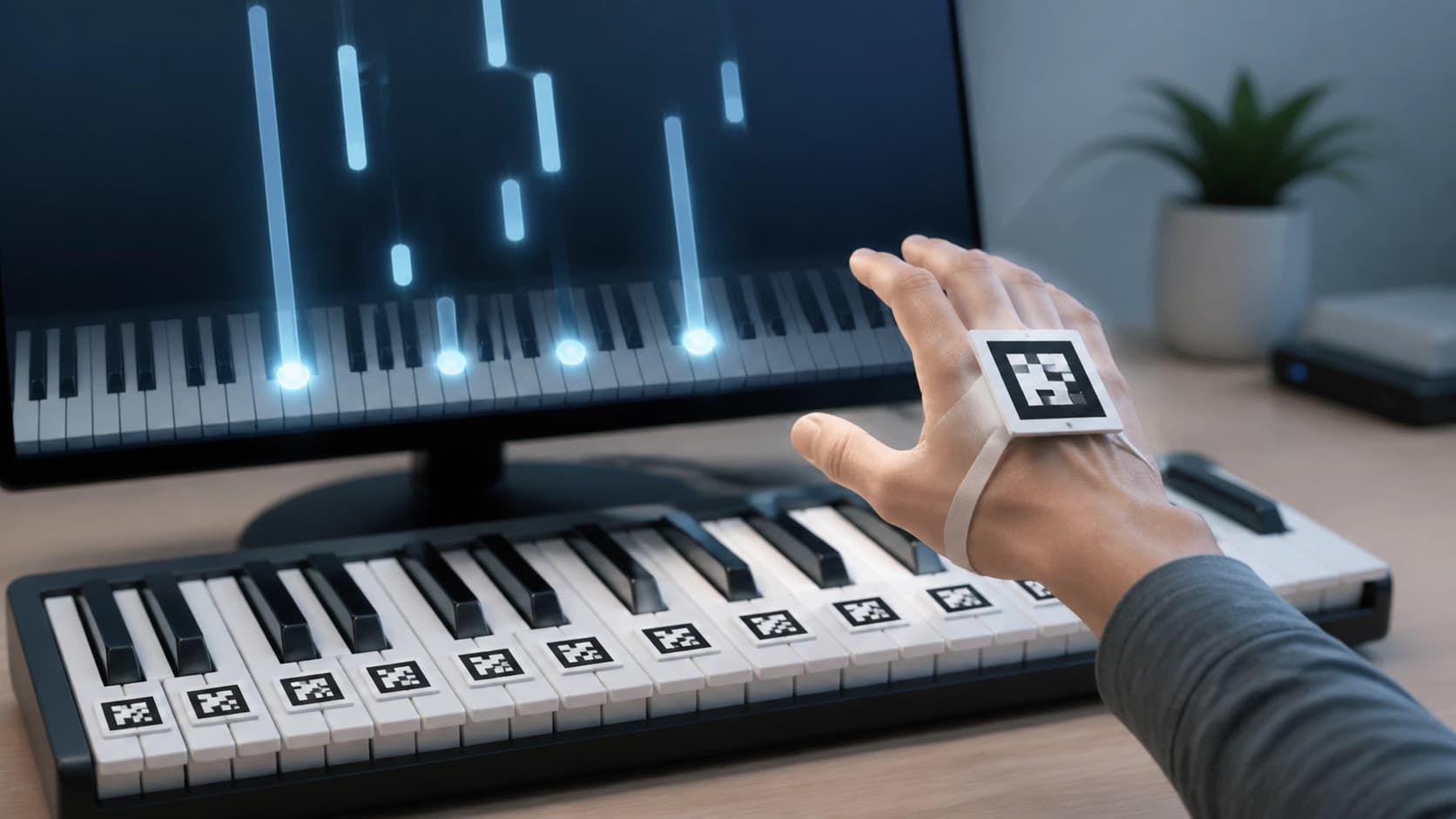
To validate the idea in a real scenario, the researchers built an interactive piano simulation. Its "engine" was UltraArUco. Static ArUco markers were placed on the keys, and additional markers were attached to the hand. Key-press recognition is based on occlusion: when a finger or palm covers the marker of a given key, the algorithm treats it as a press and plays the note. This technique allows controlling the instrument without expensive controllers, touchscreens, or other specialized devices.
The markers on the hand solve a second task — tracking spatial gestures. The system sees where the hand moves and interprets the trajectory as a chord, glissando, or other expressive technique. The result is a viable AR music interaction without special equipment: just a smartphone with a camera, a computer, and printed markers.
Results and possibilities
The mobile piano demo confirms that full-fledged AR applications can do without powerful headsets and high-end workstations. A smartphone, a computer, and a wireless network between them are enough. The evolution of UltraArUco shows that low system requirements and broad compatibility are not mutually exclusive. The sixfold latency improvement makes interfaces noticeably more responsive, while the reliance on simple ArUco markers keeps the entry barrier low for developers.
This approach can scale far beyond musical experiments: from educational materials to gesture-based smart home control or interactive displays. The technology does not require unique equipment, so the main constraint is not device performance, but the team's imagination and the quality of the interaction scenario.