

When a team grows, the question of "how do we share knowledge" is almost always answered on the fly: someone posts in a general chat, someone keeps notes, someone prefers one-on-one conversations. Formal guidelines, meanwhile, are either never established at all or are copied from a previous employer. New work on arXiv suggests that manually designing such rules may not be the most effective path — at least when it comes to collective problem-solving.

What this is all about
Collective intelligence — whether in a research group, an engineering team, or a developer community — depends heavily on knowledge-transfer processes. Who exactly shares information, what exactly they share, with whom, and at what moment — all of this determines how quickly the group arrives at a solution. Such processes partly emerge on their own, from the individual habits and cognitive traits of the participants, but they can also be deliberately imposed from the top down.
Until now, research on the impact of knowledge transfer on group outcomes has proceeded mainly through the lens of network structure: changing who is connected to whom and how often exchange occurs. This approach is convenient, but it has a fundamental limitation.
The problem with network models
A network, however complex, does not know the state of the participants. It cannot decide to "pass this along right now, because a colleague has just hit the relevant sub-task" or to "hold back information until the group has accumulated enough context." Topology describes the channels, but not the content or the timing.
In other words, classical models answer the question of "who is connected to whom" but ignore the question of "what and when." And it is often the latter that determines whether an exchange turns out to be useful or just becomes noise.
Protocols that take state into account
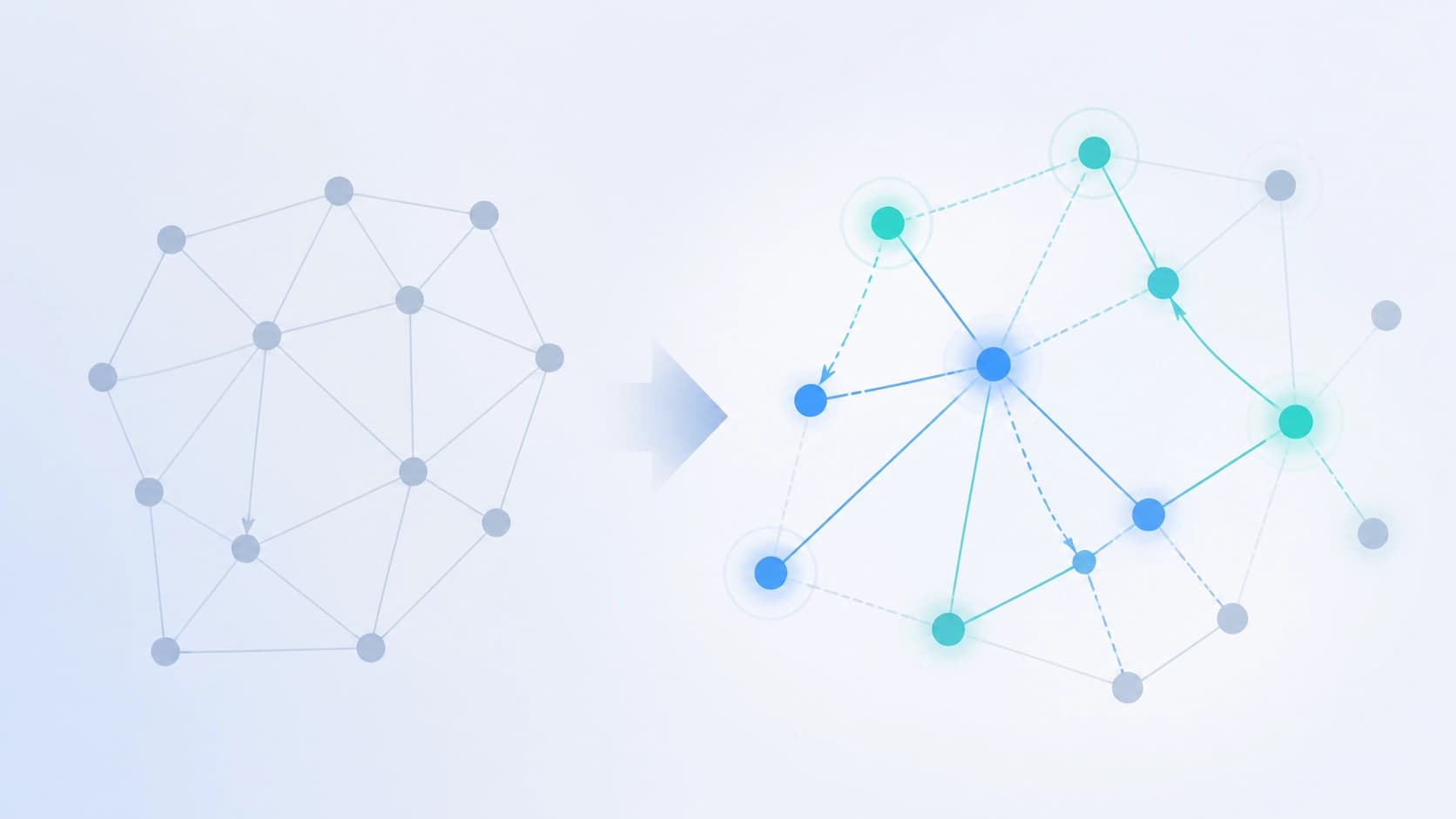
The authors of "Discovering Adaptive Transmission Programs for Collective Innovation" propose formalizing exchange rules as state-aware programs. Such a program routes information and resources based on the current situation — what a particular agent knows, what state the collective as a whole is in.
This shifts the emphasis: instead of "let's draw a graph of connections," we get "let's write an algorithm that decides at every moment who gets what." Naturally, you can't design such an algorithm by hand — the space of possible rules is enormous, and intuition is a poor guide here.
How suitable rules were sought
For the collective discovery task, the researchers applied evolutionary search, with a language model guiding the direction of movement. In essence, the LLM acts as a hypothesis generator: it proposes candidate protocols, and the evolutionary mechanism selects those that actually improve the group outcome and produces the next generations based on them.
Such a symbiosis is not uncommon in modern research, but what matters here is the result: the protocols found during the search outperformed the standard baselines from the literature, with gains in collective performance reaching 37%. This is not a cosmetic improvement but the difference between "the team works as usual" and "the team works noticeably better" — with the same composition and the same task.
A test for honesty
A pretty number is easy to get by chance, so the authors ran ablations — that is, they removed individual elements of the discovered protocols one at a time. The most telling result: if you keep the network topology and the timing of exchanges but remove the dependence on content and state, the advantage disappears entirely.
This is precisely the paper's main argument. The gain comes not from a cleverly designed connection scheme or a lucky schedule, but from sensitivity to what is happening inside the participants and the group. The ablation rules out the alternative explanation and leaves only one.
Does this work beyond a single task
The second important result is transferability. The evolved protocols retained their effectiveness when domain variations changed and when the agent population was replaced. In other words, the discovered rule is not tailored to a specific narrow scenario but reflects something more general about how information should be distributed within a group.

What this means for real teams
The authors' conclusion is this: effective and generalizable knowledge-transfer protocols can be discovered in silico — that is, in simulation — before they ever appear in a live team. This opens the way to AI-assisted design of coordination infrastructure — the rules, rituals, and tools that enhance people's collective intelligence rather than replace it.
In practice, this could look like this:
- Exchange rules stop being universal. Instead of a single guideline like "everyone writes reports on Fridays," there are scenarios that depend on what stage the work is at and what the participants already know.
- There is a demand for state. For a protocol to work, the system needs to understand who knows what and where they are stuck. This is already a question of tools — task trackers, knowledge bases, documentation systems.
- Designing rules becomes a separate task. Not "let's copy from the neighbors" but "let's run a few variants on a model and see which one gives the best result."
One caveat: the paper is published in the cs.AI section on arXiv, presented at CogSci 2026, and according to the authors, an extended version is still in preparation. This is research on simulations, not a ready-made product you can roll out tomorrow in a twenty-person department. Transferring the results to live organizations is a separate and not particularly simple task.
In short
Knowledge-exchange protocols don't have to be invented by hand or copied from others. They can be discovered automatically if you evaluate rules not by the elegance of the connection scheme but by how sensitive they are to the state of the participants. In the experiment, such a search yielded gains in collective performance of up to 37%, and ablations confirmed that it is precisely state-awareness that matters, not topology or timing. For now, this is a result in simulation — but the direction looks promising.