
PeakBench: a benchmark that tests whether an LLM agent can stay within resource limits when calling tools
A new benchmark evaluates agents on executable multi-tool scenarios with dependency annotations and measured resource profiles, and its scoring system is split into logical planning and physical scheduling — to reveal exactly where an agent breaks down: in the order of steps or in resource allocation. The authors show that sound logic alone does not save you from overloads, while open information about available resources reduces the number of preventable failures.

Why agents needed another benchmark
Most agent benchmarks answer straightforward questions: did the model pick the right tool, did it assemble the arguments correctly, did it reach the desired result. Nearly all such measurements are built around sequential execution — one call after another, with no rush and no competition for resources.
Production looks different. To stay within an acceptable latency, an agent has to fire off independent calls in parallel. But parallelism without regard for limits runs into a different wall: exhausted quotas, overflowing memory, a dropped external service.
PeakBench is precisely about this blind spot. The authors Zhi-Kai Chen, Xu-Xiang Zhong, Song-Yan Li, De-Chuan Zhan, and Han-Jia Ye describe it in the arXiv preprint arXiv:2608.24509 (v1, August 25, 2026, categories cs.AI and cs.SE); the code is promised to be released alongside the paper.
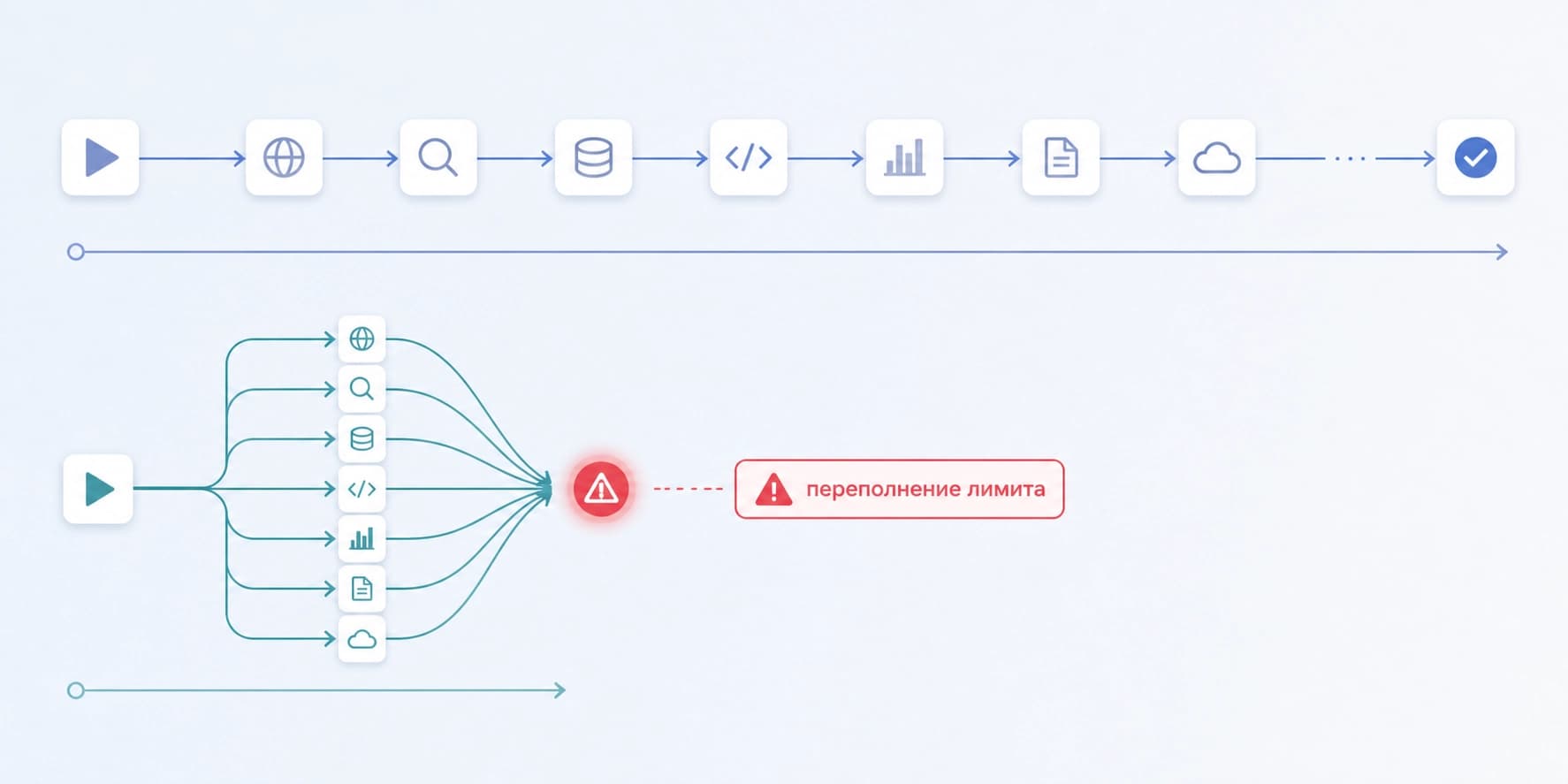
The key idea from which the whole work grows: an agent has two ways to fail, and they are opposites. Sequential execution is safe but slow — limits aren't exceeded simply because nothing happens at the same time. Parallel execution without regard for resources is fast but leads to overflows that could easily have been avoided. Between these two poles lies what no one has really measured.
What the benchmark is
Instead of static tasks with reference answers, it uses executable multi-tool workflows. Each has two important attachments: dependency annotations showing which steps are actually connected to each other, and measured resource profiles — how much memory, time, or quota a particular call consumes.
This design changes the very subject of evaluation. The question "did the right answer come out" recedes into the background, and the question "how did the agent lay out the work over time, and did it stay within budget" comes to the fore.
Logical planning versus physical
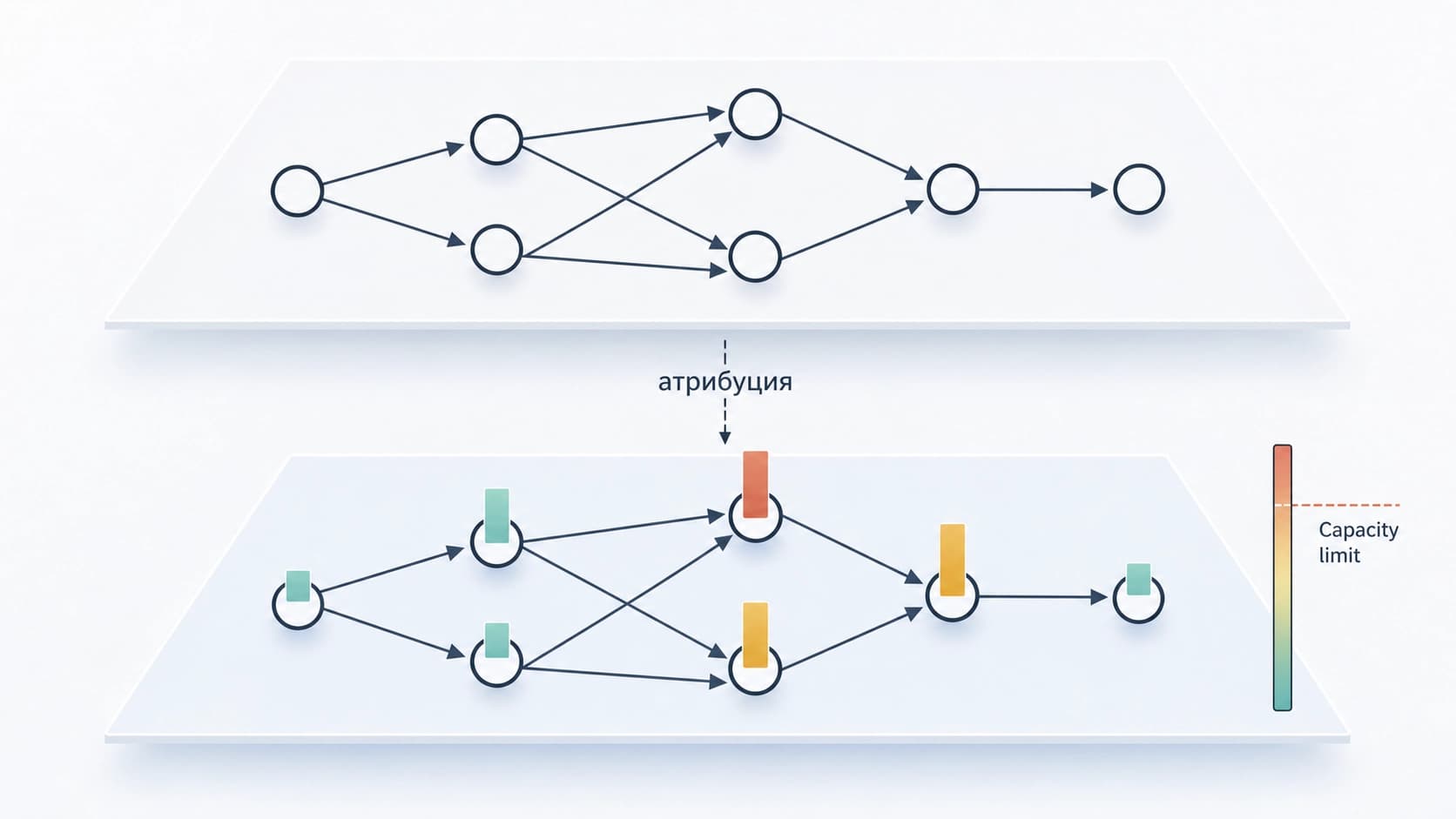
The central difficulty in evaluating such processes is attribution. When a run falls apart, it's unclear what exactly is to blame: the agent misread the dependencies, or read them correctly but didn't account for the available resources, or both at once. Lumping everything into a single success metric means losing the most useful part.
That's why evaluation is split into two parts. One dimension is responsible for logical planning: the order of steps, the correctness of dependencies, the absence of invented connections. The other is responsible for physical planning, that is, for scheduling with real constraints in mind. These dimensions have their own metrics, and a failure in one doesn't mask success in the other.
Wrong order and wrong budget are different diseases
The two-part scheme isn't for the sake of a pretty taxonomy but for the sake of diagnosis. If an agent made a mistake at the logic level, there's no point telling it about quota size — it didn't understand what depends on what. If the logic is fine but execution falls apart, the problem is in the scheduler or in how the agent was informed about the available resources.
The practical takeaway for those building agent systems: before fixing anything, it's worth understanding which of the two layers the failure belongs to. Prompt engineering, trajectory training, and tool fixes will each treat completely different breakdowns.
The main result: careful logic doesn't save you from overload
The most unpleasant of the paper's conclusions goes like this: strong logical planning guarantees neither safe nor efficient execution under resource constraints. An agent can build a flawless dependency graph — and still bring down the system by launching everything not connected by edges all at once.
Resource disclosure reduces the number of preventable overflows
The second observation: if you give the agent information about available resources, the number of preventable overflows drops and utilization rises. This isn't magic and isn't a new architecture — it's simply that the context now includes not only tool descriptions but also the budgets that must be met.
It's important not to overstate the effect here. The point is that resource transparency is a cheap and workable intervention, not that it solves the problem entirely: the agent still has to use that information wisely.

Who this is for
The benchmark is conceived as a testbed for diagnosing resource-aware agent behavior, and that is its main purpose. It doesn't so much produce a final score as show exactly where a model breaks: in understanding dependencies or in spending discipline.
Hence several use cases. For developers of agent frameworks — a way to test the scheduler before production rather than after an incident. For researchers — a reproducible setup for experiments with budgets in context. For those choosing a model for a task with tight limits — a chance to see the difference between models that ordinary success tests simply don't reveal.
What to keep in mind
The approach has an obvious entry cost: resource profiles must be measured, and dependencies must be annotated. In real systems, limits are noisy, external services change behavior under load, and the cost of a call isn't always known in advance. Laboratory precision here is higher than in the field, and the conclusions shouldn't be transferred one-to-one to production.
But the framework itself is useful even without the benchmark. Two questions — "did the agent correctly understand what depends on what" and "did it stay within budget" — are reasonable to ask of any agent system, even if there's no ready-made testbed on hand to check them.
Frequently asked questions
Related materials
All materials
Canonical Polynomial Invariants for Diagnosing RL Simulator Failures: Where Are They Actually Useful?
The study examines whether incorporating physical laws into learnable dynamics models is justified: invariants extracted from trajectories and reduced to canonical form using Gröbner bases yield modest forecasting gains, but prove powerful for diagnostics, enabling the localization of violated constraints and identification of specific erroneous parameters.
10 November 2026
AURA-Eval: How to Check Whether an LLM Agent Recognized a Risk and Changed Its Next Step
The framework evaluates LLM agents’ behavior not by their final verdict, but by how they respond to risk at key decision points: tool-call trajectories are interrupted, after which the model must continue reasoning and acting, while a panel of LLM judges assesses risk detection, the nature of the step, and its safety. Across 1,249 tasks drawn from 157 R-Judge trajectories, unsafe actions become more frequent among 20 models when no safe path is available, and removing oversight before execution turns 52.3% of initially safe cases into unsafe ones.
10 November 2026
Chern–Simons Reservoir Memory: Autonomous Connectivity Dynamics and Density Transport
The article explores how a reservoir preserves the history of input signals both in its density distribution and in its geometric degrees of freedom. A comparison of four mechanisms shows that current creates a separate connected component that alters the subsequent density response, while accounting for all measured features yields a small improvement in decoding pulse order.
10 November 2026