
Hypergraph instead of averaged embeddings: HMGCLIP teaches models to notice the tiniest differences between products
A team of researchers has introduced HMGCLIP, an approach in which multimodal product representations are built on a heterogeneous hypergraph: its structure helps identify hard negative examples and link meanings across multiple levels of granularity at once. According to the authors, this mechanism enables more accurate discrimination of attributes in visually similar items, and on a new fine-grained dataset and the public MAVE benchmark, the method outperforms strong encoders, multimodal LLMs, and applied solutions for online retail.

A product doesn't boil down to a single point in space
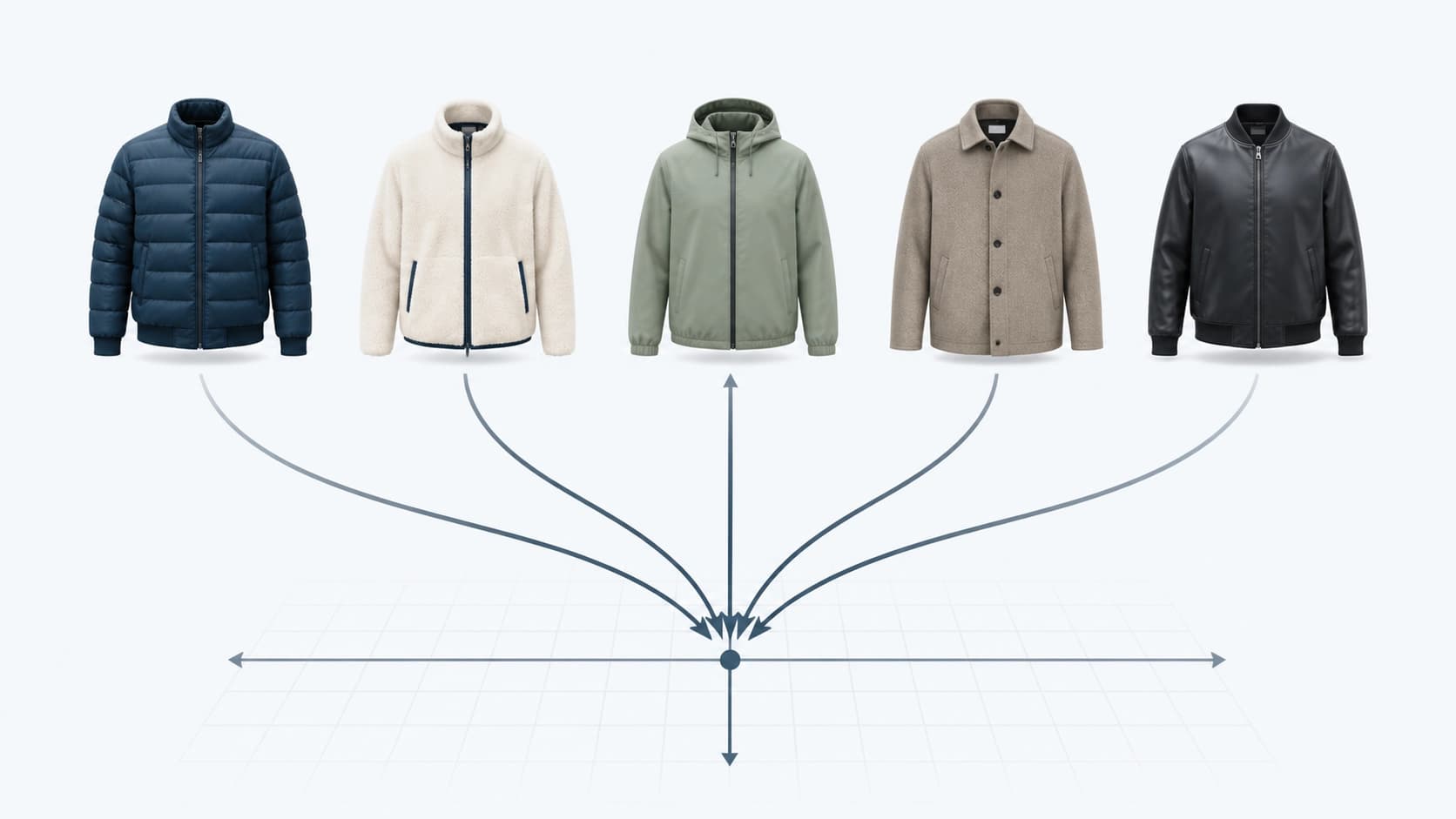
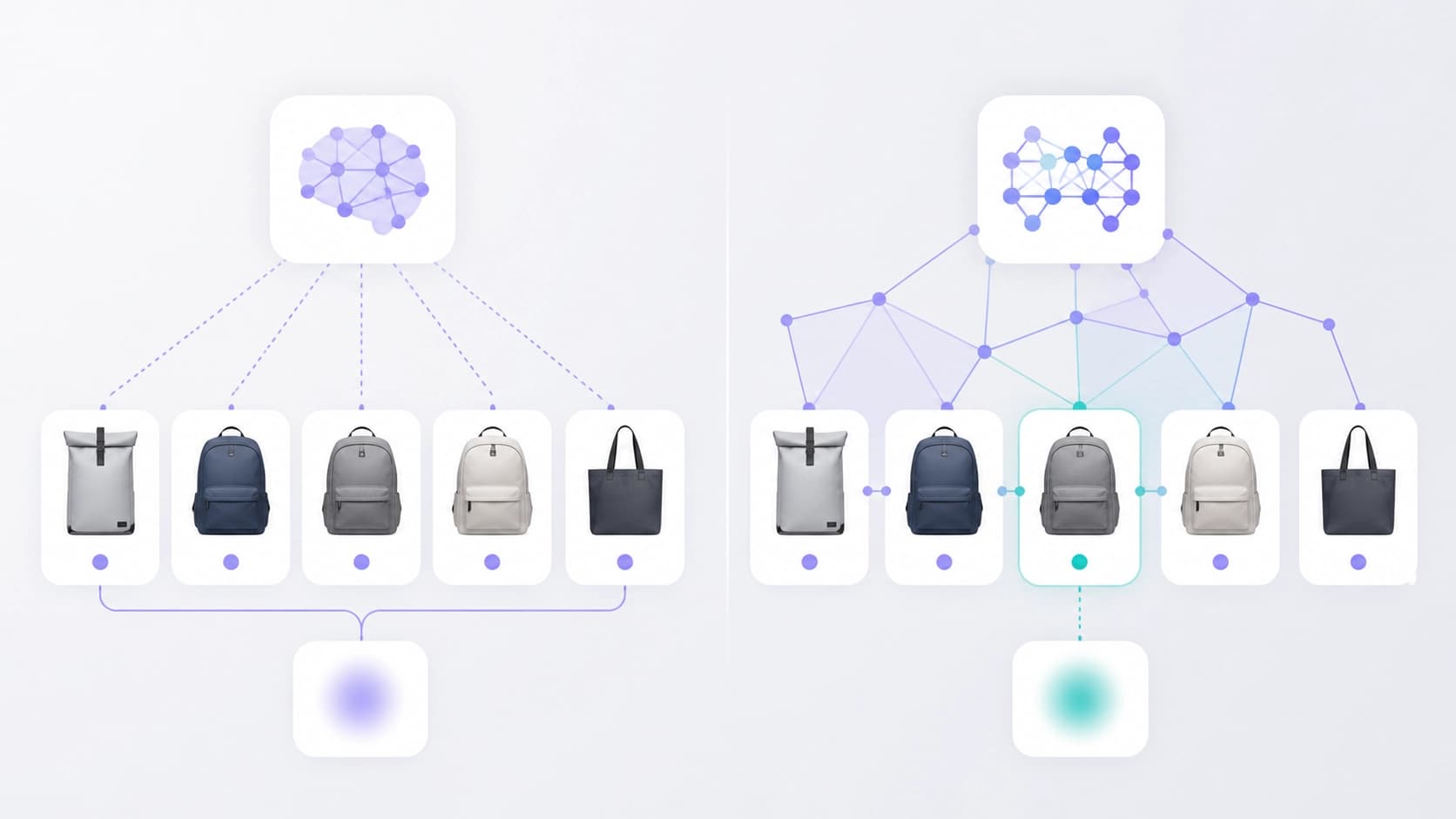
Multimodal large language models have learned to "understand" product listings quite well: they link a photo, a title, and a description into a single semantic field. But this scheme has a hidden cost. Product information gets compressed into one global embedding — an averaged vector in which details dissolve. The more a model tries to capture everything at once, the less of the specifics remains in the resulting vector.
The price of this compactness shows up in tasks where the little things matter. Two jackets made of different materials, two mugs with nearly identical glaze, two cables with different connectors — visually they're almost twins, and in embedding space they end up at almost the same point. Yet the user isn't looking for "something similar" but for a specific material, compatibility, or characteristic. It's precisely on such queries that averaging starts to get in the way: the model doesn't distinguish attributes, which means the ranking comes out approximate.
The arXiv paper 2608.24467 (Qiuyu Zhu, Yi Gao, Zhichao Wan, Mingyang Ma, August 2026) states the diagnosis bluntly: global embeddings implicitly encode a product as a whole, and this limits the capture of fine-grained attributes. Can this be cured by simply "making the vector bigger"? Judging by the logic of the work — no, the problem isn't dimensionality but the mode of representation.
A hypergraph instead of a flat list of embeddings
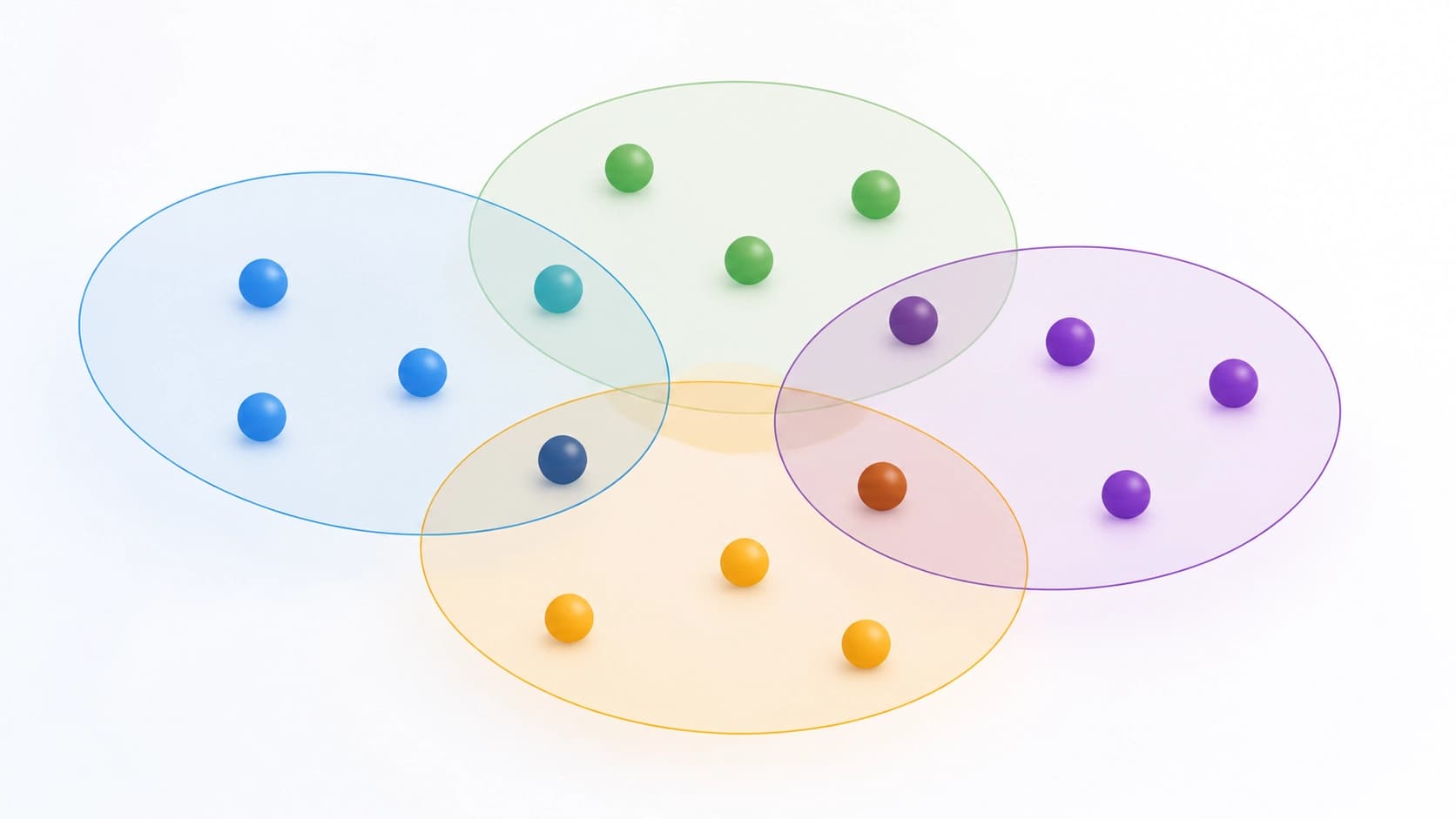
The authors propose HMGCLIP — a multimodal embedding framework built on a heterogeneous hypergraph. The difference from a conventional graph is fundamental. An ordinary edge connects two objects; a hyperedge links a whole group at once — for example, all products in one category united by a shared attribute. This construction makes it possible to describe relations that can't be broken down into pairs: "these seven items are one line of materials," "these four are interchangeable equivalents."
From there, the hypergraph topology works in two directions. First, structurally aware hard negatives are extracted from it — those similar but incorrect examples on which the model learns to discriminate. This is an important point: hard negatives aren't sampled randomly from the corpus, they're suggested by the structure of the connections itself. Second, multi-granular semantics are aligned through the hypergraph — both at the level of relations and at the level of hyperedges. Put simply, the model aligns not only individual products with each other but entire semantic groups.
Why the dual-granularity inference mechanism is needed
A separate detail is dual-granularity inference. At the output, the system dynamically combines attribute evidence so as to work equally confidently with both fine-grained and coarse-grained tasks. The practical point is that one query needs a general level ("show me sneakers"), while another needs an extremely narrow one ("sneakers with a membrane and a specific sole type"). A model tuned only to details loses in breadth; one tuned only to the general loses in precision. Here the system is expected to decide for itself at which level to look.
Dataset and validation
The authors didn't stop at architecture: they released a comprehensive fine-grained e-commerce dataset so that the task would have a reproducible benchmark for future comparisons. This is arguably no less valuable a part of the work — without a public dataset, arguing about fine-grained discrimination is pointless, since everyone measures on their own.
The experiments were run on the new dataset and on the public MAVE benchmark. The result is stated unambiguously: the approach outperforms strong multimodal encoders, multimodal LLMs, and baseline e-commerce solutions. The specific numbers and tables are in the paper itself; what matters here is the conclusion that a structural approach to representation yields gains that can't be achieved by simply making the model more complex.
Where this comes in handy in practice
The first and most obvious use is search and finding equivalents. When a buyer is looking for a replacement for something that has broken, they need compatibility by attributes, not general visual similarity. The second is recommendations: they benefit if they can tell a variant with a different material from the same product in a different configuration. The third is catalog cleanliness: duplicates and near-duplicates, which automation currently merges at random, get separated more meaningfully under a fine-grained representation.
There's also a less obvious layer — explainability. Hyperedges form a structure that shows why products ended up next to each other. For teams debugging ranking errors, this is more useful than a vector of unclear nature.
What remains open for now
Any work with a graph structure runs into cost: the hypergraph has to be built, and as the catalog updates, kept up to date. How cheap this is across millions of listings and how often it will have to be rebuilt, the authors don't disclose in the abstract.
The second question is transferability. The dataset was assembled in a single domain, and it's unknown how well the behavior pattern of hyperedges will hold up when moving, say, from clothing to electronics, where attributes are structured quite differently. The third is how such an approach coexists with already-running production pipelines: replacing the mode of representation usually means reindexing the entire search index.
Be that as it may, the direction is clearly defined. The debate isn't about whose model is bigger, but about how to properly store the meaning of a product: in a single averaged point or in a network of connections where details don't dissolve.
Frequently asked questions
Related materials
All materials
OpenCollab: programmable agent coordination, controlled execution environment, and policy compliance metric
The framework brings together the specification of agent interaction structures, a shared environment for experiments, and detailed event tracing, while the newly introduced Adherence metric reflects how closely actual execution follows the declared schema. In benchmarks, the Duo configuration achieves a new state of the art, while the single-agent variant uses the fewest tokens.
11 November 2026
Toollery: Choose tools for LLM agents from tens of thousands of options without fine-tuning
Toollery builds a search index from descriptions of skills and tools, then passes the model only a limited set of candidates for each query. In experiments with libraries containing tens of thousands of functions, the approach helps maintain selection quality at a fixed top-K, although the overall effect depends on the workload profile and the provider’s caching.
11 November 2026
Step-by-Step Evaluation of GUI Agents for Dashboard Analysis: The DashAct Benchmark
Introducing DashAct, a benchmark of 348 human-verified trajectories that breaks down GUI agents’ work with interactive dashboards into three stages and four visual conditions. The results reveal persistent issues with action prediction and visual target grounding, as well as agents’ reliance on contextual and spatial support.
11 November 2026