
Dot product as a bottleneck
Almost all modern attention architectures are built the same way: the query and the key are matched via a dot product (or its normalized version), the result is turned into weights, and the output is assembled as a weighted sum of values. The trick is universal, but it comes at a price — the geometry of the feature space in such a scheme is set rigidly: similarity is measured "in a straight line," without accounting for the fact that different directions in space may have different significance and different scale.
It is precisely this limitation that the paper arXiv:2608.24462 "Mahalanobis-Based Multi-Head Attention for Complex State Propagation" (author — Xiaohe Li; section cs.AI) targets. Instead of the usual product, it uses an RBF kernel built on the Mahalanobis distance. Put simply, the similarity between elements of a sequence is not computed "head-on," but adjusted for the covariance structure of the data — as if the space were slightly stretched and rotated before comparison so that correlated directions are not treated as independent.
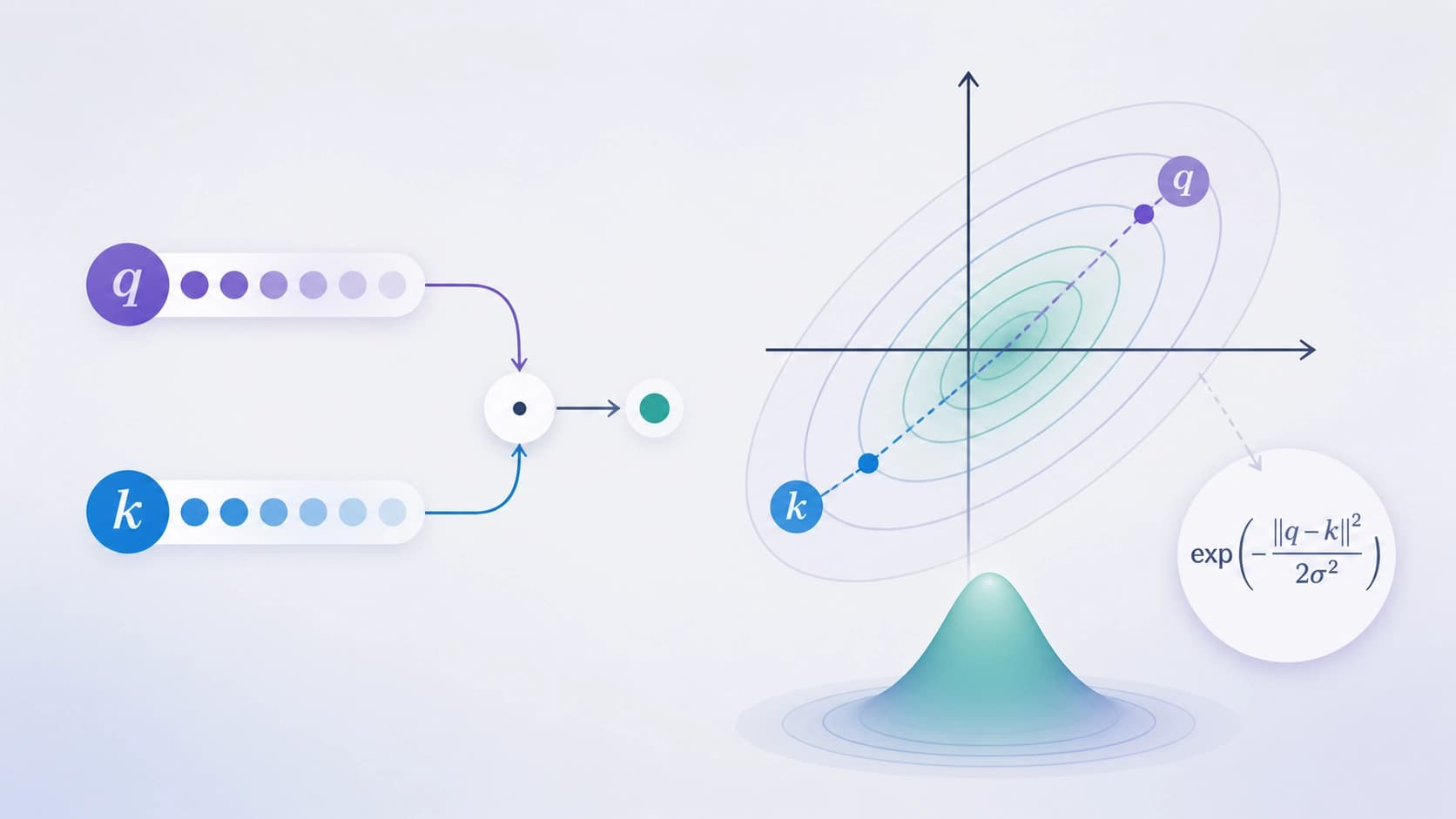
What the Mahalanobis distance provides
Attention in an infinite-dimensional space without parameter growth
The author's key claim: an RBF kernel over the Mahalanobis distance allows attention to be computed as if it lived in an infinite-dimensional feature space, while the number of trainable parameters does not grow. This is not magic but a consequence of the kernel itself already defining a nonlinear mapping — no separate layer for unfolding features is needed. In practice, this means more modest memory and optimization requirements, which in the era of gigantic models looks almost provocative.
Positive definiteness and Tree Attention
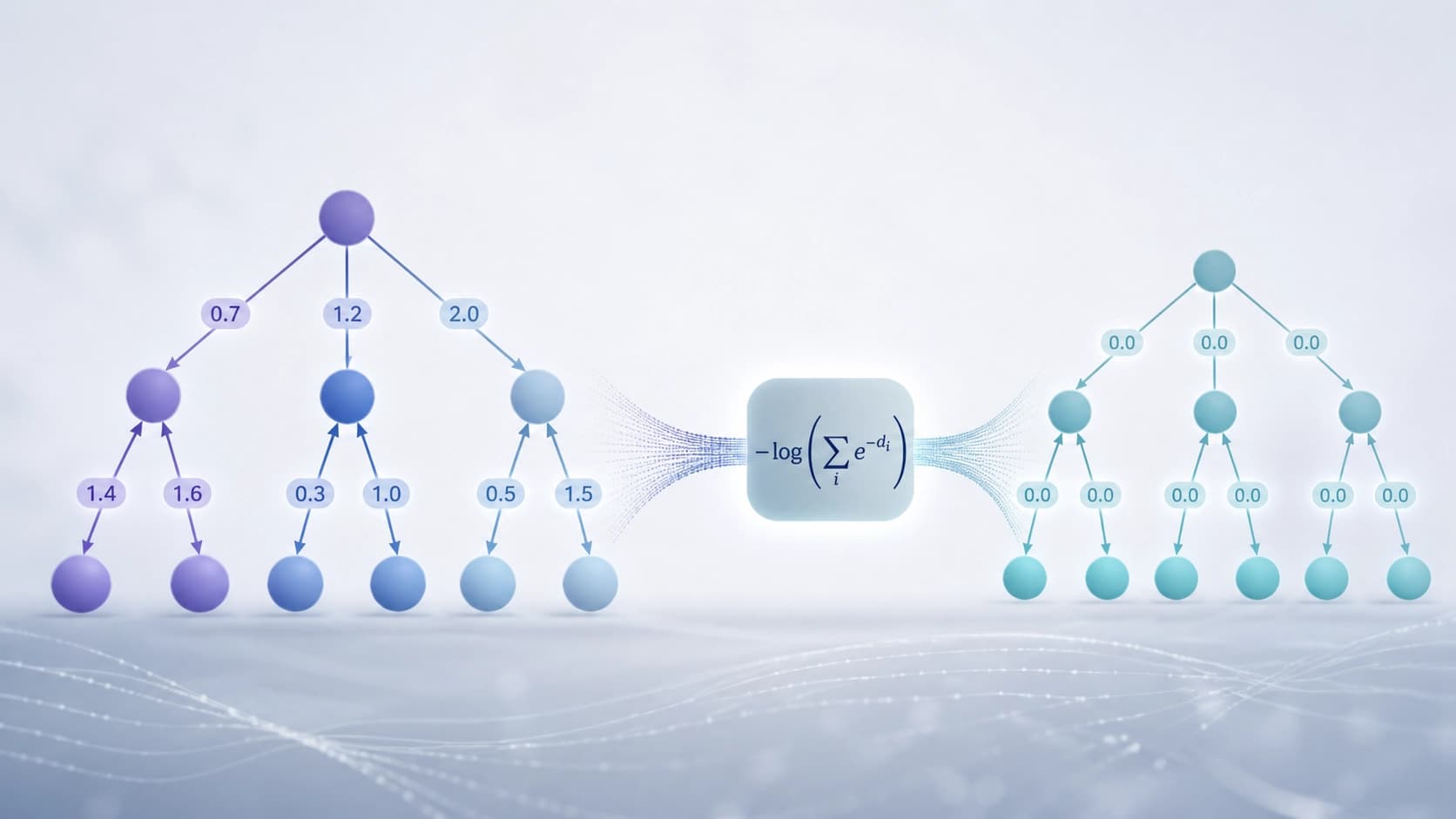
The second layer of the idea rests on a mathematical property of the Mahalanobis distance: it is positive definite. From this, one can directly build what the paper calls Tree Attention — attention scores are constructed not from "raw" similarities but from distances accumulated along a tree. To keep such accumulations from drifting numerically, a correction via LogSumExp is applied: the logarithm of the sum of exponentials over the edges is subtracted from the distance. In essence, this is a way to reconcile the contributions of different paths in the tree without losing their relative weight.
For a reader unfamiliar with the details, a useful analogy is this: instead of adding up "similarities" haphazardly, the model carefully normalizes them as it moves deeper into the structure. This is closer to bookkeeping than to intuition — but it is precisely this care that allows reasoning to remain stable over long chains of dependencies.
Attention meshing: heads start talking to each other
Usually multi-head attention is arranged as a set of nearly independent experts: each head computes its own thing, and mixing happens only at the output, via a linear projection. In MHA-CSP, the Mahalanobis distance matrices are reused — they form the basis for an "attention meshing" mechanism that makes the kernels of different heads interact directly. The author claims a double benefit: both higher accuracy and more efficient training, since the same computational work is not duplicated.
Experiments: 119K parameters versus large baseline models
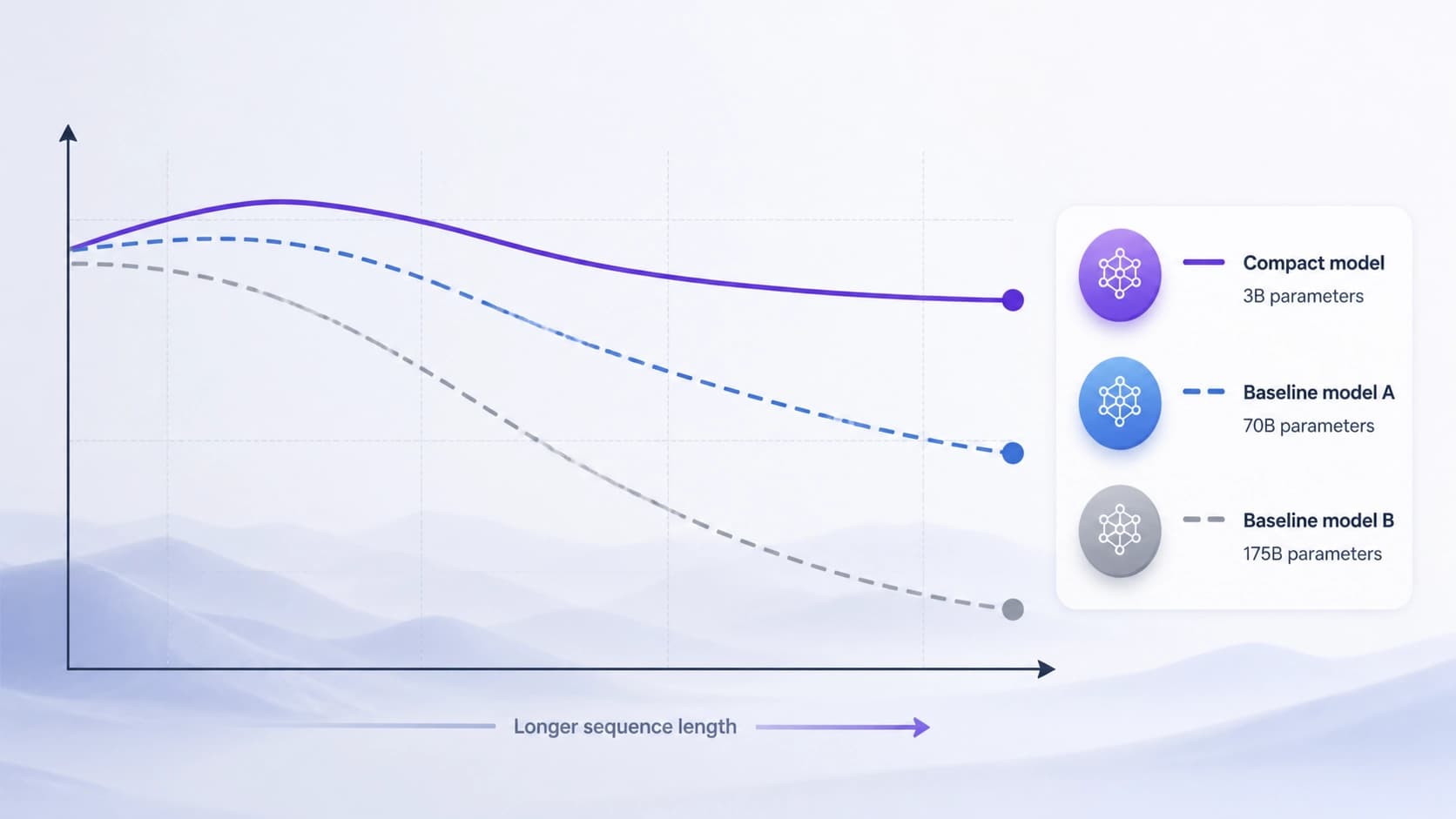
The loudest part of the work is the comparison. MHA-CSP with just 119 thousand parameters is pitted against baseline transformers and graph convolutional networks trained from scratch under identical conditions. The task is state tracking over long sequences. Moreover, teacher forcing was applied exclusively on the final hidden state, meaning the model received no hints at each step, as is often done during training more instructively.
According to the author, MHA-CSP consistently outperforms the competitors. The baseline models rely either on dense attention (transformer) or on information propagation over a graph (GCN), whereas MHA-CSP achieves structured reasoning through synthetic distance correction and an economical traversal of information inherited from the CSP backbone.
It is worth emphasizing: this is not about a small model "catching up" to large ones across the board. It is about a specific class of tasks — long sequences with internal symbolic structure, where what matters is not just remembering the context but retaining its state. That is exactly where the geometry of distances and tree-based normalization start to work.
What this changes in practice
The main conclusion of the work is formulated as follows: complex-valued state propagation combined with joint multi-head correction turns out to be a workable tool for capturing symbolic structures. And it sets a new trade-off between efficiency and quality for structured reasoning tasks.
Looking more broadly, a trend of recent years is visible here: instead of scaling up parameters, researchers are looking for better inductive biases — that is, building the right assumptions about the nature of the data into the architecture. The dot product was a convenient but rather crude assumption. Replacing it with a kernel based on a covariance metric is an attempt to tell the model: "not all directions in space are equal, take this into account from the very start."
A cautious outside view
There are reasons not to rush into rewriting pipelines. First, the results were obtained on a specific set of state-tracking tasks; transferring them to text generation, multimodality, or dialogue scenarios without separate verification is not advisable — the abstract contains no such experiments. Second, a single author and the first version of the preprint (v1, submitted August 25, 2026) mean that we have not yet seen independent replication: the 377 KB file is available in PDF, HTML, and TeX sources, but reproduction is a separate story.
And yet the direction looks productive. Moving away from the dot product, working directly with the geometry of distances, reusing computations across heads — these are exactly the moves that reduce the cost of a model without sacrificing expressiveness. If the results are confirmed in other domains, "small but properly designed" networks will gain yet another weighty argument.