
Energy-efficient AI cascades: when data corruption breaks routing
Modern AI systems are increasingly built not as one giant model, but as a cascade of several models of different sizes. The idea is simple: for simple queries, a lightweight and fast model is enough, while complex or ambiguous cases are passed on to a larger, more accurate model for processing. This approach dramatically reduces energy consumption while maintaining high prediction quality. However, this scheme has a weak point — the routing that determines which model gets the input data.

How a model cascade works
The key element of a cascade is the confidence-based deferral mechanism. A compact model processes the data and outputs not only a prediction but also an estimate of its own confidence. If confidence is high — the answer is accepted. If it is low — the sample is passed to a heavier model, which produces the final answer. On clean, undistorted data, such routing usually works reliably and delivers energy savings without sacrificing accuracy.
The problem arises when the input data contains perturbations — for example, static corruption (noise, cropping, artifacts) or sequential distortions that change from query to query. Even small changes can shift the model's confidence estimate, and with it — the decision on whether to send the sample further down the cascade.
What the study showed
A recent paper, "Accuracy and Robustness of Model Cascades Under Data Perturbations" (authors — Pallavi Mitra, Jai Kushwaha, Felix Biessmann, accepted at the GREEN-AI Workshop at ECML-PKDD 2026), focuses precisely on the robustness of such cascades to perturbations. The authors built a cascade of models for image classification, selecting a configuration at the Pareto optimum for accuracy, routing quality, and energy consumption. On clean data, this configuration demonstrates competitive predictive performance while reducing CO₂ emissions by up to 10 times compared to using only the large model. However, when the input data is artificially corrupted, the cascade's behavior changes noticeably — and not always in the expected direction.
Three failure modes
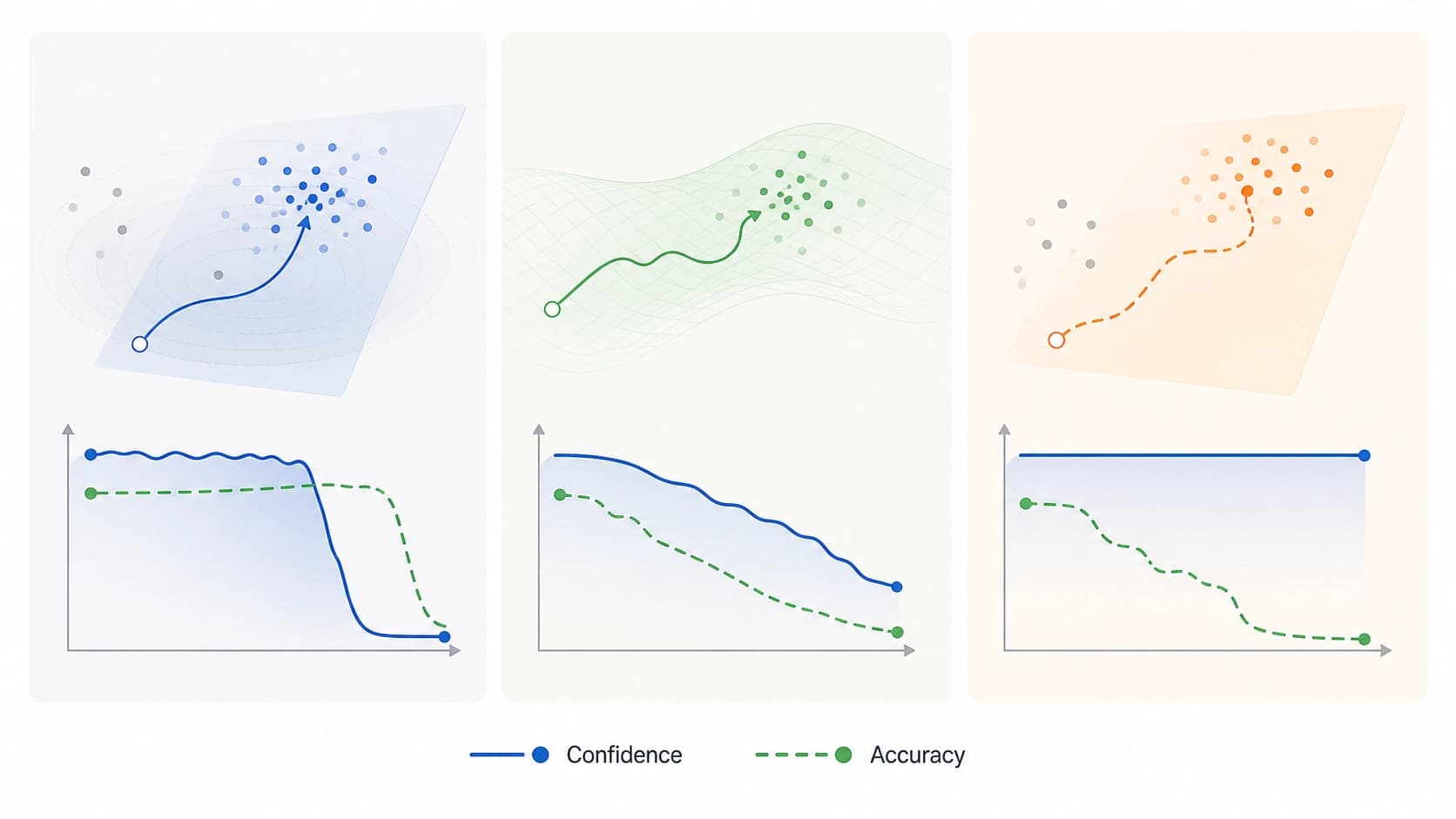
The analysis showed that perturbations lead to three characteristic scenarios, each of which disrupts the cascade's normal operation in its own way.
First mode: the routing signal breaks. Static corruption can make the confidence estimate nearly useless. The compact model does not understand that the data is corrupted and either produces a wrong answer with high confidence or, conversely, sends everything up the chain. In this case, the large model remains capable of correcting errors, but the energy advantage is lost — the cascade degrades into simple sequential processing.
Second mode: both models fail. Sometimes corruption degrades not only the lightweight model but also the large one. Then the deferral mechanism stops helping: even after passing the hard case up, accuracy is not restored. In effect, the cascade becomes no better than either of its parts, while energy consumption remains high.
Third mode: stability instead of reliability. This scenario occurs with sequential perturbations, when distortions accumulate or change from query to query. The models begin to produce stable predictions — but stably wrong ones. At the same time, the deferral mechanism is suppressed: the system is confident in its answers even though they are erroneous. This case is the most dangerous because the error is hard to spot from the cascade's behavior.
Why this matters
The researchers' conclusion is direct: evaluating energy-efficient cascades on clean accuracy alone is not enough. It is necessary to explicitly account for how routing will behave under input distribution shift. In real-world operation, data almost always differs from training data — due to changing lighting, noise in photos, new formats, or attacks on the model. If a cascade has not been tested for routing robustness, its energy efficiency becomes an illusion.
For practitioners, this means that when deploying cascade architectures, testing should include not only ideal samples but also synthetic perturbations of different types. Otherwise, you can end up with a system that saves energy only until its first encounter with the real world — and then quietly produces confident but incorrect decisions.