

Media See Only Lawyers, Not Engineers, in AI for Books
When it comes to artificial intelligence in the book industry, the focus is on courts, licenses, and copyright. The technical side — how models are built, how they are tested, and where they actually fail — is barely discussed. That is the conclusion of a study by Fred Zimmerman, published on arXiv on August 2, 2026, under identifier 2608.00964. The author analyzed how the trade press covered AI in book publishing from November 2025 to August 2026.
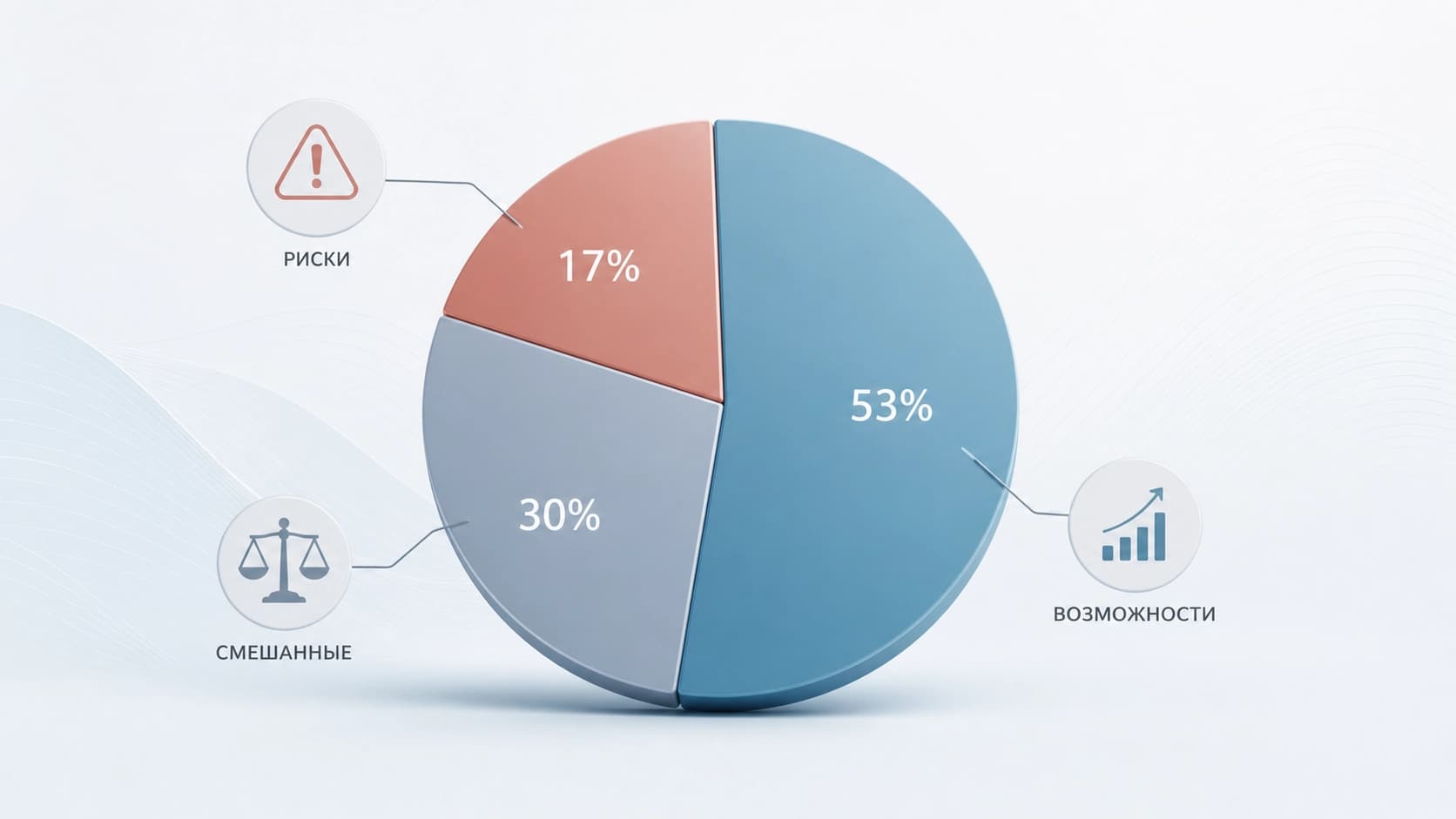
What the analysis showed: 89 articles, eight languages
The study is structured as a rapid evidence review: 89 items were collected from book-business publications, book reviews in major newspapers, and columns by technology commentators. The corpus covers eight languages — from English and Chinese to Italian and Japanese. Each publication was coded by topic, tone, technical depth, and whose voice dominates it.
The tone was split almost evenly: roughly a third of the items focused on risks, 42% were mixed, and about 28% focused on opportunities. At the same time, Chinese publications were noticeably more likely to write about practical implementation and potential benefits, while the rest of the corpus leaned toward concerns and regulation.
Headlines talk about rights, not opportunities
The main topics of the corpus are predictable: copyright, licensing, regulation, reader trust, workflow adoption, and product announcements. But the depth varies greatly. Commentaries and analytical columns are noticeably more technical than news reports. However, sustained technical examination appears in only ten out of 89 items. None of the authors interviewed a researcher from a frontier lab or an engineer who evaluates models.
The main gap: no one connects model architecture with publishing decisions
The most alarming finding is not the absence of positive scenarios, but the absence of a link between how models work and how publishers use them. Publications hardly discuss things like:
- capability elicitation — how hidden capabilities are extracted from a model;
- RAG (retrieval-augmented generation) — generation with retrieval from external sources;
- prompt injection — attacks via malicious instructions;
- reliability of agents in long workflows;
- inference economics — what running a model actually costs;
- model drift — how quality changes after updates;
- data provenance — where the content in an answer comes from;
- reader research and reproducible evaluation of workflows.
Without this, the conversation about AI in book publishing comes down to two extremes: either “everything is lost” or “everything will get better.” Neither helps a publisher decide whether to adopt a tool, how to evaluate it, and which risks are real.

What the author proposes: not “another column,” but a system
To close this gap, Zimmerman proposes not one-off pieces but a permanent coverage infrastructure. Recommendations include:
- dedicate a regular AI section in trade publications rather than rare ad hoc pieces;
- regularly interview labs, not only lawyers and consultants;
- maintain a registry of claims — record who promised what, and verify it;
- develop common test protocols and reproducible workflows;
- create reader panels to assess real-world experience;
- invite technical columnists who can explain the inner workings of models.
The study itself is seven pages long; another fifteen make up the supplementary appendix. It includes the full coded corpus of 89 items, cross-tabulations, a glossary, a BibTeX database of sources, and a citation audit. This makes the work not just a journalistic manifesto but a tool for verification and re-analysis.
Ultimately, the problem is not that the media are afraid of technology. The problem is that they describe it from a distance — as a legal abstraction rather than an engineering reality. Until that changes, industry readers will keep getting headlines about the same lawsuits instead of an understanding of which AI capabilities can actually be implemented and which are still only promises.