

Roboflow
Platform for creating, training, and deploying computer vision models.
Overview
Roboflow
Roboflow Neural Network Description
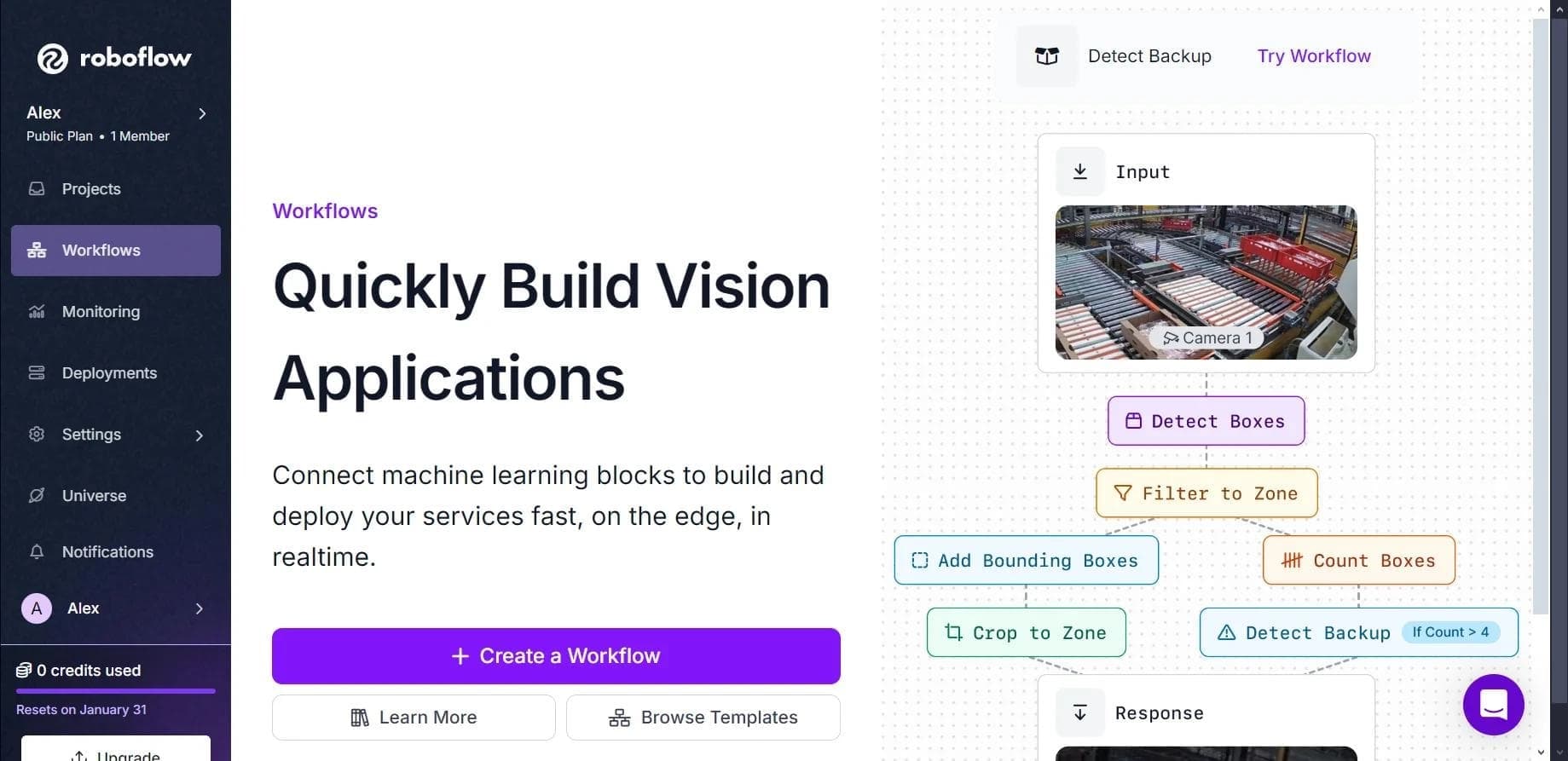
Roboflow is a platform for developing, training, and deploying computer vision models. The service covers the full lifecycle of working with such models: from dataset management and image annotation to data augmentation, training, and subsequent deployment via API. The platform supports popular machine learning frameworks, including PyTorch, TensorFlow, and YOLO, and allows exporting trained models to run both in cloud infrastructure and on edge devices. Roboflow is suitable for engineers, researchers, and companies in retail, manufacturing, healthcare, and other industries that require real-time object recognition in images and videos.
Roboflow Characteristics
| Characteristic | Value |
|---|---|
| Type | AI tool for computer vision / Platform for data preparation and machine learning |
| Platform | Web, API, local use |
| Interface language | English |
| Programming language | Python |
| Supported frameworks | TensorFlow, PyTorch, YOLO, ONNX |
| Distribution model | Freemium |
| Free plan available | Yes |
| Trial period | Two weeks of premium features |
| Credit card required | No |
| Paid plans start at | From $49/month |
| Billing cycle | Monthly |
| Lifetime plan available | No |
| Security | SOC2 Type 2, HIPAA |
Who Is the Roboflow Neural Network Suitable For?
Developers and Engineers
The platform is designed for developers building applications with computer vision capabilities. Roboflow provides tools for integrating models via API and SDK, making it possible to embed object recognition into existing software products.
Data Scientists and Researchers
Data professionals can use Roboflow to prepare datasets, train, and experiment with computer vision models. The platform supports popular libraries and frameworks, simplifying research work.
Enterprises and Organizations
Roboflow is suitable for companies of any scale, from startups to large corporations. The platform is used by more than 16,000 companies, including half of the Fortune 100, and meets corporate security standards.
Educators, Researchers, and Students
The free plan and educational materials in the form of Notebooks make Roboflow accessible for educational purposes. The platform can be used to study computer vision and run experiments without upfront investment.
How to Use the Roboflow Neural Network
Registration and Project Creation
To get started, you need to create an account on the platform. After that, a new project is created and images for the dataset are uploaded to it.
Annotation and Data Preprocessing
Uploaded images are annotated using built-in tools, both manually and with AI-assisted annotation. The platform allows you to create different versions of images, resize them, apply rotations, and add noise to improve training quality.
Model Training and Evaluation
After data preparation, a model architecture is selected (for example, YOLO, EfficientDet, or Faster R-CNN) and training is launched. The platform supports fine-tuning models on new data. Once training is complete, the model is evaluated and adjustments are made if necessary.
Deployment and Monitoring
The finished model is deployed in a production environment — through a cloud API or on edge devices. Roboflow provides capabilities for monitoring model performance and retraining it as new data arrives.
Key Features of Roboflow
Dataset Management
The platform provides tools for sorting, filtering, and creating optimal datasets for training. It supports working with images in various formats, as well as automatic augmentation to expand the sample.
Image Annotation
Roboflow allows manual and automatic image annotation using AI tools. The feature supports collaborative work and annotation consensus within a team.
Model Training
The platform supports training models on popular frameworks: TensorFlow, PyTorch, YOLO, and ONNX. Both pre-trained foundation models and the ability to fine-tune for specific tasks are available.
Deployment and Monitoring
Roboflow provides an API for deploying models in cloud infrastructure and on edge devices. Built-in monitoring tools allow you to track model performance in real time.
Advantages of Roboflow
Full Development Lifecycle
Roboflow covers all stages of computer vision work: from data preparation and annotation to training and deployment. This eliminates the need to use several separate tools.
Integration with Popular Libraries
The platform integrates with PyTorch, TensorFlow, Hugging Face, Ultralytics, and dozens of other services. Roboflow is also compatible with AWS, Google Cloud, Azure, and Supabase, making it easy to embed into an existing technology stack.
AI-Assisted Annotation
Built-in automatic annotation tools speed up data preparation and improve annotation accuracy. The feature supports collaborative work and consensus within a team.
Enterprise-Grade Security
Roboflow complies with SOC2 Type 2 standards, encrypts data in transit and at rest, and supports a HIPAA-compliant infrastructure. The platform is suitable for use in regulated industries.
Scalable Infrastructure
The platform offers hosted infrastructure with an API for model deployment, making it easier to scale projects from prototypes to production solutions.
Disadvantages of Roboflow
Limited Pricing Transparency
The main website page does not contain complete information about free plan limits and pricing details. Some sources cite different minimum prices for paid plans (from $49 to $150), which can create confusion when choosing a plan.
No Mobile App
No official Roboflow mobile apps were found in Google Play or the App Store. All functionality is available only through the web platform and API.
No Support for Autonomous AI Agents
The platform does not provide direct tools for building autonomous AI systems such as AI agents that would independently make decisions based on recognized objects.
What Tasks Does Roboflow Solve
Computer Vision Automation
The platform allows automating object recognition tasks on images, video, and in real time. This includes image annotation, processing, and generating data for model training.
Retail Inventory Management
Roboflow is used for automatic shelf product counting, inventory management, and monitoring product availability in retail stores.
Manufacturing Quality Control
In industry, the platform is used to detect product defects, monitor production lines, and automate quality inspection.
Medical Imaging
In healthcare, Roboflow helps analyze medical images, which can be used for diagnostics and patient condition monitoring.
Security and Surveillance
The platform is suitable for video surveillance, anomaly detection, and facility security monitoring.
Autonomous Vehicles
Roboflow can be used to train models for autonomous driving and vehicle control systems.
Roboflow Pricing
Roboflow operates on a freemium model, offering a free plan with limited functionality. Paid plans include:
- Public ($0) — a completely free plan with public data and models
- Basic ($49/month) — 30 credits, 5 user seats
- Growth ($299/month) — 150 credits, 20 user seats
- Enterprise (custom pricing) — for large projects and teams
A two-week trial period with premium features is available without requiring credit card details. Pricing may vary depending on the region and feature set.
Roboflow Terms of Use
Registration is required to use the platform. The free plan (Public) is available at no cost and involves the use of public data and models. Paid plans start at $49 per month and provide more credits, user seats, and additional features. No credit card entry is required to activate the premium trial period.
Roboflow Availability
The platform is available via a web interface, API, and for local deployment. The interface language is English. According to traffic data, the service is used worldwide, including India, the United States, Brazil, the Philippines, and Indonesia. There is no information about the need to use a VPN.
How Roboflow Differs from Alternatives
Roboflow differs from competitors (AWS SageMaker, Google Cloud AutoML, Microsoft Azure Custom Vision, Labelbox, SuperAnnotate) in that it offers a comprehensive solution for the full computer vision lifecycle within a single platform. Unlike the cloud services of large vendors, Roboflow builds its infrastructure on open source and popular libraries, which makes integration into existing workflows easier. The service also provides specialized tools, such as Roboflow Inference for rapid deployment, Supervision for integration into applications, and Autodistill for automatic data annotation, which have no direct counterparts among competitors.
Conclusion
Roboflow is a comprehensive computer vision platform used by more than 500,000 engineers worldwide. The service covers all stages of model development: from uploading and annotating datasets to training
Frequently asked questions

See also
Open-source platform for integrating data from various sources into data warehouses and analytics systems.

Cloud platform for launching AI applications directly in the browser without installation.
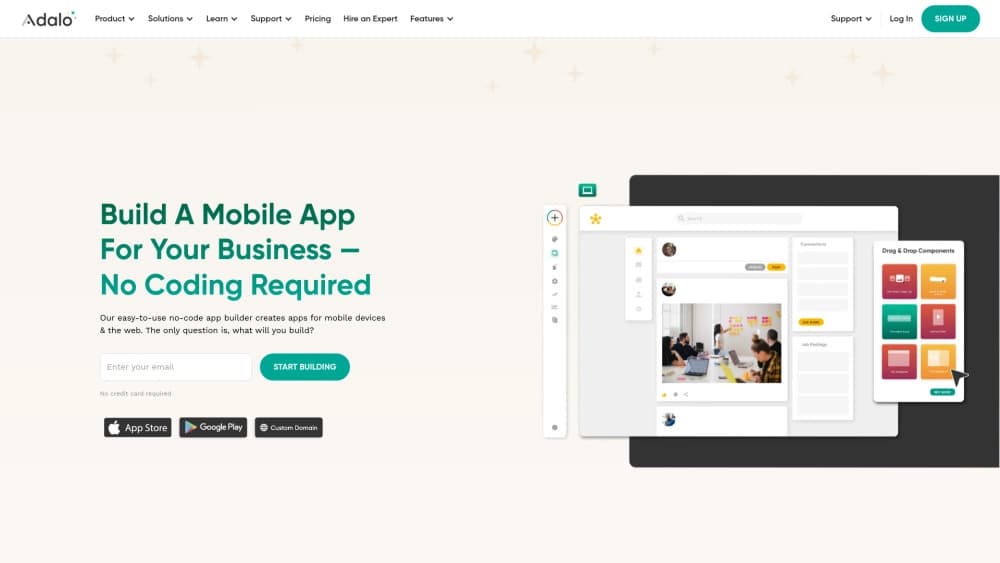
A platform for creating mobile and web applications without writing code, using a visual builder.

Web interface for testing and prototyping based on Google's artificial intelligence models.
Enterprise language model platform focused on privacy and on-premise deployment.

A design canvas built into the code editor, allowing you to create interfaces and write code in one place.
A platform for continuous localization and translation management of digital products.

A workflow automation platform that connects thousands of apps without requiring coding.