

Replicate
Cloud platform for launching and scaling open-source AI models via a simple API.
Overview
Replicate
Description of Replicate
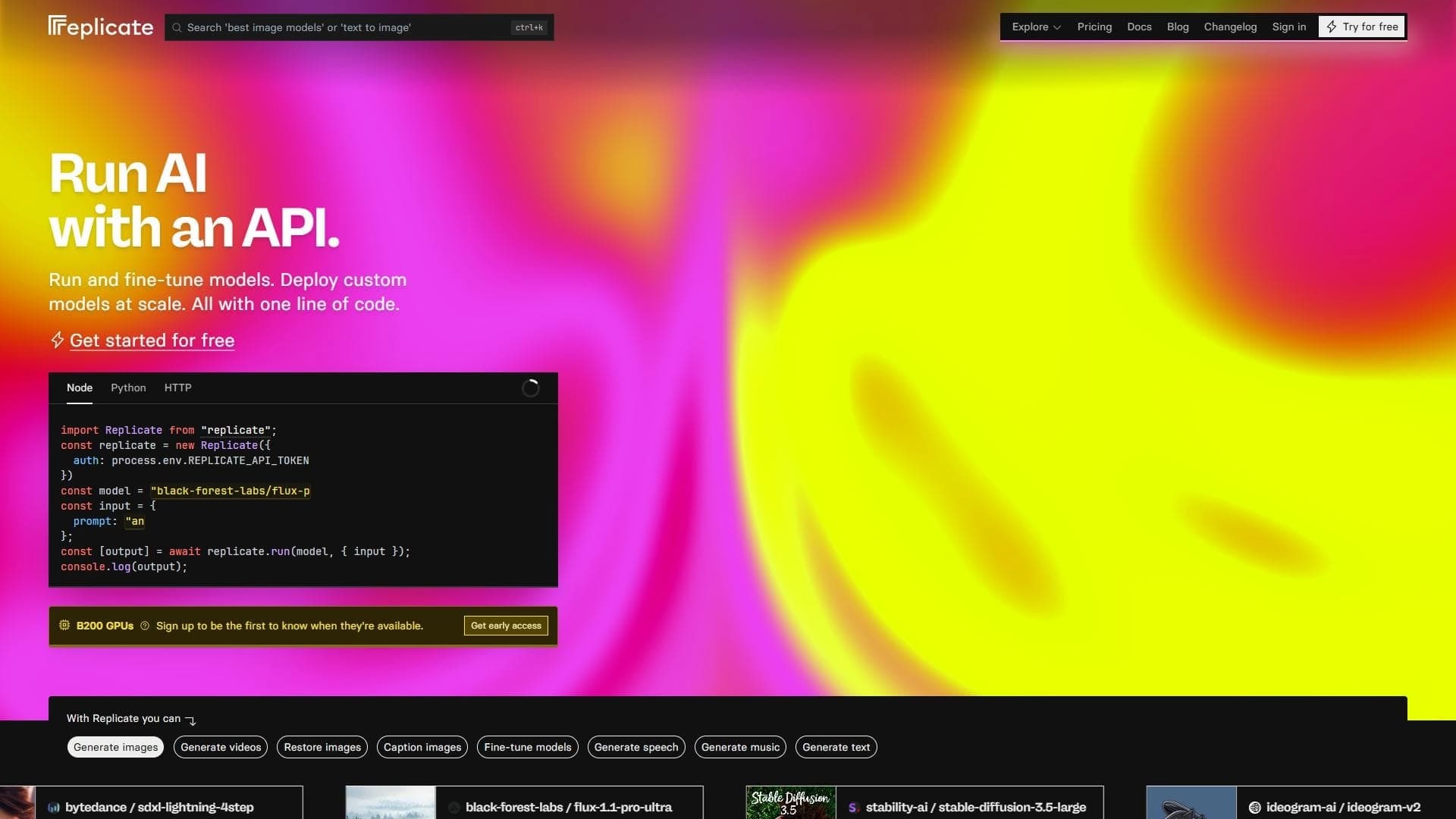
Replicate is a cloud platform that gives developers and researchers access to hundreds of open-source AI models through a simple API. The service lets you run, fine-tune, and scale neural networks for generating images, text, video, music, and speech without needing your own GPU infrastructure. Billing is per second for the compute resources actually used, and models can be launched with a single line of code. The platform also supports a community where users can share their models and modifications.
Replicate characteristics
| Characteristic | Value |
|---|---|
| Type | Cloud platform for running, fine-tuning, and deploying AI models |
| Categories | API and integrations, image, text, video, music, and speech generation, AI repurposing, AI voice cloning |
| Platforms | Web, API |
| Pricing model | Free plan + pay-as-you-go |
| API availability | Yes |
| Interface language | English (primary), Russian |
| Mobile app | Yes |
| Browser extension | Yes |
| Registration | Required for API; not required on the website |
| Date added | May 1, 2024 |
Who is Replicate for?
Software developers and ML engineers
Replicate is aimed at developers who want to integrate AI models into their applications without diving deep into machine learning. The platform lets you connect models to projects with just a few lines of code via the Python library or direct API requests.
Data scientists and research teams
Data professionals can use Replicate to quickly test open-source models, run experiments, and fine-tune neural networks for their own tasks without setting up a local environment or configuring GPU.
AI enthusiasts and business users
The platform suits those who want to run ready-made models for content generation — images, text, or video — without getting into technical details. No registration is required on the website to get started; you can simply go to the selected model.
How to use Replicate?
Registration and model selection
To work via API, you need to register on the Replicate website and read the documentation. After that, you can choose an open-source model from the catalog or upload your own. The platform provides access to thousands of community models — from language models to video generation and editing tools.
Running and fine-tuning via API
A model is launched with a single line of code — directly through the API or using the Replicate Python library. The platform automatically scales compute under load and reduces resources when there is no traffic. For fine-tuning, training and deployment tools are available, along with the open-source Cog tool that packages models into a standard container.
Getting results and publishing
After a task is complete, results are downloaded via the API. If desired, users can share their model or fine-tuned version in the Replicate community, making the platform not just a tool but an ecosystem for sharing AI solutions.
Core features of Replicate
Running open-source models
The platform provides access to hundreds of open neural networks, including models for generating images, text, video, music, and speech synthesis. Users can run any model from the catalog with one command, without worrying about environment configuration or installing dependencies.
Fine-tuning and scaling
Replicate supports fine-tuning existing models for specific tasks. The platform automatically creates a scalable API server for each model, deploying it in a GPU cluster. Compute automatically scales as load grows and drops to zero when traffic is absent.
Developer tools
The platform includes the open-source Cog tool, which solves problems with dependencies, GPU configuration, and Dockerfile. Documentation and code examples are available for all features, making it easier to integrate Replicate into existing projects.
Advantages of Replicate
Ease of use
Working with Replicate requires no local environment setup or deep understanding of machine learning. A few lines of code are enough — you can use the Replicate Python library or call the API directly. This makes the platform accessible both to experienced ML engineers and developers who are just starting out with AI.
Cost efficiency and flexibility
You pay per second only for the time code is running — no charges for idle GPUs or unused resources. The minimum cost starts at 0.0001 USD per second of CPU usage. Different GPU types are available (Nvidia A100, H100, L40S, T4, and others), so you can choose the optimal balance of price and performance.
Automatic scaling
The platform automatically manages compute resources: it increases capacity when load grows and reduces it when there is no traffic. This removes the need to manually configure infrastructure and lets users focus on development.
Disadvantages of Replicate
Dependence on internet and cloud infrastructure
Replicate is a cloud service, so it requires a stable internet connection. If the cloud is unavailable, working with the platform becomes impossible, which is critical for tasks that require local execution.
Limitations in customization and cost forecasting
Despite access to open-source models, the platform itself is not fully open — this imposes limitations on the transparency of some processes. In addition, due to dynamic scaling, it is difficult to accurately forecast costs in advance, especially with uneven load.
Entry barrier for beginners
Beginners will need time to study the API documentation and understand how to work with models. The platform is not suitable for those who are not ready to work through the API or do not use open-source models, preferring fully ready-made solutions.
What tasks does Replicate solve?
Content generation and processing
The platform allows generating images, text, video, music, and speech using ready-made open-source models. Tasks such as image restoration, adding objects to photos, extracting voice from audio, and finding objects in images are also available.
Deploying custom models
Replicate is suitable for running and scaling your own machine learning models. This can be useful for creating product mockups, writing code or posts, and conducting scientific research.
Machine learning and experiments
The platform is used for quickly testing hypotheses, fine-tuning existing models, and running compute experiments without needing to rent and configure your own GPU servers.
Replicate pricing
Free plan
Replicate offers a free plan that lets you get started without entering a credit card. Users can test models and explore the platform without financial commitment.
Pay-as-you-go
The main pricing model is pay-as-you-go, with per-second billing only for the time code is running. The minimum cost starts at 0.0001 USD per second of CPU usage. The following rates are available for GPU:
- Nvidia T4: from 0.000225 USD/sec
- Nvidia L40S: from 0.000975 USD/sec
- Nvidia A100 (80GB): from 0.0014 USD/sec
- Nvidia H100: from 0.001525 USD/sec
It is also possible to pay for using multiple GPUs simultaneously.
Replicate terms of use
Registration and access
API usage requires registration on the Replicate website. However, registration is not required to explore the platform and test some models — you can simply go to the selected model's page. Before working with the API, you should read the documentation.
Technical requirements
Working through the API requires a stable internet connection. Users can interact with the platform through the Replicate Python library or direct HTTP requests. The open-source Cog tool is available for packaging your own models into a standard container.
Replicate availability
Web platform and API
Replicate is available as a web platform at replicate.com and through the API. There are also a mobile app and a browser extension. The interface is available in English and Russian.
Geography and languages
Top 5 regions by traffic: United States (13.75%), India (7.61%), Germany (5.09%), Indonesia (4.94%), Vietnam (3.78%). Although the main interface language is English, the platform has been localized for Russian-speaking users.
How does Replicate differ from alternatives?
No need for local infrastructure
Unlike platforms such as TensorFlow, PyTorch Hub, or AWS SageMaker, Replicate does not require users to set up a local environment, configure GPU, or manage Docker containers. The platform handles all compute resource management — from automatic scaling to reducing capacity when there is no load.
Ease of integration and community
Replicate stands out for its ease of integration: models are launched with one line of code via the API or Python library, whereas Hugging Face or Google AI Platform may require a deeper understanding of infrastructure. In addition, the platform includes a community for sharing models and improvements, making it not just a tool but an ecosystem.
Per-second billing
Unlike many alternatives that charge per hour of GPU rental or use fixed rates, Replicate offers per-second billing only for the actual time code runs. This saves money on tasks with uneven load, when a GPU is idle most of the time.
Conclusion
Replicate is a cloud platform that simplifies running, fine-tuning, and scaling open-source AI models. It gives developers and researchers access to hundreds of ready-made neural networks through a simple API, removing the need to set up their own GPU infrastructure. Per-second billing, automatic scaling, and a community make Replicate a convenient choice for those who want to quickly integrate AI capabilities into their projects without diving deep into machine learning.
Frequently asked questions
Similar AI tools





See also

Mobile app and citizen science project for identifying plants from photos using machine learning.
Free five-day intensive from Kaggle and Google on building AI agents using the vibe coding technique.

A workflow automation platform that connects thousands of apps without requiring coding.
Open-source platform for integrating data from various sources into data warehouses and analytics systems.

Web interface for testing and prototyping based on Google's artificial intelligence models.
Enterprise language model platform focused on privacy and on-premise deployment.
A platform for private and free communication with AI that generates text, images, and code through open neural network models.


A service for detecting texts created by artificial intelligence, with the ability to check for plagiarism and grammar.