
VDGR-RAG: when vector search alone is not enough — a hybrid approach for complex corporate knowledge bases
Researchers proposed a framework that combines vector search, table-of-contents navigation, graph connections, and iterative self-reflection. On corporate documents from four telecom domains, this approach noticeably improves knowledge retrieval recall and answer accuracy.
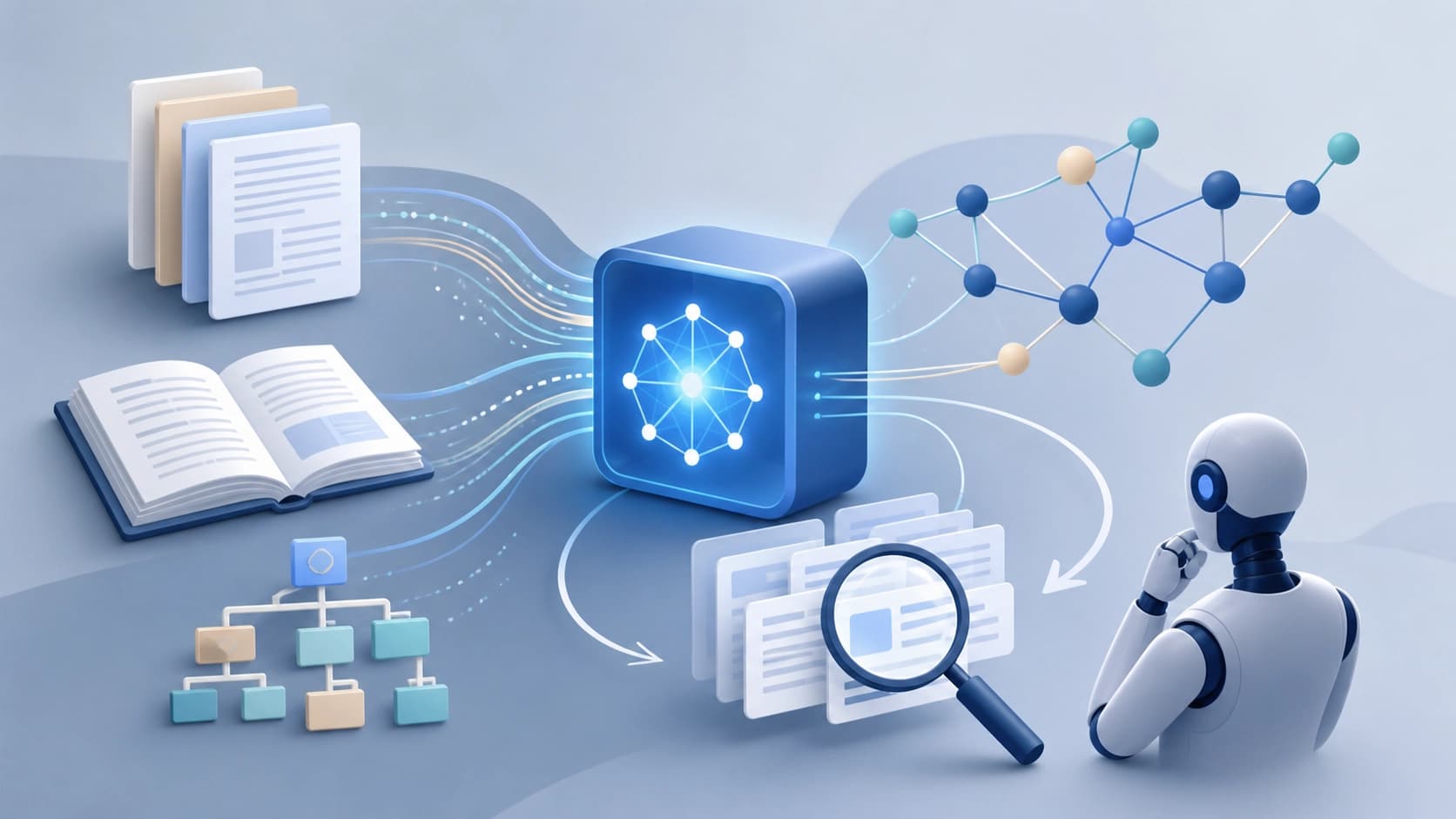
Why vector search alone is not enough
Vector databases are good at finding semantic matches, but corporate documentation follows its own rules: a strict directory hierarchy, many thematic domains, and cross-references between sections. A query like "how to reduce base station power consumption" requires not just similar paragraphs, but precise hits in the right subsection, taking adjacent instructions into account. Classic RAG pipelines start to fail at this stage: the query goes to the wrong domain, the document structure is effectively ignored, and retrieval is not backed by reasoning about where exactly to look.
The authors of a recent arXiv preprint proposed the VDGR-RAG framework, which combines four approaches: vectors, directories, graphs, and reflection. The system works as an agent: it does not just retrieve fragments, but purposefully navigates the knowledge base, evaluates intermediate results, and changes course when necessary.
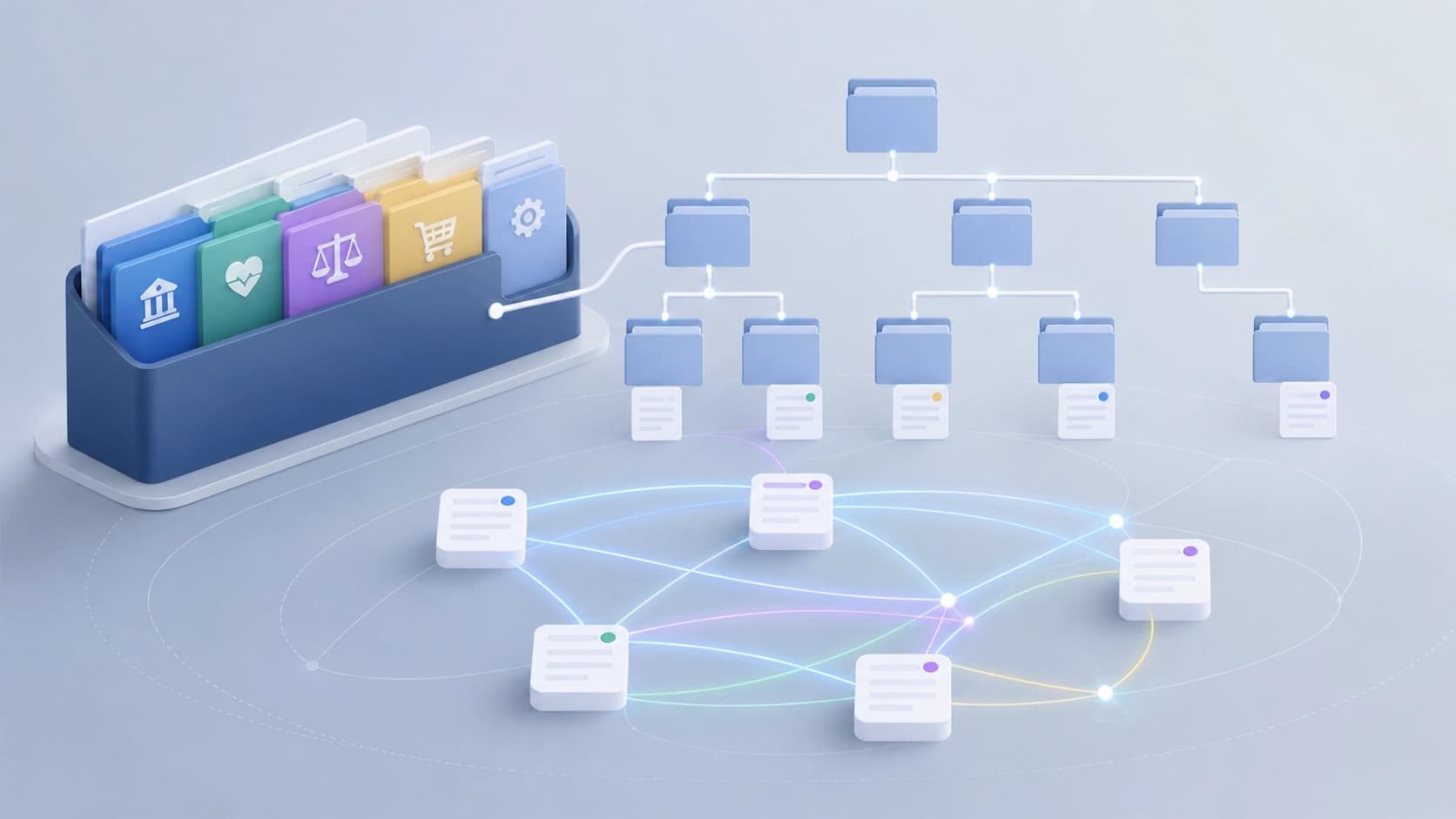
Key idea: from directory to knowledge graph
At the core of VDGR-RAG is the construction of a heterogeneous knowledge graph (H²KG) from documents. It preserves the directory hierarchy — parent-child links between sections and subsections — as well as semantic relationships between meaning blocks. This allows the system to answer at any moment: "which section does this fragment belong to?", "what else is related to this topic?", "where do I need to go up to get the broader context?".
Atomic retrieval tools
The agent logic is implemented through four interacting modules.
- Directory-enhanced routing — navigation through the table of contents. The module first decides which domain or knowledge graph the query belongs to, and only then launches deep retrieval.
- Multi-route retrieval — parallel extraction of information using three methods at once: vector, structural (by table-of-contents sections), and graph-based. This reduces the risk of missing an important document.
- Directory backtracking — if the initial routing turned out to be wrong, the agent returns to the directory and changes its retrieval trajectory.
- Dynamic reflection — after each step, the system evaluates whether enough facts have been accumulated and plans the next query. In essence, this is iterative self-reflection that prevents "digging" into irrelevant fragments.
The modules do not work one after another, but as a single loop: reflection can trigger re-routing, and multi-route retrieval can return candidates that then need to be verified through the graph. Retrieval becomes a flexible iterative process rather than a one-shot call to an index.
What the tests showed
The authors validated practical value on corporate documents spanning four wireless domains — including energy saving and fault management. The results were noticeably better than standard RAG systems, both in recall of found knowledge and in accuracy of answers to questions.

The ability to return to the directory proved especially useful: it was exactly what fixed situations where ordinary vector search confidently returned the wrong results. For hierarchical documentation, this kind of "cross-checking against the table of contents" is often more important than an additional index.
Conclusions
VDGR-RAG is not just another hybrid retriever, but an example of how agentic principles and graph representations address real enterprise problems. When hierarchy matters in a knowledge base, and a mistake in choosing a section can ruin the entire answer, vector search alone is indeed not enough.
Frequently asked questions
Related materials
All materials
AURA-Eval: How to Check Whether an LLM Agent Recognized a Risk and Changed Its Next Step
The framework evaluates LLM agents’ behavior not by their final verdict, but by how they respond to risk at key decision points: tool-call trajectories are interrupted, after which the model must continue reasoning and acting, while a panel of LLM judges assesses risk detection, the nature of the step, and its safety. Across 1,249 tasks drawn from 157 R-Judge trajectories, unsafe actions become more frequent among 20 models when no safe path is available, and removing oversight before execution turns 52.3% of initially safe cases into unsafe ones.
10 November 2026
Chern–Simons Reservoir Memory: Autonomous Connectivity Dynamics and Density Transport
The article explores how a reservoir preserves the history of input signals both in its density distribution and in its geometric degrees of freedom. A comparison of four mechanisms shows that current creates a separate connected component that alters the subsequent density response, while accounting for all measured features yields a small improvement in decoding pulse order.
10 November 2026
STAR: Adaptive Normalization of Temporal Context and Service Graphs for End-to-End Incident Management
The STAR framework trains representations from metrics, logs, and traces, using learnable normalization that accounts for multiscale temporal dynamics and dependency structures between services. On two real-world datasets, this pipeline delivers consistent improvements in anomaly detection, failure ranking, and root cause analysis over state-of-the-art baselines.
10 November 2026