
Agentic SQL without illusions: a unified autonomy scale and an honest comparison of LLM benchmarks
Researchers propose viewing the Text-to-SQL field as a consolidated leaderboard, where results are distributed by the degree of model autonomy in generating SQL queries. They conduct measurements on Spider and show that successes do not always transfer to other benchmarks, and that autonomy provides robustness but requires significant computational resources.

Why "Records" in Text-to-SQL Are Dangerous
Every month, new claims emerge that yet another LLM has nearly matched humans on SQL benchmarks. But if you look closely, these numbers hide very different conditions: some use a simple prompt without database access, some allow the model to execute queries iteratively, and some have reasoning built directly into the model's weights. Comparing such results directly is like putting a car with a mechanic next to a self-driving vehicle that repairs itself while driving.
The authors of a fresh preprint on arXiv (2608.15389) drew attention to exactly this problem. They propose no longer measuring "progress" by an abstract position in a leaderboard, but first honestly recording how much autonomy the system had when generating SQL. Without such a caveat, any comparison between works becomes unstable: changing the benchmark, the base model, or even a slightly different inference protocol can alter the conclusions.

The Autonomy Axis: From Prompts to Self-Sufficient Agents
Instead of simply collecting all numbers into one table, the researchers redefine the very field of Text-to-SQL as "leaderboard aggregation." They gather metrics that system authors report themselves and lay them out along the axis of inference autonomy. This yields five levels:
- Constrained generation — the model merely selects an answer from a tightly restricted space of valid queries, often with external syntax checking.
- In-context generation — SQL is built in a single pass over the context with examples and a schema description.
- Iterative generation — the system can make several attempts, refining the query based on execution results or the database's response.
- Agentic generation — the model works as an agent: it explores the database schema itself, runs queries, reacts to errors, and plans next steps.
- Reasoning-internalized generation — "reasoning" is pre-built into the model, so at inference it outputs the query directly, without external orchestration or intermediate steps.
Such a scale does not say that one level is "better" than another. It merely records the conditions for a fair comparison: a system with internal reasoning cannot be pitted against bare single-shot output on equal terms, just as an agentic loop with the right to execute queries should not be compared with a model that was never given that right.
Importantly, for each cell of such a leaderboard, traceable provenance of the metric is preserved. This means the reader can always understand which specific configuration produced the result, rather than trying to guess from fragments of the experimental section.

What the Experiment on Spider and Beyond Showed
To anchor metric aggregation in reality, the authors conducted a targeted study on the Spider benchmark. They compared open 8B models — with and without CoT supervision — against few-shot baselines based on DeepSeek V3 and GLM-4. Interestingly, they used few-shot protocols rather than fully fine-tuned versions, so the comparison turned out fairly clean.
Four patterns relevant to practitioners emerge from the experiment.
First, improvements obtained on Spider transfer to BIRD and Spider 2.0 unevenly. A model may show a nice gain on one set of queries and barely move on another. This confirms once again: blindly chasing a single score on one popular benchmark creates the illusion of overall progress.
Second, autonomy adds robustness, but at a non-trivial cost. Agentic loops do handle multi-step and ambiguous tasks better, yet token costs and execution time grow noticeably. While such a price is justified for an interactive analyst, for batch processing it can eat up all the gains from fewer errors.
Third, the reasoning-internalized mode occupies a surprisingly middle position. It sits between "dumb" answer decoding without reasoning and externally orchestrated agents. For a number of tasks, this mode delivers near-agentic quality, but without the need to build a complex tool-based loop. Although there is no universal "free lunch": built-in reasoning also has its limitations.
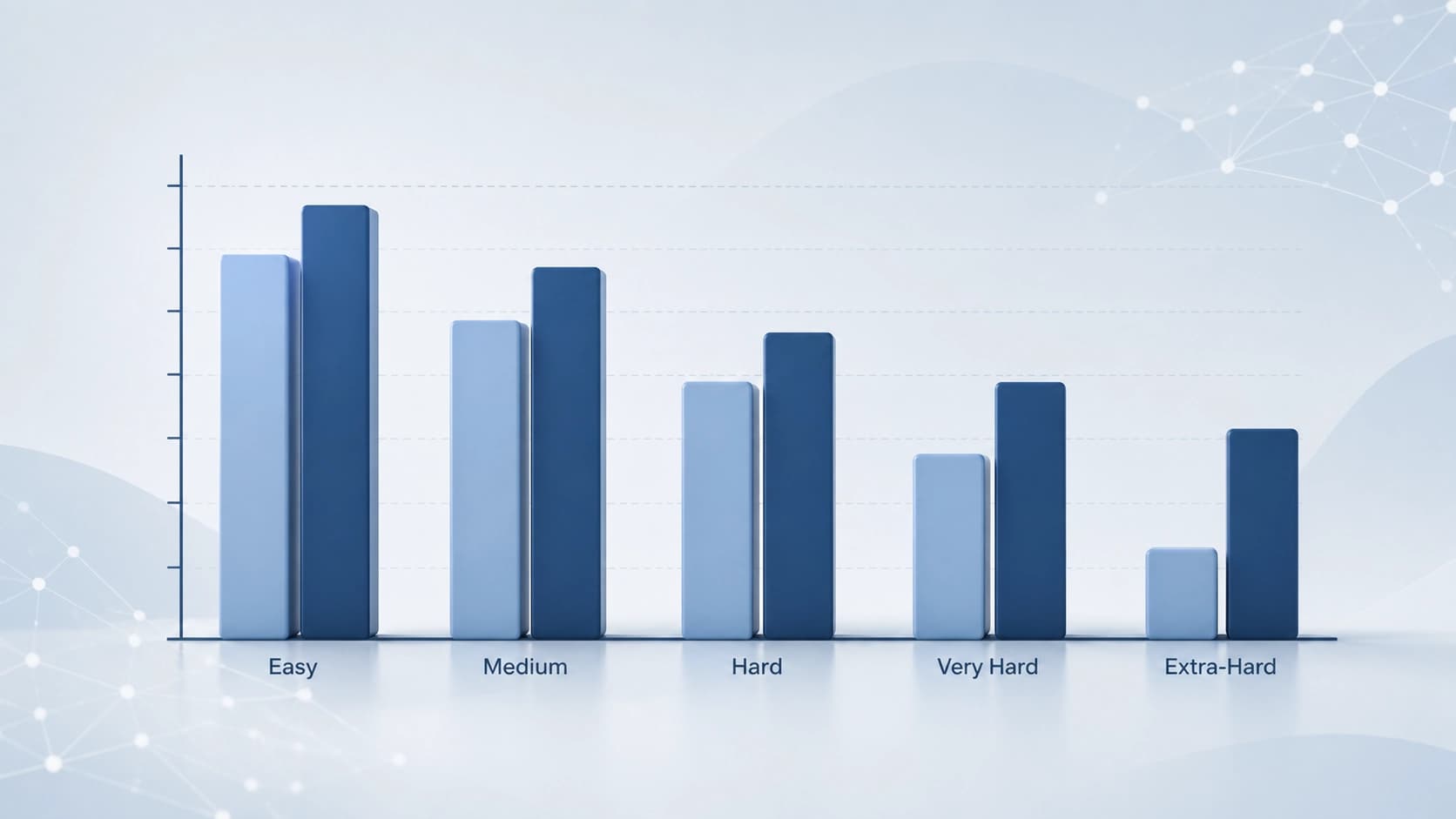
Fourth, gains from CoT supervision concentrate on Hard and Extra-Hard queries. On simple questions, the difference is barely noticeable or even negative — why should a model reason aloud when the answer is immediately visible? But on complex multi-step tasks, the ability to verbalize steps aloud provides a clear advantage. This is an important signal for those building SQL assistants: focus additional compute on high-complexity queries rather than spending it on typical simple cases.
How to Use This Scale in Practice
The most useful takeaway of the work is not even the taxonomy itself, but the public Python harness the authors released alongside the preprint. The harness reproduces the autonomy axis and allows adding new methods to the leaderboard without rewriting the entire environment. If you are developing yet another Text-to-SQL approach, you only need to specify at which autonomy level it operates — and the community will be able to compare you with previous systems on equal terms.
Of course, aggregations based on self-reported metrics should still be trusted with caution. Not everyone has the budget to replicate others' experiments, but a unified annotation is already a big step forward. For now, when reading yet another "state-of-the-art," keep a simple question in mind: what exactly was the model allowed to do during query generation? If the answer to this question is missing, then the number in the paper is just a pretty figure without solid grounding.
Frequently asked questions
Related materials
All materials
MathAdv: What the Final Accuracy of Machine-Generated Proofs Conceals
A diagnostic suite of tasks spanning 13 undergraduate and graduate mathematics topics evaluates machine-proving systems in Lean 4 not only by their final results, but also by their subject-matter mastery, the quality of their informal reasoning, and their robustness to rephrased conditions. A component-by-component analysis shows that translating a problem into formal form remains the main obstacle, and that success depends heavily on the area of mathematics and how the problem is framed.
9 November 2026
AffordanceWAM: Affordances as an intermediary between scene prediction and manipulator control
The work describes a generative model that jointly predicts future RGB observations, scalar fields, affordance heatmaps, and continuous robot commands, using human videos to broaden interaction diversity without action annotations or retargeting. On RoboCasa, CALVIN ABC→D, and real-world tasks, the approach delivers consistent gains over RGB-only and robot-data-only baselines.
9 November 2026
Presentation Editing as Controlled Operations: The EditPPT Framework and DeckEdit-Bench Benchmark
The authors break down slide editing into specific objects, permitted actions, and checks to ensure unrelated content remains untouched, rather than relying on free-form code generation. To measure quality, they created DeckEdit-Bench (183 tasks across 28 human-made presentations), and the multi-agent EditPPT framework achieves a 66.7–74.9% task success rate across five base models while preserving over 97% of the content.
8 November 2026