
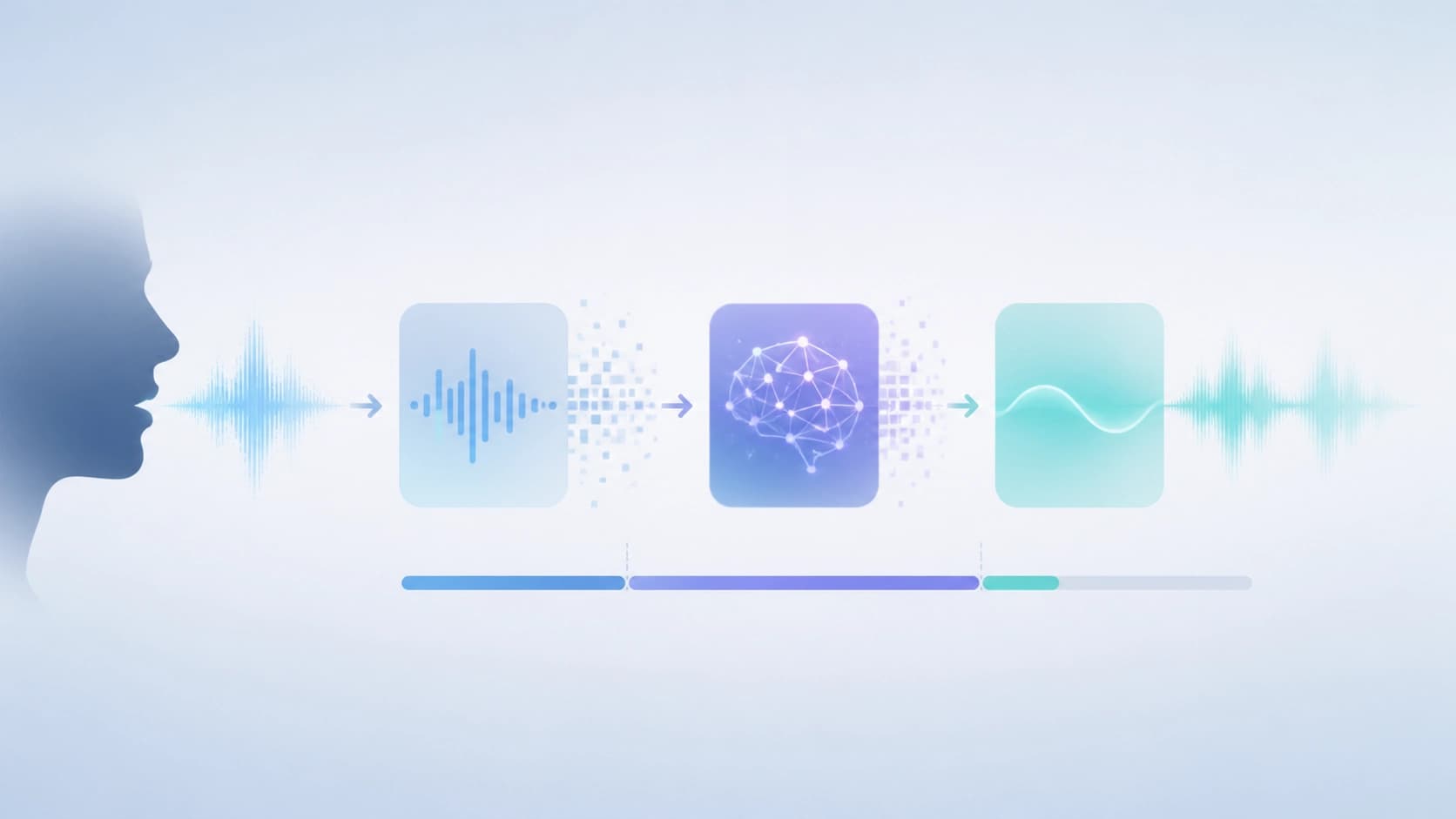
In the world of voice agents, latency is the main currency. While the user waits for a response, the assistant performs three tasks: recognizing speech, thinking of an answer, and synthesizing a voice reply. If each stage eats up tens of milliseconds, the dialogue no longer feels alive. A recent NVIDIA release, announced in August 2026, shows that speech synthesis is no longer the bottleneck: the NVIDIA Magpie TTS model delivers the first audio frame in 32 milliseconds on a top-tier accelerator and speaks twelve languages.
What the model is and why it matters
NVIDIA Magpie TTS is an open text-to-speech system with 364 million parameters. This isn't just a research checkpoint: for production, NVIDIA offers the NVIDIA NIM service stack, which lets you deploy multilingual synthesis on your own servers — where your company's data lives.
The current version supports 12 languages: English, Spanish, French, German, Italian, Vietnamese, Mandarin, Hindi, Japanese, plus three new additions — Arabic, Korean, and Brazilian Portuguese. Existing languages were also upgraded: training data was refreshed and the model was refined, so speech quality improved without changing the architecture.
An interesting detail: voices aren't structured as separate entities per language, but as a shared multilingual representation of speakers. One "speaker" can speak all supported languages, with male and female variants available for each language. This is convenient for products that need a single brand voice across multiple regions.
Code-switching — when a speaker switches between languages within a single phrase — deserves special mention. For Hindi and Japanese, this support was expanded: an IPA-based grapheme-to-phoneme converter and customizable pronunciation dictionaries are used.
Latency: what it was all about
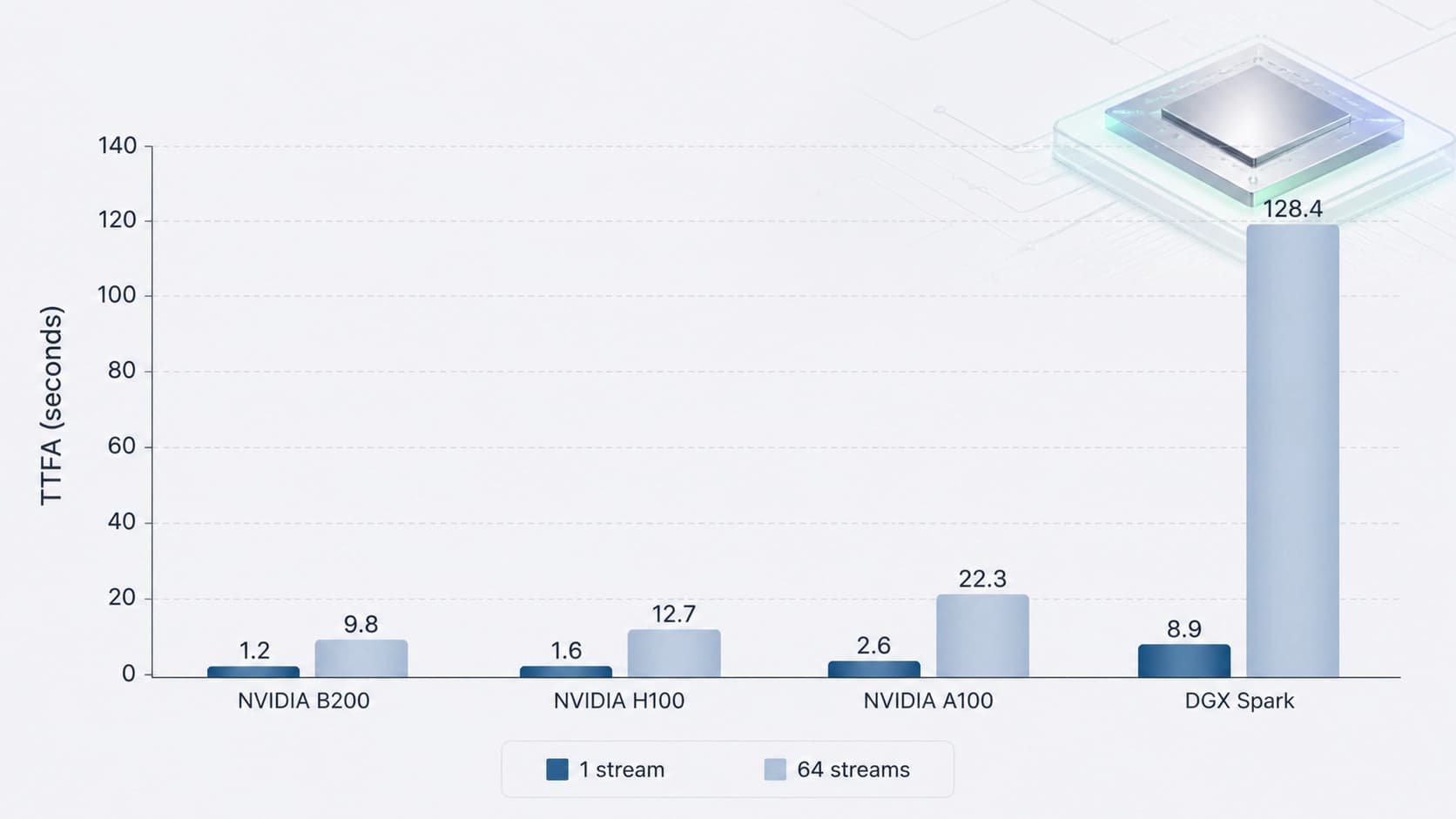
The published materials include performance measurements taken on NVIDIA's own GPUs using NVIDIA NIM. The key metrics are TTFA (time from request to first audio) and RTFX (how many times faster the model generates than real time). The data is an average of three runs.
| Accelerator | TTFA, 1 stream | RTFX, 1 stream | TTFA, 64 streams | RTFX, 64 streams |
|---|---|---|---|---|
| NVIDIA B200 | 32 ms | 12.1× | 239 ms | 319.81× |
| NVIDIA H100 | 47 ms | 14.7× | 275 ms | 290.79× |
| DGX Spark | 53 ms | 9.8× | 962 ms | 75.88× |
| NVIDIA A100 | 79 ms | 12.2× | 395 ms | 197× |
What these numbers mean in practice.
- A single conversation. On a single stream, the first audio arrives in 32–79 ms depending on the GPU. For natural dialogue, the recommended end-to-end latency budget is around 200 ms. Speech recognition and the language model also take time, but when TTS fits within 32 ms (as on the B200), synthesis barely affects the overall picture — the rest of the budget can be allocated to ASR and the LLM.
- Many parallel conversations. With 64 concurrent streams on the B200, time to first audio grows to 239 ms, but throughput reaches roughly 320× real time. In other words, the model synthesizes a minute of speech hundreds of times faster than it plays — a single server can handle an entire call center.
An important nuance: a checkpoint with the same weights is available on Hugging Face — it's meant for research and fine-tuning. The measurements, however, refer to deployment via NVIDIA NIM, i.e., the optimized production stack. If you need predictable latency under load, NIM is what you should rely on.
How the model manages to be so fast
Speed is the result of two architectural changes.
- Frame stacking. The decoder now predicts two audio frames per step instead of one. The number of decoder iterations is halved, which means half the compute work for each speech segment.
- Local transformer. The attention mechanism works with local contexts rather than the entire sequence at once. This reduces computational complexity on long audio and speeds up inference. That said, the authors describe the details of this part of the architecture rather sparingly.
Together, these changes keep latency in the tens of milliseconds even on relatively affordable hardware.
Cascade instead of a black box
Developers of voice products are often offered integrated speech models: one API call and you get recognition, synthesis, and even the model's response. It looks simple, but this approach has a downside: you can't swap one component for another, fine-tune a single layer, meet data residency requirements, or even understand where latency occurs.
A cascaded architecture — where speech recognition (ASR), the language model (LLM), and synthesis (TTS) work as separate services — solves these problems. Each layer can be configured, updated, and scaled independently. The open weights of NVIDIA Magpie TTS and its availability as an NVIDIA NIM container make this approach realistic: you deploy the synthesizer next to your data and get predictable latency without calls to external APIs.

Where to apply this
There are quite a few scenarios where a fast multilingual TTS with local deployment options delivers practical value:
- customer support voice agents — especially those operating across multiple countries;
- medical assistants, where data privacy is critical;
- enterprise copilots embedded into company workflows;
- translation systems that need voice output rather than text;
- conversational AI applications where latency directly affects user experience.
The common denominator across all these use cases is deployment requirements: data must not leave the organization's perimeter, pronunciation and voices need to be adapted to the product, and behavior under load must remain predictable. This is exactly what the new NVIDIA Magpie TTS release addresses: an open model, advanced multilingual support, minimal latency, and no dependence on a managed cloud service.