
Neural surrogates for wave scattering: a new algorithm removes the scaling limitation
The authors proposed training a one-step surrogate on dynamically selected challenging examples where the model diverges from the exact simulator. This enabled scaling to 41,772 controlled variables and inductive generalization to domains with over 3 million variables, accelerating optical device design by up to 26.5 times compared to FDTD.
Introduction
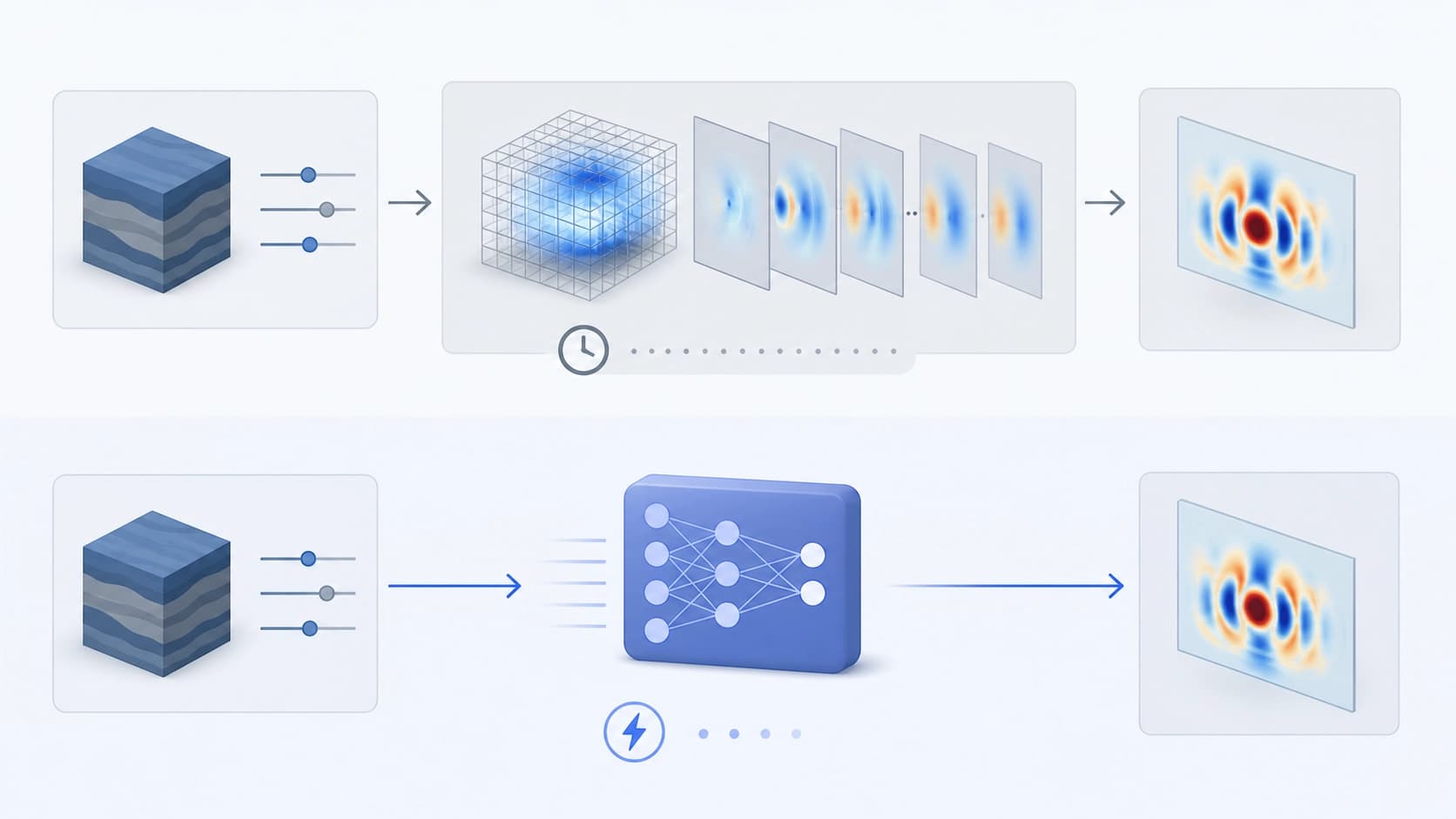
Electromagnetic simulation has long been a bottleneck in the development of optical systems. Classical methods such as FDTD require enormous computational resources, especially when it comes to tuning parameters of complex structures. In recent years, neural network surrogates have come to the rescue — trained models that mimic the behavior of a physical simulator but operate orders of magnitude faster. However, such substitutes had a significant drawback: they could only be trained for problems with a very small number of controllable parameters.
The Scaling Problem
One-step (non-recurrent) surrogates previously worked efficiently only with a few dozen variables. As soon as the number of parameters grew, training became unstable and the model itself lost accuracy. The reason lies in the training data generation strategy: examples were typically drawn randomly from a huge space of possible configurations. The model received a lot of "equally useless" data and could not focus on difficult cases where its errors were especially large.
The authors of the new work — Charles Dow and Laura Waller — proposed changing the very approach to generating training data. Instead of passive random sampling, they run an active search process for "hard" examples that works in parallel with surrogate training.
New Training Algorithm
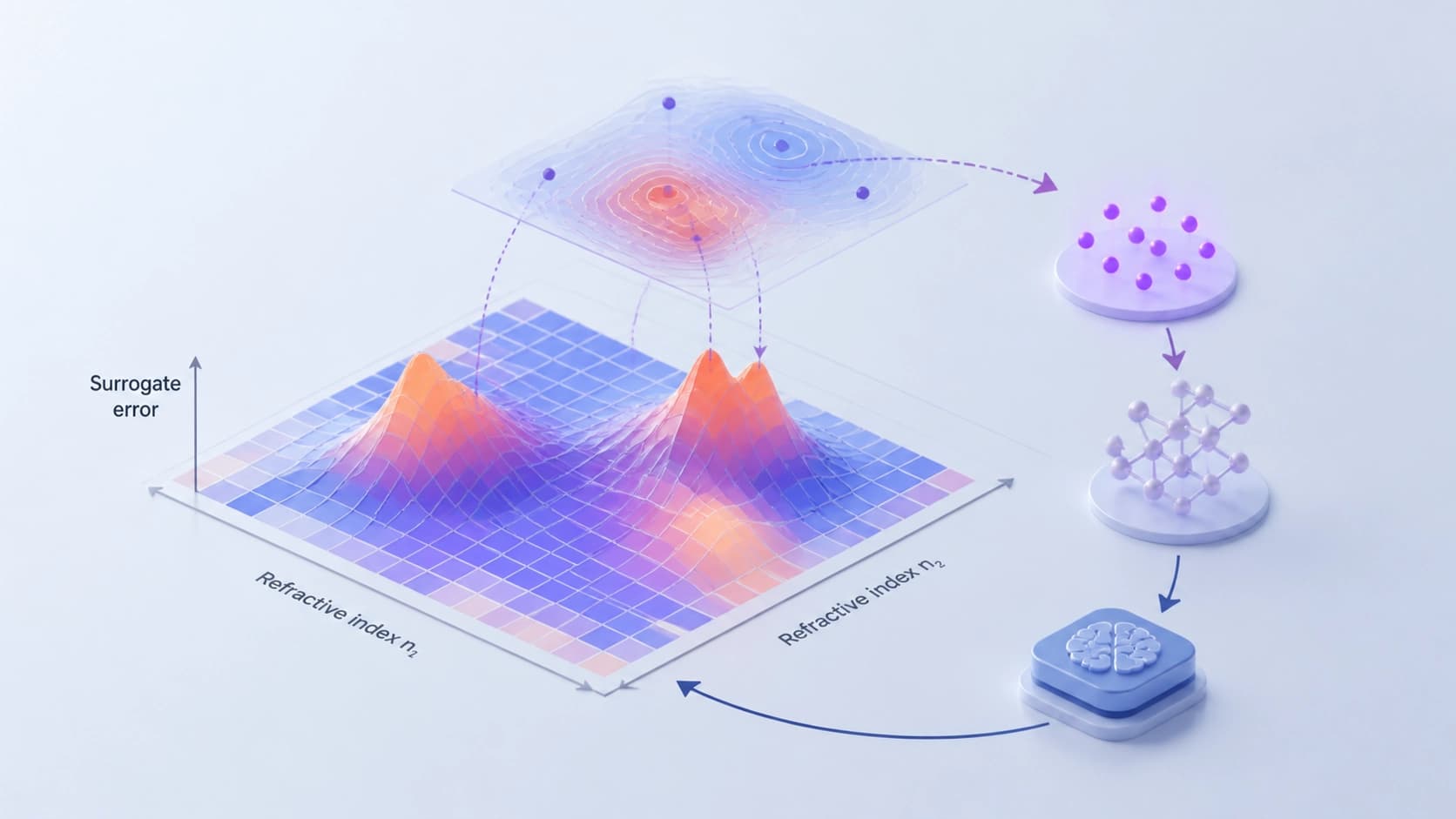
The key idea is to force the surrogate to train precisely on those configurations it cannot yet handle. For this, gradient ascent is used: the algorithm seeks refractive index distributions and source parameters that maximize the discrepancy between the neural network's prediction and the exact full-wave calculation. These "problematic" examples are added to the training set, and the model is compelled to improve exactly where errors were previously critical.
Dynamic Example Generation
This approach resembles adversarial training: the surrogate constantly encounters new challenges generated based on its current weaknesses. Instead of trying to cover the entire parameter space uniformly, the method concentrates on the most informative points. This drastically reduces the required data volume and accelerates convergence.
Normalization and Replay Set
To keep training stable, the authors employ two additional techniques. First, both the input source and the ground-truth solution are normalized — this prevents issues with fields of different scales. Second, an evolving replay dataset is used: a portion of previously generated examples is retained and periodically mixed back into training. This "memory" prevents the model from forgetting already mastered scenarios.
Results
Experiments were conducted on a two-dimensional wave scattering problem. The surrogate was successfully trained for systems with 41,772 controllable variables, which is several orders of magnitude beyond previous capabilities. The model maintained accuracy both on structured (regular) objects and on fully free-form configurations.
Most interesting is the property of inductive generalization: the trained surrogate can handle domains whose size was never seen during training. Without additional tuning, it handled systems containing over 3 million variables — a 73.8× increase relative to the original scale.
Practical Applications
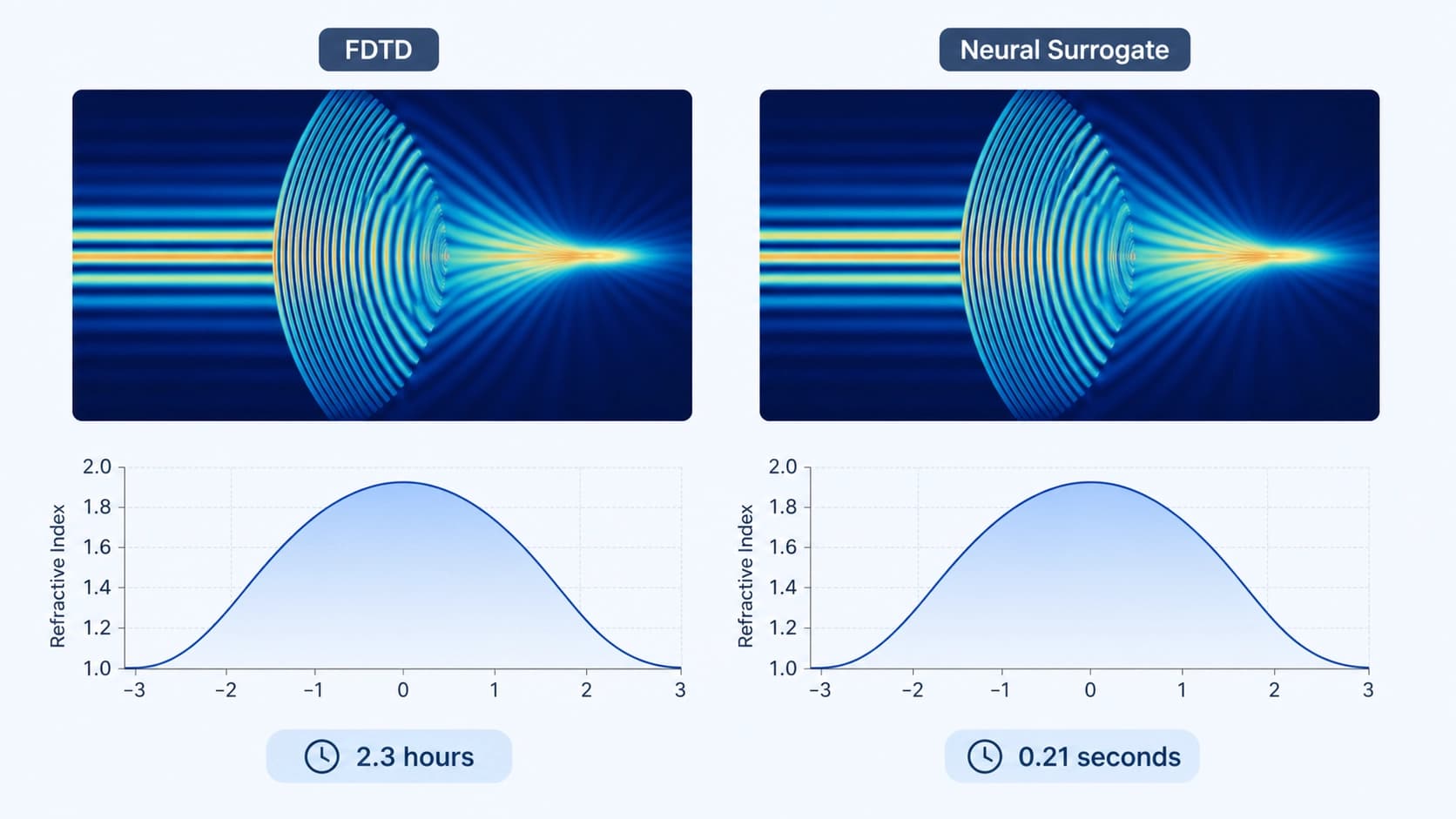
The approach's capabilities were demonstrated on real inverse design problems for optical elements. These include freeform beam splitters and GRIN lenses up to 98 wavelengths wide. The designs produced by the surrogate are on par with solutions found using FDTD, and in some cases even surpass them in quality. As for speed, the acceleration compared to the classical simulator ranged from 1.29× to 26.5× depending on the setup.
Conclusions
The proposed algorithm removes the main limitation of one-step neural surrogates — the inability to scale to practically significant problems. Through active search for hard training examples, normalization, and the use of a replay set, it becomes possible to train a model that works with millions of variables while remaining accurate and fast. This opens the way to using neural surrogates in interactive design environments where days-long cluster computations were previously required.
Further development of the method may include transitioning to three-dimensional problems and more complex physical models, where the gain from replacing simulators with neural networks will be even more significant.
Frequently asked questions
Related materials
All materials
AURA-Eval: How to Check Whether an LLM Agent Recognized a Risk and Changed Its Next Step
The framework evaluates LLM agents’ behavior not by their final verdict, but by how they respond to risk at key decision points: tool-call trajectories are interrupted, after which the model must continue reasoning and acting, while a panel of LLM judges assesses risk detection, the nature of the step, and its safety. Across 1,249 tasks drawn from 157 R-Judge trajectories, unsafe actions become more frequent among 20 models when no safe path is available, and removing oversight before execution turns 52.3% of initially safe cases into unsafe ones.
10 November 2026
Chern–Simons Reservoir Memory: Autonomous Connectivity Dynamics and Density Transport
The article explores how a reservoir preserves the history of input signals both in its density distribution and in its geometric degrees of freedom. A comparison of four mechanisms shows that current creates a separate connected component that alters the subsequent density response, while accounting for all measured features yields a small improvement in decoding pulse order.
10 November 2026
STAR: Adaptive Normalization of Temporal Context and Service Graphs for End-to-End Incident Management
The STAR framework trains representations from metrics, logs, and traces, using learnable normalization that accounts for multiscale temporal dynamics and dependency structures between services. On two real-world datasets, this pipeline delivers consistent improvements in anomaly detection, failure ranking, and root cause analysis over state-of-the-art baselines.
10 November 2026