
How pointwise LLM prompting uncovers hidden medical data that standard de-identification systems miss
New research shows that large language models with prompts calibrated for a specific clinic close gaps in medical information protection—including internal codes and building names—outperforming existing algorithms in accuracy while also uncovering errors in reference annotations.
Why Standard De-identifiers Miss "Local" Data
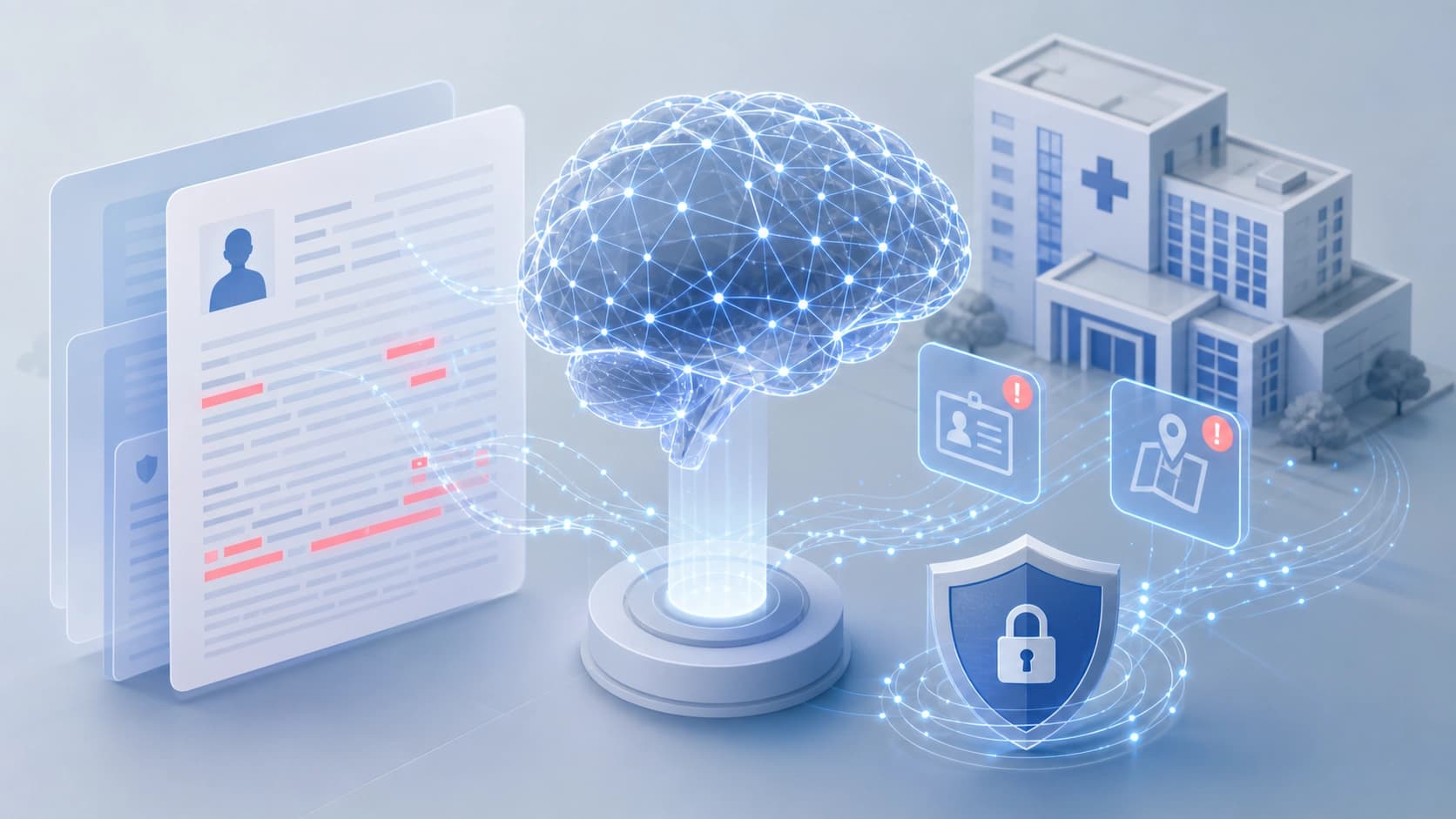
Automated de-identification systems for medical records usually handle typical types of protected information well: names, dates of birth, insurance numbers. But in a real hospital, there is data that is sensitive only within that organization. This includes abbreviated clinic names, building names, and internal department codes. To a human, such strings unambiguously indicate the place of treatment, but a universal algorithm cannot know all local designations.
Traditional solutions rely either on dictionaries or on trained models with fixed categories. Both miss what is not in their reference sets. Researchers call this "institutionally localized" PHI, and this is exactly where serious leakage risks arise.
How LLMs Bridge the Gap
To test whether large language models with in-context learning can solve this problem, the experiment's authors took 100 annotated pediatric oncology notes — over five thousand PHI fragments in total — and then compared eight LLMs against two specialized systems (Stanford TiDE and OpenMed PII) and two pattern baselines.
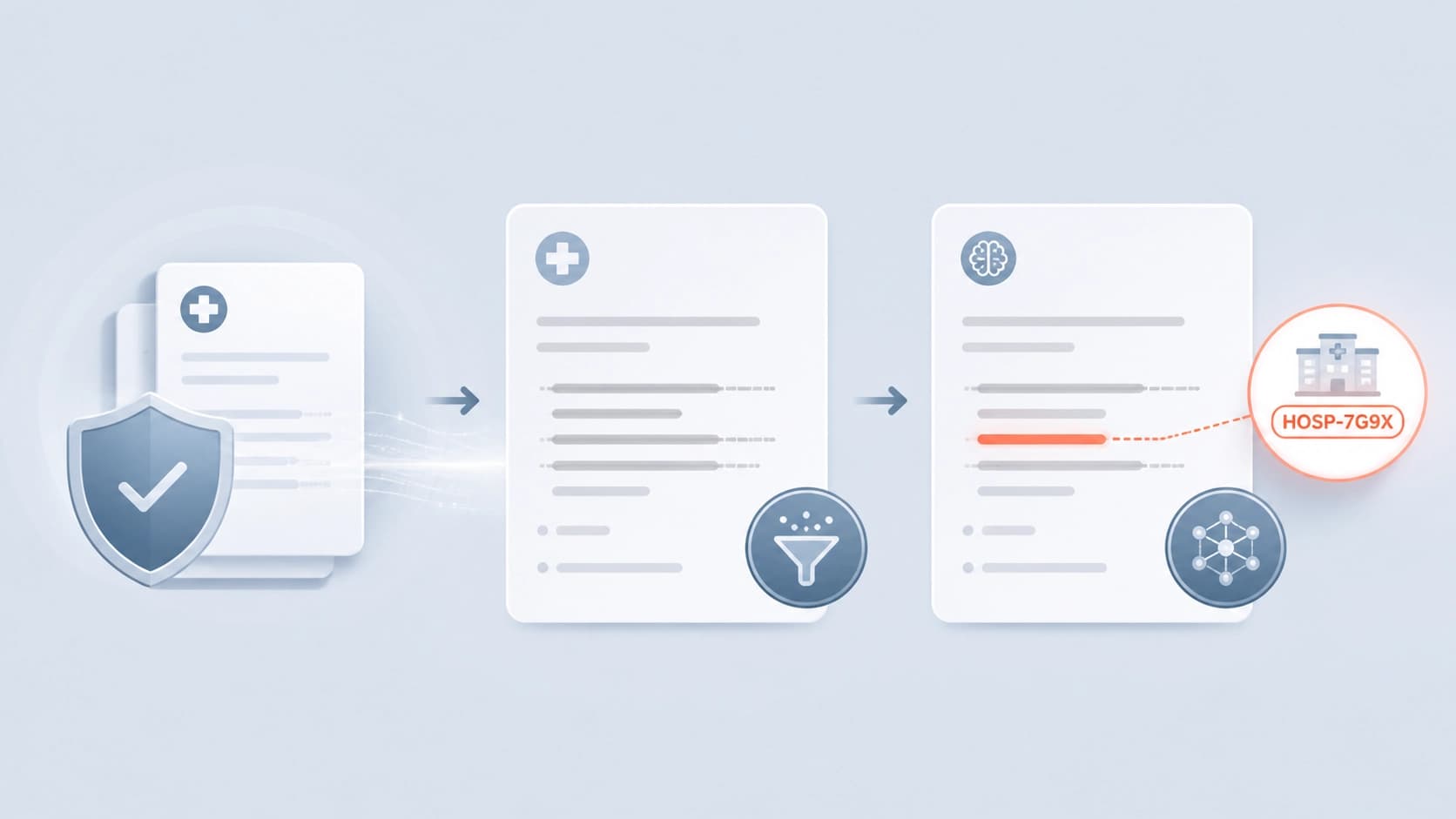
The result favored the LLMs: the best model achieved F1 = 0.918 ± 0.001, while the best specialized system, TiDE, only reached 0.779. The advantage was especially noticeable on context-dependent categories — precisely those local designations that usually fall outside the algorithms' scope.
Three Levels of Prompts: From HIPAA to Fine-Tuning
The key technique is not just a query, but a deliberate prompt configuration tailored to a specific institution. The experiment used three variants:
- Basic prompt — general instructions per the HIPAA standard.
- Prompt with local categories — adds a list of institutional PHI types that the standard does not cover.
- Prompt with protection against over-redaction — an additional instruction not to cut out excess clinical content.
Listing the missed categories recovered 79% of the 61 previously unfound fragments (48 items). And the instruction against over-redaction restored the precision that had suffered from the model's "over-caution."

Agents and Ensembles Offered No Gain
One might assume that running multiple models or a multi-agent scheme would yield even better results. The authors tested 14 such configurations and compared them against the best single prompt. It turned out that no agent architecture outperformed a simple single-pass calibrated prompt. Agents held F1 in the 0.906–0.907 range — essentially the same level, but without any additional gain.
LLMs as Annotation Auditors
A separate value of the LLM approach is that it helps verify the quality of the reference set itself. The models flagged 414 places where the original annotation was likely incomplete. Manual review confirmed 227 missed PHI spans. After fixing the annotation and re-running the prompting, recall rose to 0.981 with F1 = 0.907 ± 0.002. This means an LLM can serve not only as a de-identification tool, but also as an auditor for building more accurate training sets.
Conclusions
A well-tuned prompt allows an LLM to close the institutional PHI gap and find the optimal precision-recall balance in a single call to the model. This approach is more expensive than traditional dictionary-based methods, but those costs are partially offset by the ability to verify and improve the reference standard itself.
The authors consider LLMs a legitimate, adaptable alternative to specialized de-identifiers. The main implementation strategy is developing institution-specific prompts that account for each clinic's local realities.
Frequently asked questions
Related materials
All materials
Moving to the Probability Simplex Reduces the Modality Gap in Contrastive Multimodal Models
The paper arXiv:2610.32890 proposes replacing spherical embeddings with a probabilistic simplex, adding lightweight softmax adapters and Total Variation similarity. Across five retrieval benchmarks, the cross-modal centroid ℓ2 distance decreases by 97–99% while retrieval quality is maintained or improved.
3 November 2026
How ActionRAG Reconsiders Evidence During Diffusion Across the Memory Graph of LLM Agents
A graph-memory architecture is proposed that carefully reconciles entities during indexing and reevaluates relationships at query time based on local structure. On MemoryAgentBench, the method achieved an average accuracy of 55.1, outperforming the strongest retrieval baseline by 5.4 percentage points while keeping synthesis costs low per query.
3 November 2026
Fifteen companies backed MDK Tether for mining automation
Equipment manufacturers, mining pools, and operators have taken on the development of integrations with Tether’s open suite to standardize equipment monitoring and management; the QVAC AI agent is already built on this foundation. Independent confirmation of reduced electricity costs or increased efficiency has not yet been published.
2 November 2026