
Moving to the Probability Simplex Reduces the Modality Gap in Contrastive Multimodal Models
The paper arXiv:2610.32890 proposes replacing spherical embeddings with a probabilistic simplex, adding lightweight softmax adapters and Total Variation similarity. Across five retrieval benchmarks, the cross-modal centroid ℓ2 distance decreases by 97–99% while retrieval quality is maintained or improved.

Task: Modality Gap in Contrastive Models
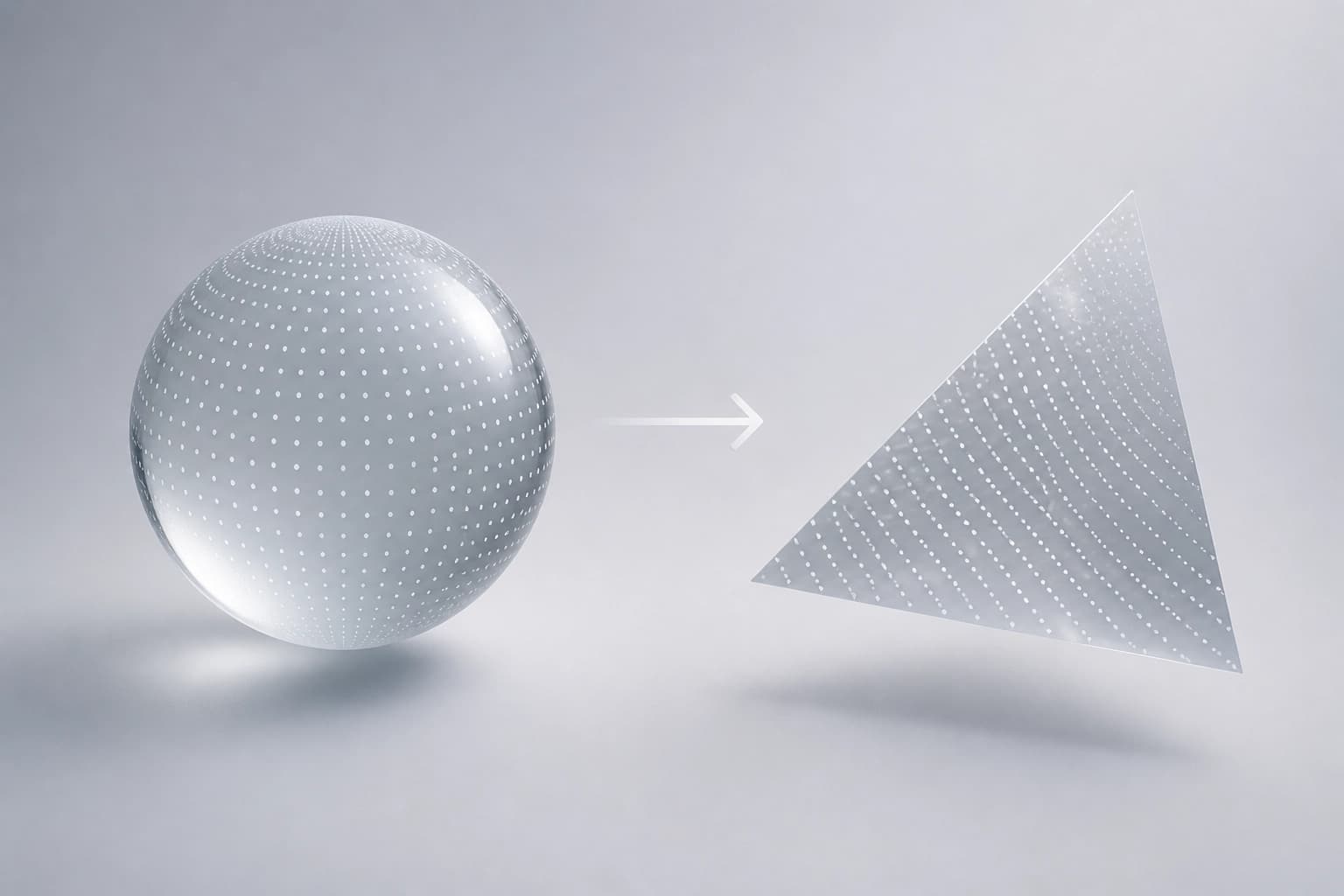
The paper “Closing the Modality Gap via Simplex-Constrained Representations” was published on arXiv on October 23, 2026. Paper identifier: arXiv:2610.32890. It examines the modality gap in multimodal contrastive models such as CLIP and CLAP. The authors propose changing the representation space: replacing the unit sphere (S^{d-1}) with the probability simplex (\Delta^{d-1}).
- Object: modality gap.
- Models: multimodal contrastive models CLIP and CLAP.
- Change: transition from sphere to simplex.
- Preservation: the intrinsic dimensionality of the spaces is the same.
Practical criterion: check whether the approach defines a new representation space.
Simplex as a Shared Coordinate Basis
The simplex defines nonnegative coordinates that sum to one. These conditions establish a coordinate basis shared across modalities. The sphere and simplex have the same intrinsic dimensionality.
| Feature | Unit sphere (S^{d-1}) | Probability simplex (\Delta^{d-1}) |
|---|---|---|
| Intrinsic dimensionality | The same for both spaces | The same for both spaces |
| Coordinate constraints | Not specified by the source | Nonnegativity and unit sum |
| Shared modality basis | Not described by the source | Defines a coordinate basis |
Practical criterion: check whether the constraint defines a shared coordinate basis for both modalities.
How the Method Works
The method uses lightweight softmax adapters. It calculates representation similarity using Total Variation. The probability simplex defines the constraint on the space.
- Adapters: lightweight softmax adapters.
- Similarity: Total Variation.
- Space: probability simplex.
- Authors’ assessment: simplex geometry provides semantic alignment.
Practical criterion: check for two components in the method—softmax adapters and Total Variation similarity.
What the Measurements Show
The authors report a 97–99% reduction in the centroidal (\ell_2) gap across five multimodal retrieval benchmarks. Retrieval quality matches or exceeds that of standard models without these constraints.
These results concern the geometric gap and retrieval quality. The authors present them as an assessment of simplex geometry.
- Number of benchmarks: five.
- Benchmark type: multimodal retrieval.
- Gap metric: centroidal (\ell_2) gap.
- Reduction: 97–99%.
- Retrieval quality: on par with or better than standard unconstrained models.
Practical criterion: verify the claimed gap reduction against results on five retrieval benchmarks.
How to Interpret the Result
According to the authors, simplex geometry provides semantic alignment. A reduction in the centroidal gap does not replace evaluating retrieval quality. The paper compares retrieval quality with that of standard models without these constraints.
- Geometric effect: reduction in the centroidal (\ell_2) gap.
- Semantic assessment: simplex geometry provides alignment.
- Quality comparison: matches or exceeds standard models without constraints.
Criterion: consider the conclusion supported if geometry and retrieval quality are evaluated separately.
Frequently asked questions
Related materials
All materials
How ActionRAG Reconsiders Evidence During Diffusion Across the Memory Graph of LLM Agents
A graph-memory architecture is proposed that carefully reconciles entities during indexing and reevaluates relationships at query time based on local structure. On MemoryAgentBench, the method achieved an average accuracy of 55.1, outperforming the strongest retrieval baseline by 5.4 percentage points while keeping synthesis costs low per query.
3 November 2026
Fifteen companies backed MDK Tether for mining automation
Equipment manufacturers, mining pools, and operators have taken on the development of integrations with Tether’s open suite to standardize equipment monitoring and management; the QVAC AI agent is already built on this foundation. Independent confirmation of reduced electricity costs or increased efficiency has not yet been published.
2 November 2026
Controlled Evolution of LLM Agents in Autonomous Investing: A Multi-Agent Architecture with an Immutable Safety Layer
The article describes Steward, a system of nine role-based LLM agents in which portfolio decisions are reviewed by a risk manager, and prompt changes are allowed only through reversible controls and replay of recorded data. The key takeaway is that an immutable core and audit procedures allow the agents to evolve without giving them control over risk rules and order execution.
1 November 2026