

Introduction
Tensor networks have long promised efficient work with data of enormous dimensionality. At their core lies the idea of the tensor train (TT-format): a multidimensional array is decomposed into a chain of small cores, making it possible to store and process objects whose number of elements is exponentially large. However, until now the question remained open of how to perform elementwise nonlinear transformations — for example, computing sine, exponential, or threshold filters — without unfolding the tensor into a full representation. The new ITNT framework closes this gap.
General idea of ITNT
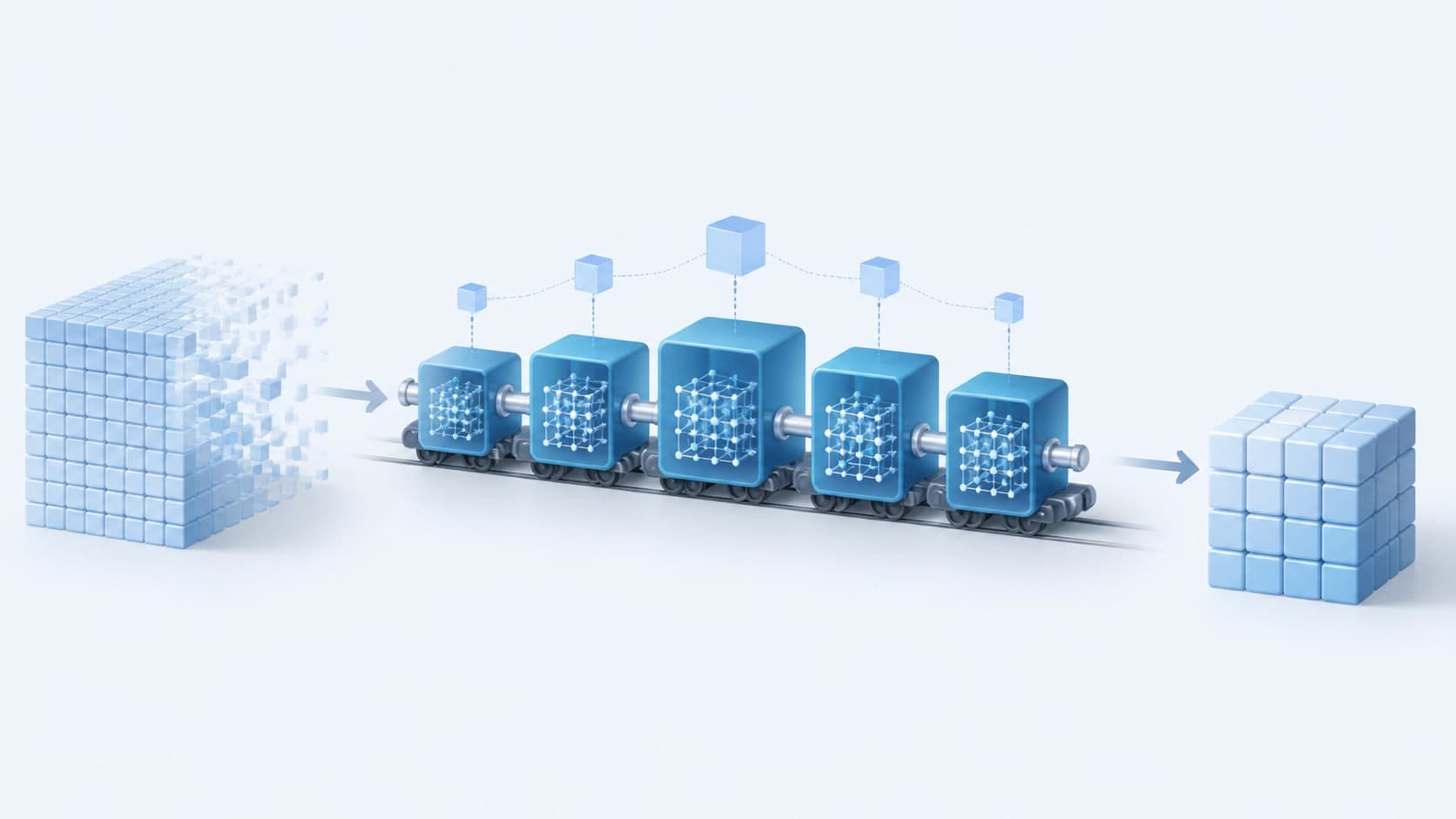
Iterative tensor network transformations, abbreviated as ITNT, are a general algorithmic framework that allows applying a broad class of elementwise functions to data in TT-format. Instead of unpacking the tensor into a regular array, computations are performed directly in the compressed space. This makes it possible to work with datasets of colossal size at a manageable computational cost.
The key advantage of the approach is its universality. ITNT supports not only simple mathematical operations such as addition and multiplication, but also strongly nonlinear elementary functions, as well as filtering transformations that isolate regions of interest in the data. The method automatically controls accuracy, which is important for practical applications.
Application to a three-dimensional reacting flow
In one of the demonstrations, ITNT is applied to a three-dimensional reacting flow. In such models, the rate of a chemical reaction depends on local values of temperature and concentrations in a nonlinear way. Using the new method, it was possible to compute strongly nonlinear functions for the entire volume of data while remaining in TT-format.
The result is impressive: the reaction rate is recovered with high accuracy, and the data itself can be filtered directly in the compressed form — for example, isolating zones of intense reaction. This means the method can become a foundation for analyzing large simulations without the need to store or process full arrays of values.
Optimization: from extrema to Max-SAT
Another important area of application for ITNT is finding extrema. Many optimization problems, including NP-hard ones, can be reduced to working with Boolean or multivalued variables. The framework is used here as a tool for global search: it finds configurations that deliver the maximum or minimum of the objective function, and the size of the search space can be astronomical.
The work demonstrates solving Max-SAT — the problem of maximum satisfiability of Boolean formulas — on spaces of up to 2^70 possible configurations. This is unattainable for classical approaches that explicitly enumerate options. At the same time, the new method maintains controlled complexity, opening the way to applications in combinatorial optimization and machine learning.

Why this matters
Tensor methods are usually good for operations that do not change the structure of the data, but struggle with strong nonlinearity. ITNT removes this limitation, turning tensor networks into a full-fledged general-purpose data analysis tool. Essentially, this is a step toward using compressed representations not only for storage and linear transformations, but also for complex functional computations.
Moreover, the framework is not tied to a specific domain. It handles both physicochemical simulations and discrete optimization problems equally well. Such universality is rare even among classical computational methods.
Conclusions
The ITNT framework presented on arXiv (paper 2608.17135) represents notable progress in the development of tensor computations. The work spans 23 pages and 10 figures, indicating detailed elaboration of both theory and experiments. The authors — a group of researchers from different organizations — propose viewing ITNT as a basic building block for future applications of tensor networks. It can be expected that new works using this approach in big data analysis, modeling, and optimization will appear in the near future.