
BIRDNet: a neural network extracts boolean rules directly from tabular data while remaining transparent
The method builds a compact network where each hidden block corresponds to one discovered rule linking a pair of features. On biomedical data, BIRDNet nearly matches dense counterparts in accuracy but requires significantly fewer active parameters and allows rules to be read without additional explanatory models.

Transparency as part of the architecture
An ordinary neural network is good at finding patterns, but it can only explain them in hindsight. Most often, this requires connecting third-party interpreters or simplified surrogate models, and such explanations are merely approximations of what actually happens inside. The BIRDNet model tries to avoid this compromise: it makes rules part of the architecture and reads them directly from the network.
Each hidden block of such a network is not an abstract "neuron" but a compact representation of a Boolean rule: "if feature A is present, then feature B is expected." After training, no separate explanatory models are needed: the connections and weights already carry symbolic meaning.
How rules emerge from tables
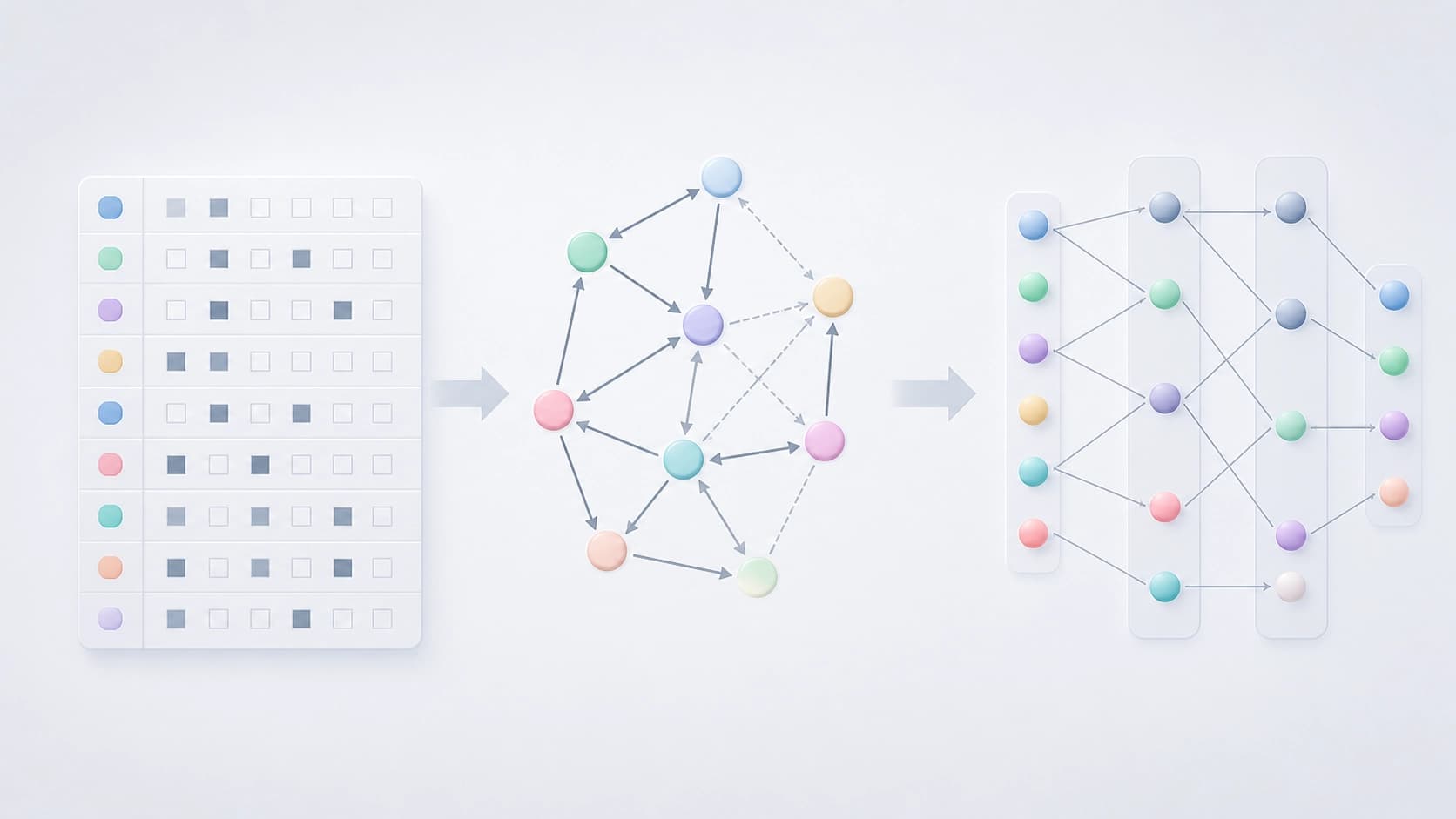
BIRDNet begins extracting symbolic rules from tables without an external knowledge base. In data from domains with rich accumulated knowledge—for example, in biomedical tables—Boolean implications often hide between pairs of features. The search for such relationships is statistical, using a binomial test, and rare exceptions do not break a rule but are considered acceptable deviations.
Once pairs of features are found, a typed implication graph is assembled from them. The graph itself is then transformed into neural network layers:
- each hidden block corresponds to one extracted rule;
- a block connects only to its two features;
- in the implication layer, the share of active weights does not exceed
2/d, wheredis the input dimension.
This sparsity makes the network lightweight while maintaining a direct link between the architecture and the symbolic rules.
Experiments: accuracy barely suffers
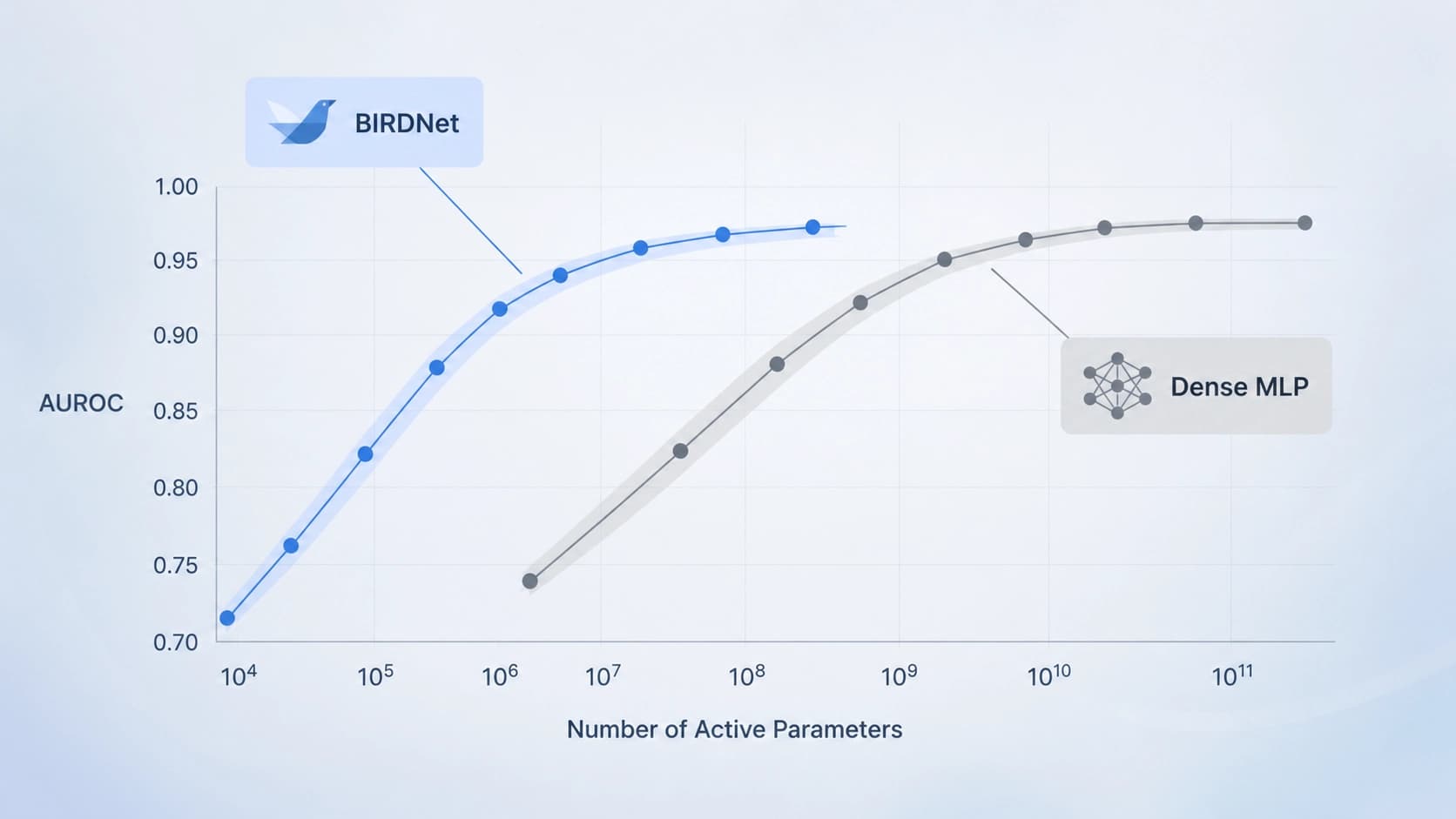
To check whether transparency comes at the cost of prediction quality, BIRDNet was run on six transcriptomic and proteomic benchmarks. Comparison with dense baseline models yielded two important figures:
- the gap to the strongest dense solution in AUROC was no more than 0.02;
- at the same time, BIRDNet uses up to 95 times fewer active parameters than an architecturally comparable dense MLP.
In other words, the model is almost as accurate but requires far fewer parameters. In practice, this means a more robust and economical architecture that is easier to deploy and analyze.
Rules are valuable for meaning, not just metrics
This approach has a non-obvious nuance. In control experiments where pairs of features were shuffled or replaced with random ones, accuracy did not drop: random connections turned out to be comparable to the original ones or even surpassed them in AUROC. This means that the extracted pairs themselves do not give the model an advantage in predictions. Their value lies elsewhere.
Meaningful implications retain symbolic interpretation. The rules of BIRDNet's first layer align with known biological signatures for several cancer subtypes and tissue types. Random pairs, despite comparable accuracy, carry no meaning at all.
Therefore, BIRDNet is not just another way to predict a target variable slightly better. It is an example of how a neural network can be used simultaneously as a predictive model and as a source of testable hypotheses. The work appeared on arXiv and was accepted at CIKM 2026—a strong signal that the topic of interpretable neuro-symbolic architectures is only gaining momentum.
Frequently asked questions
Related materials
All materials
Toollery: Choose tools for LLM agents from tens of thousands of options without fine-tuning
Toollery builds a search index from descriptions of skills and tools, then passes the model only a limited set of candidates for each query. In experiments with libraries containing tens of thousands of functions, the approach helps maintain selection quality at a fixed top-K, although the overall effect depends on the workload profile and the provider’s caching.
11 November 2026
Step-by-Step Evaluation of GUI Agents for Dashboard Analysis: The DashAct Benchmark
Introducing DashAct, a benchmark of 348 human-verified trajectories that breaks down GUI agents’ work with interactive dashboards into three stages and four visual conditions. The results reveal persistent issues with action prediction and visual target grounding, as well as agents’ reliance on contextual and spatial support.
11 November 2026
WILSON: combining magnifications and patient slides for pathomorphological analysis and report generation
The preprint introduces WILSON, a vision-language model that encodes images of whole slides and series of slides from a single patient at different magnifications, rather than just a single “best” slide. Without task-specific fine-tuning, it outperforms specialized and larger slide models on a range of metrics while requiring substantially less compute, and its diagnostic descriptions received higher ratings from pathologists.
11 November 2026