
ISO for RLVR: Preserving the Spectrum of Base Weights When Tuning Singular Frames
This work investigates the RLVR optimization layer and confirms that a model can be fine-tuned while preserving the singular values of its base weights and adapting the associated frames. The offline ISO-Merger method combines specialists without additional data, while the online ISO optimizer accelerates convergence and improves accuracy on mathematical and programming tasks.

Spectrum and Frames in RLVR
ISO (Isospectral Optimization) is an optimization stack for RLVR with offline and online variants. The authors functionally confirmed spectral inheritance. RLVR can reuse the base model’s weight spectra. New behavior emerges by adapting the input and output singular frames associated with the spectrum.
- The weight spectrum is inherited from the base model.
- New behavior is shaped by tuning the singular frames.
- RLVR design principle: inherit the spectrum, optimize the frames.
Practical criterion: preserve the base model’s spectrum and optimize the singular frames.

Offline Merging with ISO-Merger
ISO-Merger works offline. It merges experts that share a base model. Merging takes place in frame coordinates with a fixed spectrum. No post-merger data, rollouts, or distillation are needed.
- Merges experts that share a base model.
- Fixes the spectrum in frame coordinates.
- Requires no post-merger data, rollouts, or distillation.
- Achieves the highest aggregate scores among data-free merging methods.
Selection criterion: ISO-Merger is suitable when experts need to be merged without post-merger data.
Online Optimization with ISO-Optimizer
ISO-Optimizer works online. It applies AdamW or Muon directly to the frame variables. The base model’s spectra remain fixed. In the reported mathematics and programming experiments, the method increases aggregate accuracy.
- Online optimization of frame variables.
- AdamW or Muon as optimizers.
- The base model’s spectra remain fixed.
- Increases aggregate accuracy in mathematics and programming experiments.
Selection criterion: ISO-Optimizer is used in online RLVR when the goal is to improve aggregate accuracy in mathematics and programming.
Comparing ISO-AdamW and AdamW
On Qwen3-4B-Base, ISO-AdamW reaches the accuracy AdamW achieves after 400 updates in 280 updates. This is 1.5× fewer updates. Wall-clock time is 27% lower. At update 400, ISO-AdamW outperforms AdamW by 2.2 points.
| Metric | AdamW | ISO-AdamW |
|---|---|---|
| Updates to reach AdamW@400 accuracy | 400 | 280 |
| Wall-clock time | baseline | 27% lower |
| Accuracy at update 400 | baseline | 2.2 points higher |
The result shows that fixing the spectrum and optimizing the frames accelerates the achievement of target accuracy and delivers a gain at update 400.
Criteria for Choosing an ISO Variant
ISO-Merger and ISO-Optimizer address different tasks. The offline variant merges experts that share a base model. The online variant tunes frames during RLVR. The common principle is to inherit the spectrum and optimize the frames.
| Task | ISO variant | Conditions |
|---|---|---|
| Merge experts that share a base model | ISO-Merger | No post-merger data, rollouts, or distillation |
| Improve aggregate accuracy in online RLVR for mathematics and programming | ISO-Optimizer | Fixed spectra, AdamW or Muon |
Practical takeaway: the choice of variant depends on the availability of post-merger data and the RLVR regime. The base model’s spectrum remains fixed in both cases.
Frequently asked questions
Related materials
All materials
MathAdv: What the Final Accuracy of Machine-Generated Proofs Conceals
A diagnostic suite of tasks spanning 13 undergraduate and graduate mathematics topics evaluates machine-proving systems in Lean 4 not only by their final results, but also by their subject-matter mastery, the quality of their informal reasoning, and their robustness to rephrased conditions. A component-by-component analysis shows that translating a problem into formal form remains the main obstacle, and that success depends heavily on the area of mathematics and how the problem is framed.
9 November 2026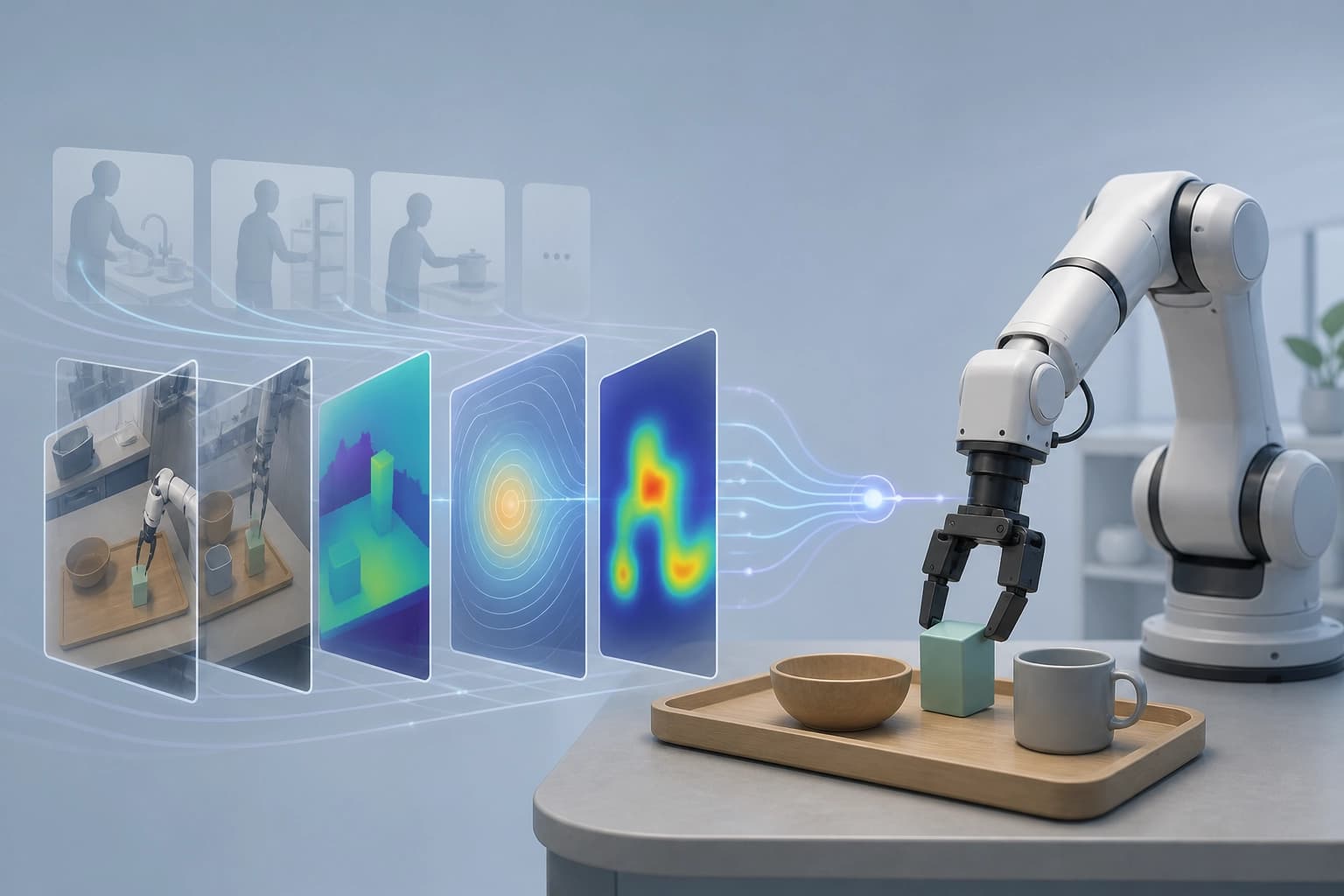
AffordanceWAM: Affordances as an intermediary between scene prediction and manipulator control
The work describes a generative model that jointly predicts future RGB observations, scalar fields, affordance heatmaps, and continuous robot commands, using human videos to broaden interaction diversity without action annotations or retargeting. On RoboCasa, CALVIN ABC→D, and real-world tasks, the approach delivers consistent gains over RGB-only and robot-data-only baselines.
9 November 2026
Presentation Editing as Controlled Operations: The EditPPT Framework and DeckEdit-Bench Benchmark
The authors break down slide editing into specific objects, permitted actions, and checks to ensure unrelated content remains untouched, rather than relying on free-form code generation. To measure quality, they created DeckEdit-Bench (183 tasks across 28 human-made presentations), and the multi-agent EditPPT framework achieves a 66.7–74.9% task success rate across five base models while preserving over 97% of the content.
8 November 2026