
Nested Data and the Old Problem of Causal Inference
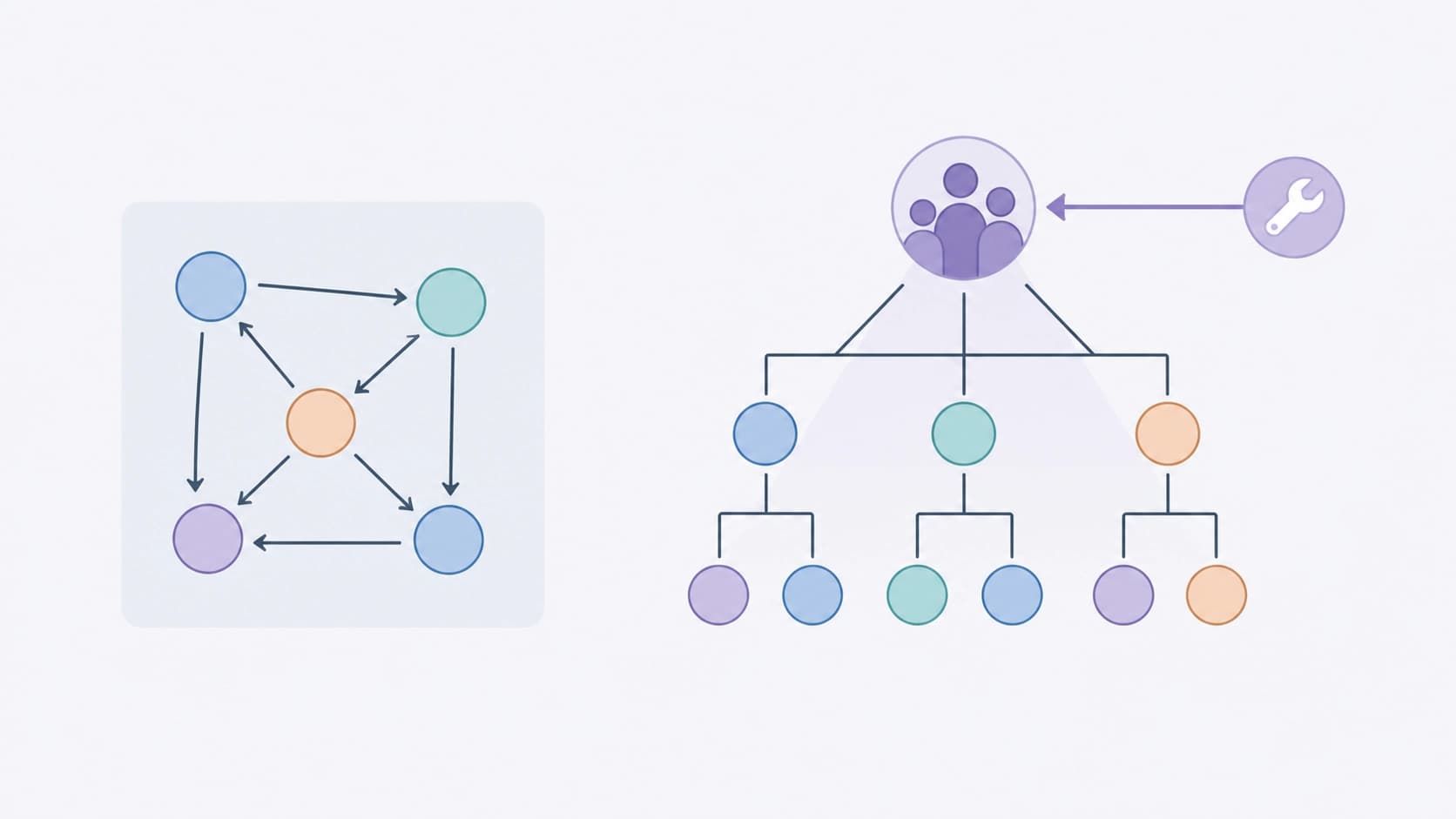
Classical causal inference methods work well when observations are independent of each other. But once data acquires a hierarchy — students within classes, patients within clinics, employees within departments — the naive approach starts to deceive. A shared group creates a correlation between objects that the model mistakenly takes for signal, and interventions occurring at the upper level (for example, changing conditions in an entire class) have nowhere to be "connected."
This is exactly the subject of a new arXiv preprint 2608.24500 in the stat.ML section — "Scalable and Versatile Identification for Hierarchical Structural Causal Models: A New Look at Project STAR." The work was published on August 25, 2026, prepared by a group of nine authors — Janis Aiad, Aghiles Drali, Aymen El Ouadrhiri, Anass Ettahiri, Yasser Oufqir, Simon Patry, David Cortes, Marianne Clausel, and Emilie Devijver. PDF, HTML version, and TeX sources are available; the subject area is machine learning and artificial intelligence.
The material is interesting not so much for yet another model as for its attempt to assemble a complete, reproducible pipeline: from the formal specification of the graph to a concrete number that can be defended in a paper or a report to a client.
What the Authors Propose
This concerns a pipeline for hierarchical structural causal models (HSCM). It is open and designed to be scalable: the same logic should hold up for both a small educational example and data with a large number of groups.
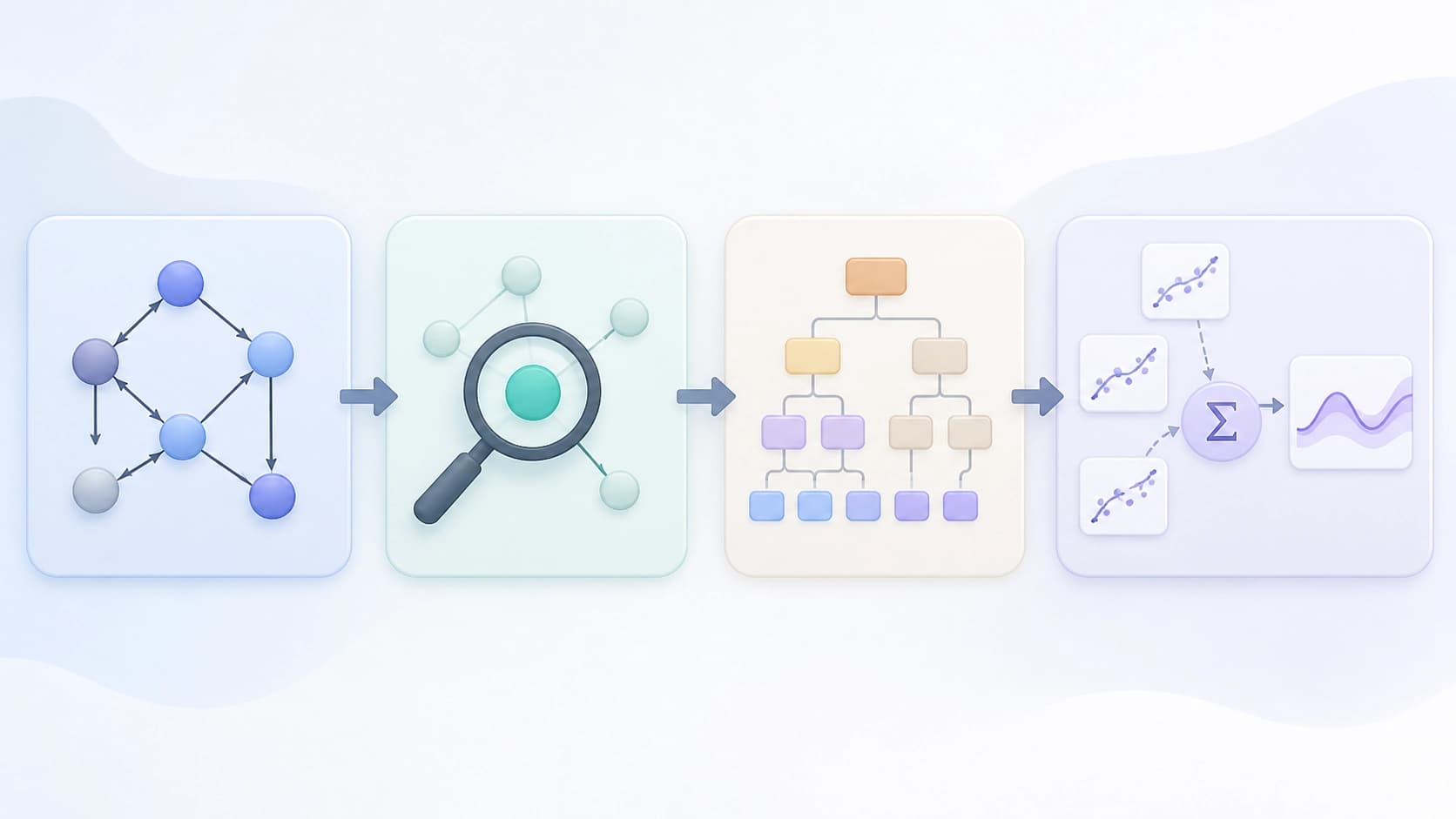
The construction is assembled from four layers:
- graph transformations — preparing the structure that describes dependencies between levels;
- symbolic identification via do-calculus in the pyAgrum library — the machine itself determines which effects are at all derivable from the available data and produces the corresponding expression;
- translating that expression into closed-form HSCM formulas — the symbolic result is turned into something computable within the hierarchical model;
- numerical estimation based on already fitted local probabilistic models.
The logic here is fundamentally two-stage. First it is determined whether the effect is identifiable in principle — this is a question of mathematics, not data. And only then does statistics come in: estimation, error, robustness.
Abstract Syntax Tree as the Key to Scale
The main technical finding of the work is an adapted abstract syntax tree (AST). The identified formula from pyAgrum is not computed "head-on": it is decomposed into a tree, and the leaves of this tree become independent subtasks of three types — density computation, expectation computation, and marginalization.
Why does this matter? The resulting subtasks can be computed in parallel and intermediate results can be cached. Instead of one unwieldy expression where an error at an early step spoils everything downstream, there is a set of independent pieces, each of which can be verified separately. In essence, the authors turn a problem of computational power into a problem of organizing computations.

Validation on Project STAR
As a substantive example, the STAR (Student-Teacher Achievement Ratio) experiment conducted in 1985 in the state of Tennessee, USA, is used. This is a benchmark hierarchical dataset: it was created to assess the impact of class size on academic performance, and its observations are nested within classes. Such a structure is an ideal testing ground for HSCM, because the intervention here naturally occurs at the class level, not at the level of an individual child.
Before moving to real data, the authors test the pipeline on canonical HSCM motifs and benchmark scenarios where the true answer is known in advance. This is a sensible order: first make sure the method finds the right answer where it is known, and only then apply it to data where there is nothing to check against. The final application is the results on mathematics in kindergarten within STAR.
What the Results Showed
The conclusions turned out to be sobering, and that is where their value lies.
First, flat baseline models that ignore the hierarchy do recover associations — but they are incapable of encoding an intervention at the class level. The correlation "smaller class — higher scores" and the causal effect of reducing class size are different things, and the former does not replace the latter.
Second, symbolic identification alone is not enough. Even if the formula is correctly derived, a working numerical layer is needed for practical hierarchical inference.
Hence the third thesis: scalable estimation and numerical stability checks are not an add-on to the method but its central part. A beautiful expression that cannot be computed or that falls apart at the slightest change in the data carries no scientific value. That is why the pipeline devotes so much attention to decomposing computations and controlling stability.
Why This Is Needed Beyond STAR
Hierarchical data occurs far more often than it seems. Education, medicine, A/B tests with clustering, regional social surveys, industrial measurements by batch — nesting is everywhere, and everywhere there is a temptation to ignore it for the sake of simplicity.
The value of the work is that it offers not a separate trick but a reproducible procedure. Open code, automatic identification via pyAgrum, a formal transition to computable formulas, independent subtasks — all of this together lowers the barrier to entry: a researcher does not need to derive formulas themselves for each new graph structure.
Limitations and Common Sense
It is worth remembering that this is a preprint, not a peer-reviewed publication: arXiv:2608.24500 in version v1, DOI 10.48550/arXiv.2608.24500. Results on canonical motifs and a single dataset are a good check, but not universal proof.
Moreover, any causal inference relies on assumptions about the graph structure. The pipeline automates computations and makes them more transparent, but it does not eliminate the question "did we even describe the world correctly." If the graph is wrong, a carefully computed effect will still remain a carefully computed delusion.
That is precisely why the main practical takeaway of the paper sounds down-to-earth: identification without estimation is useless, estimation without robustness is risky, and nested data requires a separate level in the model, otherwise there is simply nothing to relate group-level interventions to.