

Why a one-size-fits-all policy doesn't exist
Generative AI arrives in very different organizations, and each one has its own risk profile. A bank fears customer data leaks and incorrect financial advice, a clinic fears inaccurate medical recommendations, a school fears inappropriate content in conversations with teenagers. Add to that the regulatory requirements of the industry, the company's internal values, and who exactly is on the other side of the chat: a rank-and-file employee, a contractor, or an external user.
This leads to an inconvenient conclusion: a single security template for GenAI doesn't work. Settings have to be tailored to a specific scenario rather than copied from a playbook.
The second problem is a tooling one. Conventional policy specification mechanisms grew up around access management: they answer the question "who is allowed access to which resources." But in applications with generative models, a different question matters far more — what can actually end up in a response. Content-bound restrictions are poorly described in terms of roles and permissions, and this is the seam where manual work usually begins, work that can't be scaled.

What Granite.Trust offers
The toolkit is described in the arXiv preprint 2608.23870 in the cs.AI section. The material was submitted on August 24, 2026, and the authors include Nathalie Baracaldo, Nicolas Mello, Kush R. Varshney, Heiko Ludwig, Kate Soule, and David Cox — six people in total. The source files come to about 2.7 MB, which for a paper with a toolkit suggests a fairly tangible codebase rather than just a concept.
The authors claim two main things.
Actionable Policy: policy as an editable document
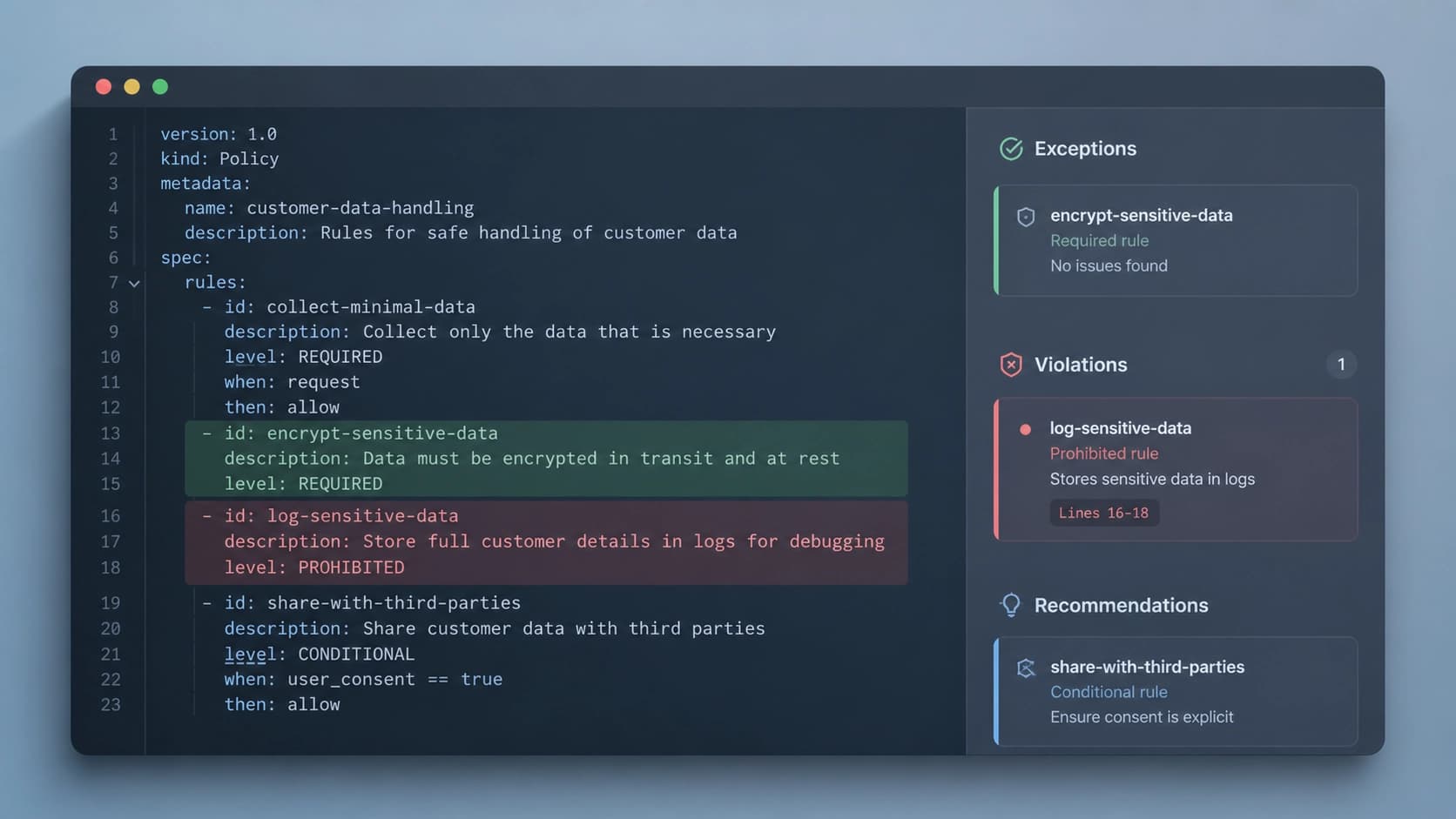
The first is the Actionable Policy schema, a YAML-based format. It's not an abstract "security guideline" but a machine-readable description of which model responses are acceptable and which are not. The key detail is exception-based management: the rules have explicit caveats, and it's these that make it possible to track cases of policy violations. Put simply, the team gets not just a list of prohibitions but also a mechanism for understanding exactly where the model overstepped and why.
Synthetic data for policy testing
The second is a synthetic data generation pipeline. It creates training examples aligned with the policy described above, and they serve two purposes: model alignment and model testing. There's also a set of utilities that help design the schema itself and then monitor compliance with the rules.
The logic here is sound: if a policy exists separately from the data the model is trained on, it remains a declaration. But when "this is allowed" and "this is not allowed" examples grow automatically out of the policy, the requirements become something verifiable.
Define once — apply across the entire lifecycle
The main practical value of this combination is that the policy stops being a one-off document. An organization formulates it once and then carries it through the entire application lifecycle: from the model alignment stage to monitoring an already-running product.
This noticeably changes teams' day-to-day routine. Usually security requirements live in one place, tests in a second, and production logs in a third, and they have to be synchronized manually. Here, a single source of rules is assumed, on which training, pre-release checks, and live traffic monitoring all depend.
It's worth noting: the toolkit doesn't decide for the organization which risks are critical for it. It provides a language for describing policy and the infrastructure for enforcing it — but the content of the rules themselves remains the job of people who understand their product, industry, and audience.

Open source and where to look next
The schema, policy examples, and the tools themselves are publicly available. The authors explicitly invite ideas, improvements, and feedback — a bet typical of such projects that the community will find scenarios faster than the research group could reach them.
The full text is available in several formats: PDF, an experimental HTML version, and TeX sources. The paper has a DOI — 10.48550/arXiv.2608.23870 — so it can be cited in corporate documents without caveats about a preprint lacking an identifier.
If you're currently trying to translate internal GenAI requirements from the "board presentation" format into a format that actually does something in the pipeline, this is exactly the class of solution worth looking at firsthand. Start with the policy examples: they give a good sense of how concretely the authors envision real-world constraints, not just an academic framing of the problem.