
Problem: One reward for the entire trajectory
LLM-based multi-turn agents learn by trial and error: they execute a chain of actions, receive a final score, and adjust their behavior based on it. The trouble is that this score usually arrives for the entire trajectory as a whole. The agent learns that the task was solved or failed, but not at which specific step things went wrong.
Then comes the arithmetic that sits poorly with common sense. The same advantage gets smeared across all consecutive steps — across a lucky tool choice, a random typo in a query, and a routine "confirm action." As a result, the model simultaneously rewards random missteps and normal working steps if the ending turned out successful. Credit for success goes to everyone equally, and blame for failure — also to everyone.
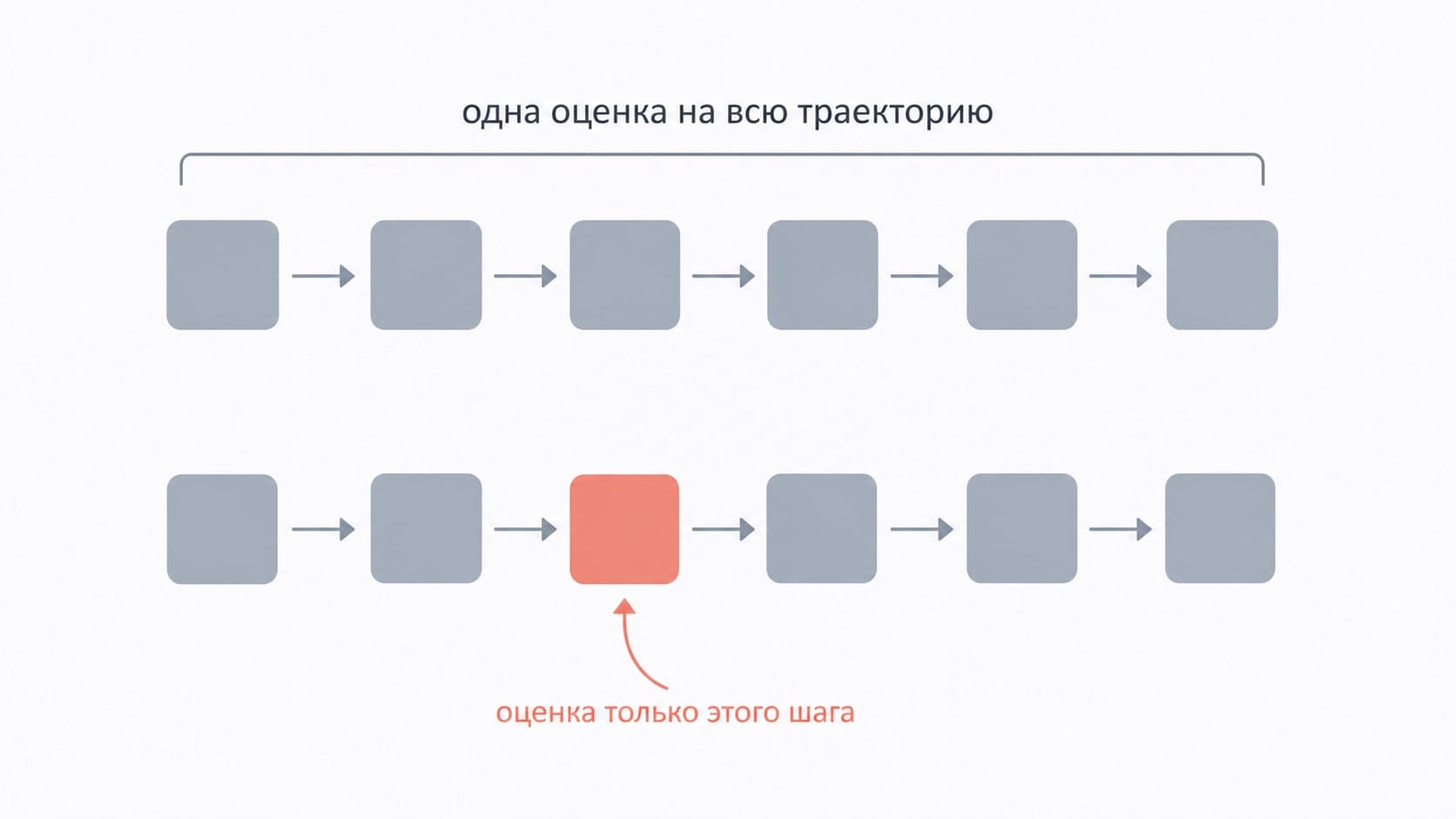
The classic remedy is self-distillation with privileged information. The teacher knows more than the student: it has access to the environment, to intermediate signals, to the correct answer. It can provide hints at every step, not just at the end. Sounds good, but this approach has a hidden carelessness: the same hint is issued to all steps indiscriminately.
The asymmetry of steps: routine and errors need different things
The key idea of the AHEAD paper is that steps in a trajectory are not equivalent, and supervision for them should also differ.
- Routine steps — opening a page, confirming a transition, calling the right tool — barely need hints. The model handles them anyway. Extra guidance here only adds noise to training and wastes budget.
- Critical steps with an error — where the agent took a wrong turn and lost its chance at success — require not just a statement of "this is bad," but a concrete direction: what should have been done instead.
- Feedback from the environment grounds what's happening well: it says what actually happened. But it cannot explain how one should have acted. The signal "the door didn't open" doesn't hint at where the key was.
It turns out that the two sources of supervision complement each other but don't replace each other. Environment feedback provides a dense and honest signal at every step; model-generated corrective hints provide what is fundamentally absent from environment feedback — intent and an alternative. Blending them blindly across the entire trajectory means losing the strengths of both.
How AHEAD is structured
The authors — Xiaolong Jin, Dingmin Wang, Vijay Lingam, and Varun Kumar — propose a framework that is aware of the step type and selects a supervision source to match it. The paper was posted on arXiv in late August 2026, under the cs.AI category; it spans 22 pages, 15 figures, and 7 tables, so there's plenty of material for detail.
A teacher that sees the environment
The teacher model receives environment feedback at all steps — this is a grounded and dense signal, equally available on both successful and failed segments. Such a teacher doesn't fantasize: it relies on what actually happened in the environment.

Corrective hints — selectively
On top of this, the teacher receives LLM-generated hints, but not at all steps — specifically at erroneous ones. The logic is simple: where the agent made a mistake, a fact from the environment alone is insufficient; an explanation of where it should have headed is needed. Where everything goes smoothly, no additional guidance is added at all.
This is the "selective hint" from the title: not smeared across the trajectory, but focused on problem points. Step-aware matching of supervision sources instead of a single signal for the entire chain of actions.
Minimal changes to GRPO
Worth noting separately is the method's engineering modesty. GRPO — a popular reinforcement learning algorithm — is not rewritten from scratch: changes are made selectively, on top of the standard scheme. For practitioners this matters because it doesn't require rebuilding the entire agent training pipeline.
What the experiments showed
Evaluation was conducted on three types of tasks: ALFWorld — multi-step scenarios in a text environment, WebShop — interaction with an online store, and search-based question answering. Three model scales were tested, so the conclusions aren't tied to a single size.
Results compared to standard GRPO:
- +13.3 points success rate on ALFWorld with a 7B model;
- +11.0 points on WebShop at the same scale.
Beyond the absolute numbers, there are two equally interesting effects. First, a given success level is reached in fewer training steps — meaning the method is not only better in the limit, but also reaches working condition faster. Second, the agent solves tasks within narrower interaction budgets than approaches based only on final reward and previous self-distillation methods.

The second point, in my view, is underappreciated. Saving interaction steps is not just a beauty metric. In real scenarios, every tool call costs money, time, and risk. An agent that reaches its goal in five actions instead of ten is more useful not by 13 percent, but many times over — especially where the cost of error is high.
Why this works and what remains off-screen
The method's explanation is almost pedagogical. A good teacher doesn't comment on every move the student makes — they stay silent while the student does reasonable things and intervene exactly where the student has strayed from the path. If you comment on everything, the student stops thinking for themselves and starts waiting for hints. If you comment on nothing, they'll repeat the same mistakes.
AHEAD formalizes this intuition in reinforcement learning terms: different step type — different signal source. Dense grounded feedback — as background, corrective direction — as emphasis. No magic, just a rejection of the idea that all steps are equal.
What remains open questions. Generating corrective hints itself requires a model, which means it adds computational cost and depends on its quality — if the teacher explains incorrectly, the student will receive confident but wrong direction. It also remains open how well the method transfers to tasks where the cost of an intermediate step isn't as obvious as in ALFWorld or WebShop, and where the "erroneousness" of a step can't always be determined immediately, but only by delayed consequences.
Nevertheless, the direction looks healthy. The main line of development in agent methods in recent years is not to enlarge the model, but to manage the training signal more intelligently. AHEAD is squarely in this line: selective intervention instead of total control.