
Confidence Falls Short: How Search Agents Lose Accuracy on Multi-Step Tasks and What RGV Offers
A team of researchers has shown that the usual voting by token log-probabilities fails when an LLM operates as an agent with document retrieval: fragments copied from sources receive inflated scores and equalize the weights of rollouts. Instead, the authors propose evaluating runs by the lexical overlap of the final answer with the retrieved documents — the RGV method yields up to +5.4% accuracy and is notably helpful on rare questions where the correct option appears in only one or two out of eight runs.

Why confidence voting worked in the first place
The idea, familiar to anyone who has built pipelines around large language models, is simple: run the same task several times in parallel, then pick the answer by majority. But not a "flat" majority — a weighted one, where each run gets a weight based on the model's internal signals, most often token log-probabilities. The variant in which the model was more confident speaks louder than the rest.
For single-step reasoning, this scheme performs reasonably well: if the model is wrong, it usually wavers, while a correct answer comes with high confidence. The gap in log-probabilities becomes something like a built-in error detector that requires neither additional calls, nor labels, nor a separate judge model.
It breaks exactly where it began: on multi-step search
The problem is that modern agents are built differently. They don't just reason in a single pass: they formulate queries, retrieve external documents, embed them into context, refine the query, and so on several times until they have gathered enough material for a final answer. Each step adds chunks of someone else's text to the model's window.
The authors of "Beyond Confidence: Test-Time Scaling for Multi-Turn Search Agents via Retrieval Grounding" (arXiv:2608.24024, accepted to the Findings of the EMNLP 2026 conference) — Hyunho Kook, Junhyuk So, Tianyu Fu, Haizhong Zheng, and Beidi Chen — tested what happens to confidence voting in this scenario. The result is unpleasant: a technique fine-tuned on single-step tasks transfers poorly to search agents.
The failure mechanism: copy inflation
The researchers named the cause copy inflation. When retrieved documents enter the context, the tokens that the model carries over from those documents into its answer receive systematically inflated log-probabilities. Copying is an easy operation: continuing text that lies right in front of you is statistically simpler than generating something of your own. The model is "confident" in such a token not because it is correct, but because it is literally copied.
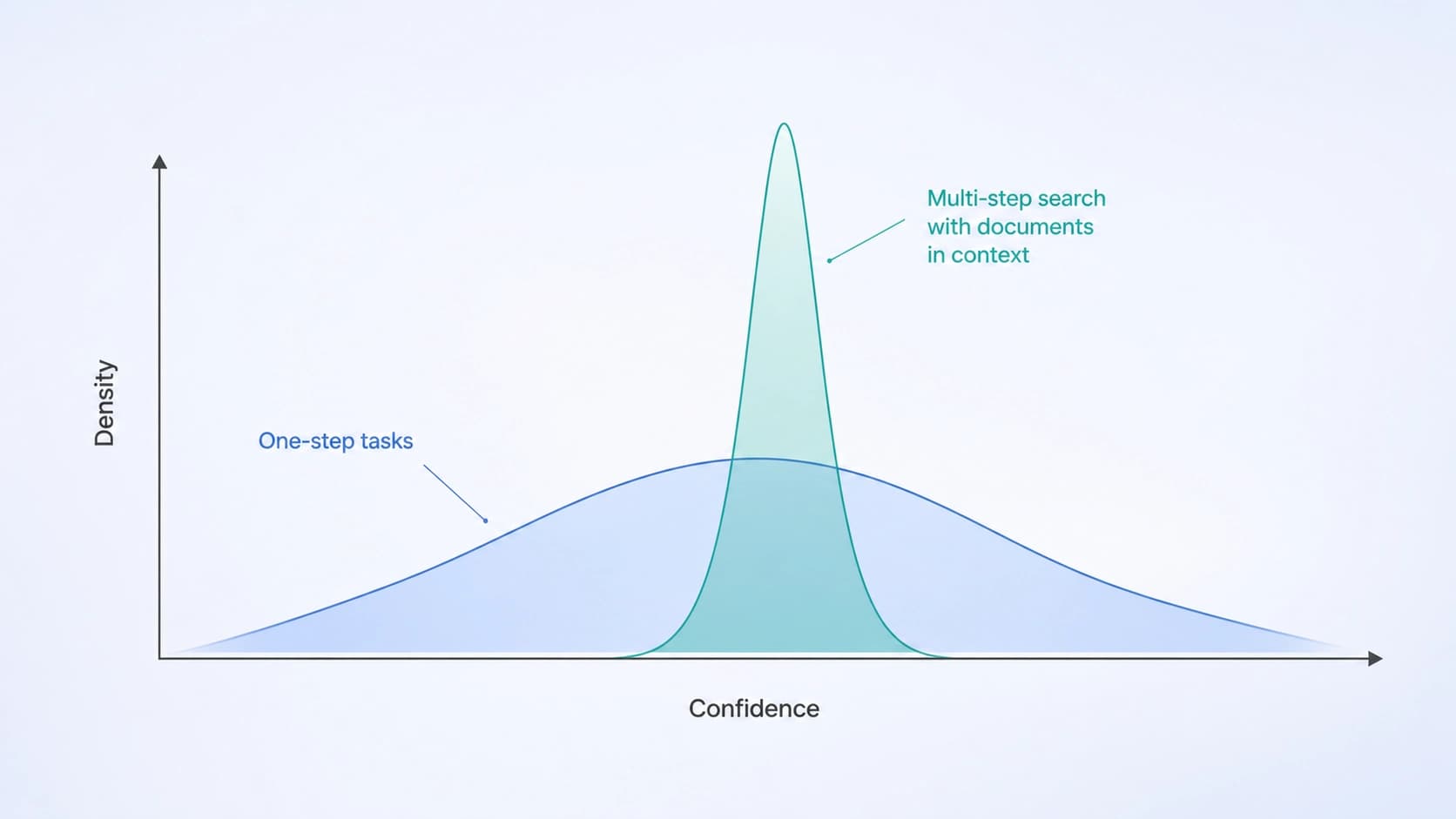
The effect then compounds. Since all runs rely on the retrieved documents in one way or another, all of them get their share of inflated probabilities. Confidence scores within a single question level out and compress into a narrow range — and weighted voting loses the very thing it existed for: the ability to tell a strong run from a weak one. The weights become nearly identical, and aggregation degenerates into plain majority voting, only with extra computational overhead.
What they propose: Retrieval-Grounded Voting
As a replacement, the authors propose the Retrieval-Grounded Voting (RGV) method. It also scores each run individually, but it looks not inside the model, but outside — at the connection between the final answer and the documents that this very run retrieved.
The metric is deliberately simple: lexical overlap between the answer text and the text of the retrieved sources. The more the answer leans on the retrieved material, the higher its score. A run that made something up on its own or drifted off course shares fewer words with its documents and gets a lower weight.
Why the signal works
The logic here is this: if the agent really did find relevant pages and built its conclusion on them, the wording of the answer will inevitably overlap with the wording of the sources — terms, names, turns of phrase. This is not a perfect indicator of correctness, but it holds up where log-probabilities are already corrupted.
RGV's key advantage is that it computes the signal outside the contaminated context. The score is built on the "answer — documents" pair, not on the model's state at generation time, so copy inflation does not affect it. At the same time, the method needs no access to token log-probabilities and no additional LLM calls: no judge model, no second pass, just counting overlaps — an operation that can be done with ordinary code almost for free.

Results
The experiments were run on four benchmarks for search agents and five different language models. The picture repeats: RGV consistently outperforms confidence voting.
The most telling measurement is on "minority-correct" questions, where the correct answer appears in only one or two runs out of eight. This is precisely where confidence weighting fails hardest: inflated probabilities pull the vote toward the popular but incorrect version. The gain from RGV on such questions reaches +35%, and up to +5.4% in overall accuracy.
The numbers should be read with a caveat: this is not "plus five percent to the quality of any search system," but an improvement to the aggregation procedure with the model and the set of runs held fixed. That is, the method changes nothing in the agent itself — it merely selects more carefully from what the agent has already generated.
What this means in practice
If you are building a multi-step agent and already use self-consistency or any probability-based voting, RGV has three practical advantages:
- It costs nothing in inference. No additional model calls are needed; the weight is computed after the fact from the already-finished answers and documents.
- It works with closed models. Token log-probabilities are far from always available, and sometimes are hidden behind an API altogether. Text comparison is free of this limitation.
- It debugs predictably. The metric is transparent: you can look at which words produced a match and understand why a run got the weight it did.
Where the method may stumble
The weak spot is obvious from the construction itself: lexical overlap rewards matching words, not matching meaning. A paraphrased but correct answer will get an unfairly low weight; a numerical result or a short summary will also barely overlap with the source text, even if it fully corresponds to it. The reverse situation is even more unpleasant: a run that simply quotes the retrieved material at length will score high without adding anything to the solution.
Hence the sensible strategy — to treat RGV not as a replacement for all signals, but as an additional vote that is especially useful precisely where the model's confidence stops meaning anything. It also makes sense to combine it with other types of checks: comparing meanings, scoring by a separate model, fact verification. Judging by how the task is framed, the authors were moving in exactly this direction — from "trusting the model's inner feeling" to "evaluating what it actually did."

Takeaway
The copy inflation story is a good illustration of a general problem with agentic pipelines: techniques fine-tuned in isolation on a single model with a single reasoning step quietly fall apart once search, context, and other people's texts enter the loop. The model's confidence stops being a measure of correctness and turns into a measure of how easy something is to copy.
RGV offers a workaround that looks almost boring — counting the overlap of words between the answer and the sources. But it is precisely this boringness that makes the method appealing: it is cheap, transparent, requires no model internals, and delivers a noticeable gain where the correct answer drowns in noise. For teams building search agents from off-the-shelf APIs, this is a rare case of a useful improvement that requires neither retraining nor new inference budgets.
Frequently asked questions
Related materials
All materials
Canonical Polynomial Invariants for Diagnosing RL Simulator Failures: Where Are They Actually Useful?
The study examines whether incorporating physical laws into learnable dynamics models is justified: invariants extracted from trajectories and reduced to canonical form using Gröbner bases yield modest forecasting gains, but prove powerful for diagnostics, enabling the localization of violated constraints and identification of specific erroneous parameters.
10 November 2026
AURA-Eval: How to Check Whether an LLM Agent Recognized a Risk and Changed Its Next Step
The framework evaluates LLM agents’ behavior not by their final verdict, but by how they respond to risk at key decision points: tool-call trajectories are interrupted, after which the model must continue reasoning and acting, while a panel of LLM judges assesses risk detection, the nature of the step, and its safety. Across 1,249 tasks drawn from 157 R-Judge trajectories, unsafe actions become more frequent among 20 models when no safe path is available, and removing oversight before execution turns 52.3% of initially safe cases into unsafe ones.
10 November 2026
Chern–Simons Reservoir Memory: Autonomous Connectivity Dynamics and Density Transport
The article explores how a reservoir preserves the history of input signals both in its density distribution and in its geometric degrees of freedom. A comparison of four mechanisms shows that current creates a separate connected component that alters the subsequent density response, while accounting for all measured features yields a small improvement in decoding pulse order.
10 November 2026