
DiSCO: text-to-image protection from harmful content without access to the model's internals
DiSCO works as an external module: it selects safe prompts and reduces the success rate of red-team attacks by 37.7% for unprotected models and by 25.13% for already protected systems. At the same time, semantic accuracy is preserved, and image coherence even improves.

The Hidden Threat in Innocent Prompts
Modern neural networks that generate images from text descriptions can create impressive pictures, but sometimes they "produce" unwanted content. Typically, the protection of such systems is built on intervening in their internal structure: retraining the text encoder, adjusting weights, or special processing at the inference stage. This approach is effective as long as you have access to the model itself, but it is completely unsuitable for closed proprietary services that operate on the "black box" principle.

As an alternative, large language models are being used to automatically rewrite prompts into a safe form. But there is a weak spot here too: the prompt turns out to be linguistically completely harmless, yet due to how the model distributed data during training, generation still veers into a harmful area. The authors call this mode "benign adversarial" — when the text is formally safe, but the result is not.
What DiSCO Offers
The DiSCO method (Distribution-guided contrastive prompt optimization), developed by a group of researchers, proposes a completely different path: protecting generation at the prompt level without looking inside the model. This is a strictly black-box solution that works as an external plug-and-play module. It requires no fine-tuning, retraining, or any information about the parameters and architecture of the target system.
The idea is to automatically modify the suffix — that is, the tail part of the prompt — in such a way as to steer generation into a safe direction. The search for a suitable suffix is performed using beam search, and the quality of candidates is evaluated with contrastive scoring. To do this, the module pre-generates two pools of images using the target model itself: safe and unsafe. By comparing generation results with the reference pools, DiSCO understands which way to "push" the suffix.
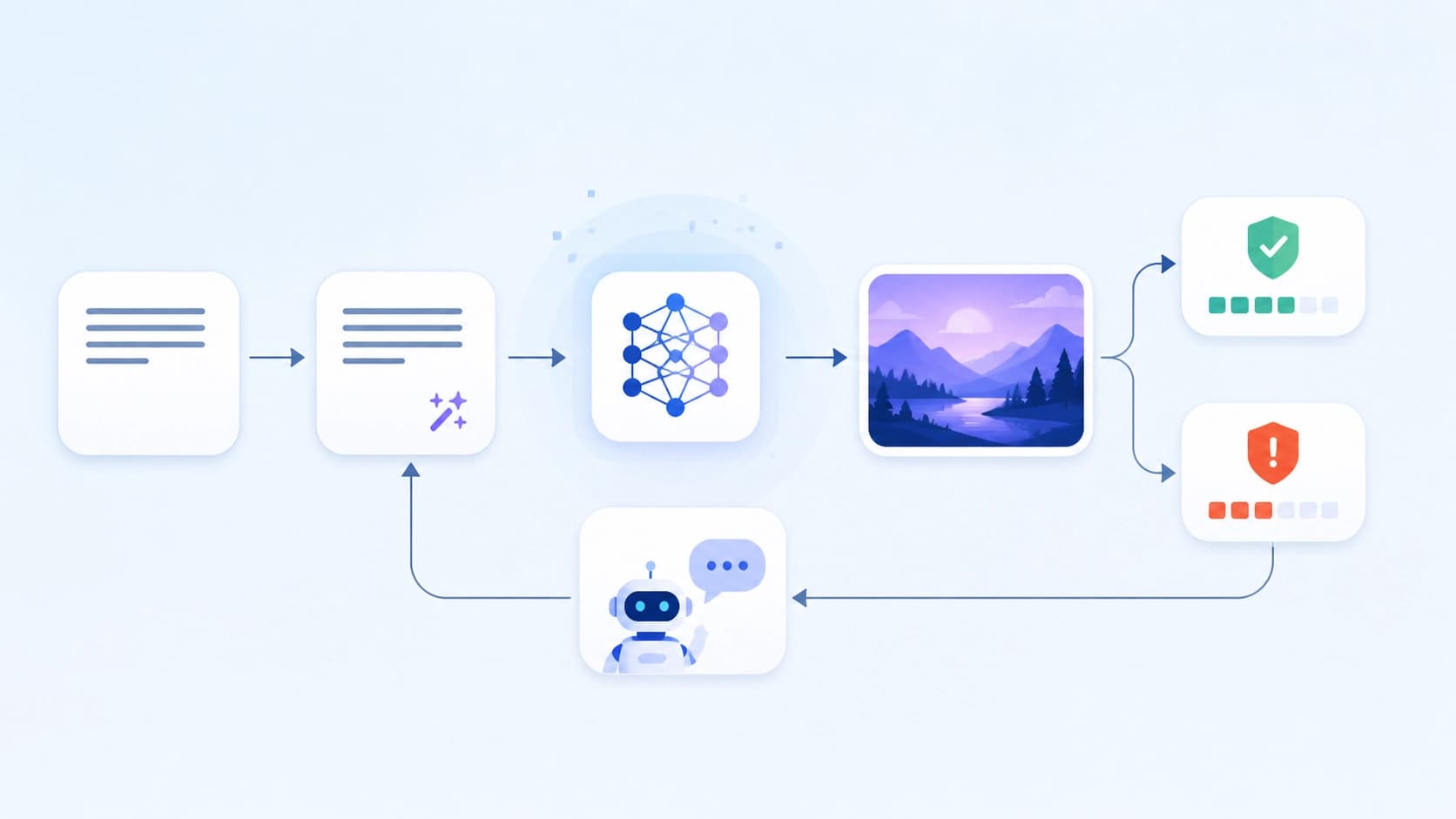
The process is iterative: after each step, the module evaluates the resulting image and, if it still contains unwanted elements, adjusts the suffix again. This continues until the generation matches the safe pool. At no stage does this require revealing the model's internals — all interaction happens only through sending prompts and receiving images.
How Effective Is It
The researchers tested DiSCO on the I2P (Inappropriate Image Prompts) benchmark in scenarios of multiple red-teaming attacks. The results show that the success rate of attacks drops by 37.7% for models without any protection and by 25.13% for models that were already protected by other methods. This means DiSCO not only closes gaps where no protection exists but also strengthens existing barriers.
Notably, semantic accuracy does not suffer: generated images remain relevant to the original prompt, and coherence even improves. In other words, the module does not degrade generation quality but merely steers it away from potentially dangerous interpretations.
Since DiSCO is architecture-agnostic, it can be connected to any text-to-image system without changing the model itself. This is especially valuable for closed commercial APIs where access is limited, and for users who want to improve the safety of third-party services — for example, before using them in public applications.
Despite the impressive results, it is worth remembering that the method is not a "silver bullet" but one layer of protection. Completely eliminating risks is unlikely, but shifting the approach from "internal" security to "external" and adaptive security is an important step toward making generative systems more resilient to malicious requests.
Frequently asked questions
Related materials
All materials
AURA-Eval: How to Check Whether an LLM Agent Recognized a Risk and Changed Its Next Step
The framework evaluates LLM agents’ behavior not by their final verdict, but by how they respond to risk at key decision points: tool-call trajectories are interrupted, after which the model must continue reasoning and acting, while a panel of LLM judges assesses risk detection, the nature of the step, and its safety. Across 1,249 tasks drawn from 157 R-Judge trajectories, unsafe actions become more frequent among 20 models when no safe path is available, and removing oversight before execution turns 52.3% of initially safe cases into unsafe ones.
10 November 2026
Chern–Simons Reservoir Memory: Autonomous Connectivity Dynamics and Density Transport
The article explores how a reservoir preserves the history of input signals both in its density distribution and in its geometric degrees of freedom. A comparison of four mechanisms shows that current creates a separate connected component that alters the subsequent density response, while accounting for all measured features yields a small improvement in decoding pulse order.
10 November 2026
STAR: Adaptive Normalization of Temporal Context and Service Graphs for End-to-End Incident Management
The STAR framework trains representations from metrics, logs, and traces, using learnable normalization that accounts for multiscale temporal dynamics and dependency structures between services. On two real-world datasets, this pipeline delivers consistent improvements in anomaly detection, failure ranking, and root cause analysis over state-of-the-art baselines.
10 November 2026