

Cognitive limitations of AI: what prevents models from truly thinking
Generative and agentic systems can already write code, conduct dialogue, and solve narrow tasks. But when you try to use them in long-term projects or unusual situations, it quickly becomes apparent: behind the surface fluency often lies a lack of sustained reasoning, memory, and self-control. A recent survey posted on arXiv (2608.02553) attempted to systematize these problems and outline a path from “smart executors” to systems with genuine cognitive capabilities.
The authors of the work — Taye Akinrele, Sindhuja Penchala, Noorbakhsh Amiri Golilarz, Sudip Mittal, and Shahram Rahimi — collected and classified research on the gaps between current AI capabilities and what is required for cognitive behavior. Rather than simply listing shortcomings, they proposed a taxonomy covering five key dimensions. This is not just a theoretical framework: it lets developers see which capabilities remain fragmented and where efforts should be concentrated.
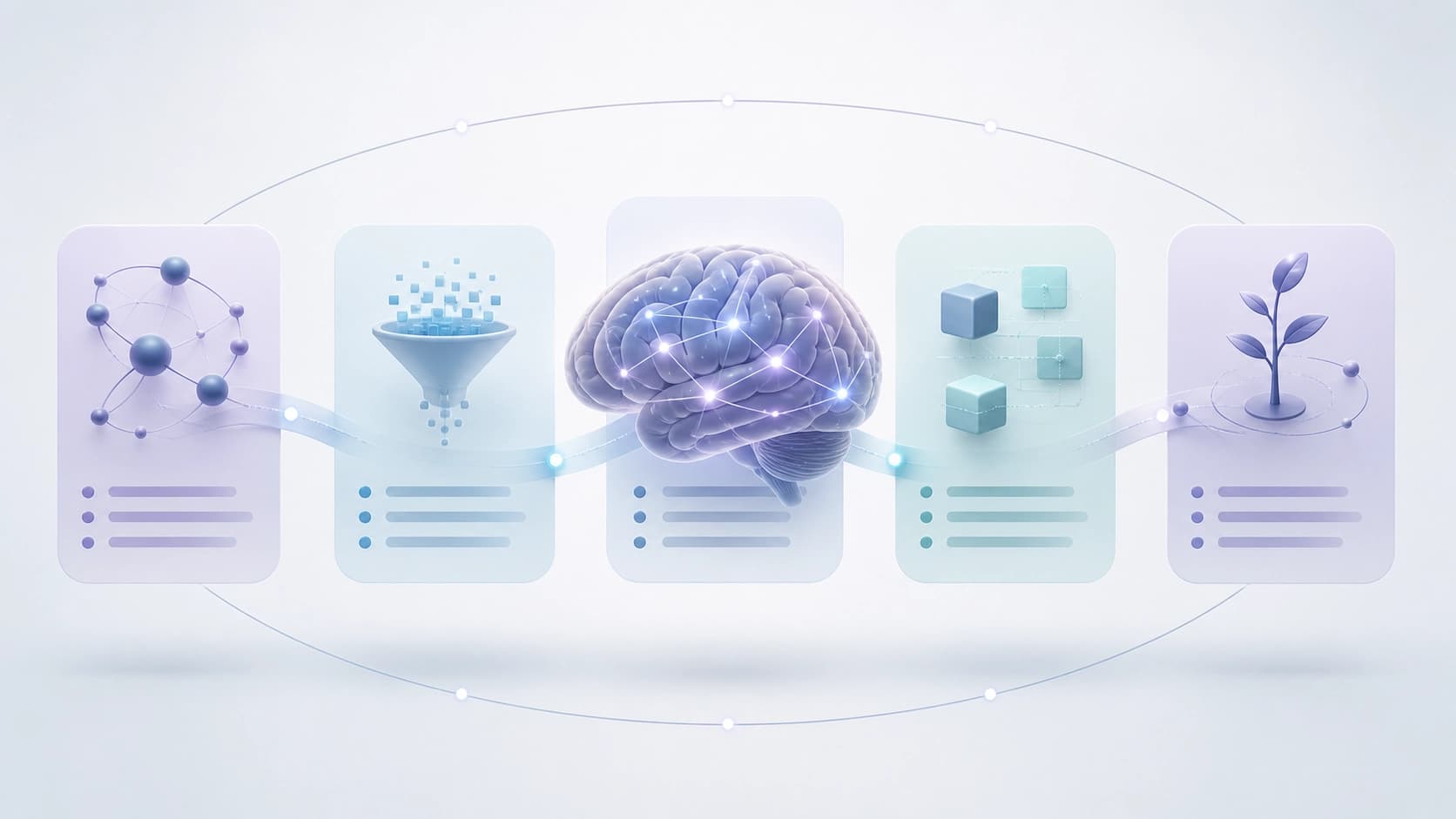
Five dimensions of the cognitive gap
The first dimension is persistent state modeling. It concerns a system's ability to maintain and update an internal model of the world over extended periods. For most current models, context is limited to an attention window, so they “forget” earlier interactions or fail to correctly connect current events with past ones. This is critical for tasks that require planning and sequential decisions.
The second dimension is goal-directed autonomy. A model may be able to formulate a goal, but holding onto it throughout a complex scenario is a different matter. An agent often deviates from the intended plan at the first unexpected outcome because it cannot adjust its strategy without external intervention.

The third dimension is self-monitoring and control. This includes the ability to evaluate one's own actions, notice mistakes, doubt answers, and calibrate confidence. Modern generative models often display misplaced overconfidence, and internal verification mechanisms are either absent or operate only as an additional post-processing step.
The fourth is environment interaction. To operate in the real world, an agent must not only receive feedback but also actively experiment, explore the state space, and learn from failures. At present, most systems are trained on static datasets and cannot genuinely “probe” the environment in real time.
The fifth dimension is learning and adaptation. This is the ability to change behavior based on new experience, not just to further train on labeled examples. Lifelong learning, transfer of skills across tasks, and robustness to changing conditions remain open problems.
The ACIA architecture and cognition-centric evaluation
To bring all five directions together, the authors propose a conceptual architecture, the Adaptive Cognitive Intelligence Architecture (ACIA). It is not a ready-made product but rather a framework: it describes how persistent state, goal-setting, self-monitoring, environment interaction, and learning modules can be linked into a single system. In the authors' view, this architecture should serve as a foundation for future experiments and engineering work.
Special attention in the survey is given to cognition-centric evaluation. Traditional benchmarks test accuracy on individual tasks but do not measure whether a system can sustain reasoning over long distances, adapt to novelty, or control its own actions. The new approach holds that tests should be built around these cognitive functions; otherwise, progress in the field will be evaluated incorrectly.
What's next?
The taxonomy in the survey is an attempt to bring order to scattered research. Instead of collecting isolated tricks such as improved memory or a new attention mechanism, developers get a common map of problems. This is especially important on the path toward Cognitive AI and, ultimately, Artificial General Intelligence (AGI).
For now, generative and agentic models remain powerful but limited tools. They handle tasks well when no persistent state, internal critique, or long-term goal pursuit is required. But true thinking—with its capacity for self-regulation, learning from experience, and adaptation in unpredictable environments—is still beyond them. Systematizing these limitations is the first step toward turning that promise from a marketing claim into an engineering reality.