
Global practice: what OpenAI data says about everyday ChatGPT use
Fresh OpenAI Signals data reveals how people in different countries integrate ChatGPT into their workflows, showing notable shifts in user habits. We break down the key numbers and insights on adoption levels.
ChatGPT has quickly evolved from a technological novelty into a working tool used by millions of people around the world. The data that OpenAI publishes about user behavior shows that the AI assistant has long ceased to be just a "chatbot." It is a full-fledged helper for solving a wide variety of tasks — from writing code to planning a weekly meal menu.
Numbers and trends: what the statistics show
Based on public reports and anonymized analytics, ChatGPT has indeed become a global phenomenon. What draws attention is not only the total number of active users, but also the geography. The United States and India lead as expected, but there is noticeable steady growth in Southeast Asia, Latin America, and Europe. At the same time, usage patterns differ by region: in some places people turn to it more often for help with studies, while in others — for automating routine office tasks.
The time-of-day dynamics are also telling. Peak requests occur during working hours, but a significant share of activity shifts toward evenings and weekends. This suggests that the service is perceived not only as a work resource, but also as a personal assistant for everyday questions. The number of short "conversations," such as quick questions and translations, is growing, while long multi-hour sessions are more often tied to writing texts or programming.
Another trend is the rise in requests via mobile apps. In many countries, the smartphone has become the primary way to access the neural network: people ask questions on their way to work, during breaks, or while waiting in line. This also shapes a particular style of interacting with the model: queries become shorter, and answers — more pragmatic.

Use cases: from work to everyday life
If we divide all requests into categories, the largest one would be "help with work and studies." However, within this group there are notable differences that illustrate how the approach to using neural networks has changed.
Work tasks
Office workers use ChatGPT to draft emails, resumes, presentations, and plans. Developers use it as a mentor that explains unfamiliar code snippets and suggests how to fix errors. Marketers ask it to come up with slogan options, and analysts — to simplify complex reports into clear takeaways.
A separate layer is translations and text adaptation. People have started looking into dictionaries less often and trusting the neural network more with stylistic editing. Users save a lot of time: what used to take several hours now takes a couple of iterations with clarifying queries. Importantly, the conversational format makes it easy to quickly refine details and get a more accurate result.
Education and self-development
The second most significant use case is learning. Students ask for complex topics to be explained in simple words, for self-test questions to be generated, or for an exam preparation plan. Schoolchildren use the service for "explain it like I'm five" — when the textbook is unclear and there is no one to ask.
Interestingly, requests are often phrased in the format of "check me" or "look at my solution." In other words, the neural network is used as a trainer that does not give the answer but leads to it through questions and hints. This changes the approach to independent study: making a mistake is no longer scary, because you can always ask to find the weak spot in your reasoning.
Entertainment and personal communication
Leisure should not be overlooked either. Here, ChatGPT is a conversational partner you can "chat" with, play a text-based game, come up with a greeting, or get a movie recommendation for the evening. Many turn the dialogue into a creative exercise: writing poems, comedy sketches, or alternative endings to favorite books.
It is telling that some users turn to the service for support. The model's empathetic responses help reframe anxious thoughts, look at a situation from the outside, or simply vent. Of course, this is no substitute for a psychologist, but as a tool for reflection, it is in demand.

What this data says about the future
The main takeaway from public data is not about a technological breakthrough, but about habit. ChatGPT has become an everyday tool, like a calculator or email. Use cases increasingly look less like "playing around with a novelty" and more like "solving a specific task right now."
Analysis of requests shows that people's behavior is beginning to self-organize: they are learning to formulate chains of questions, break large tasks into steps, and rephrase unsuccessful answers. In effect, a mass learning of the skill of working with generative models is taking place, and this skill will be in demand in any profession.
For businesses, this is a signal: develop products that can integrate into everyday processes, rather than just "answer everything." Success will come to services that reduce the friction between a task and the result. OpenAI's data shows: the simpler and more useful the tool, the more actively it is used — regardless of country, time of day, or level of technical expertise.
Frequently asked questions
Related materials
All materials
Checking LLM Hallucinations via SQL-Based Source Representation Without Fine-Tuning
The study examines whether an LLM can apply a basic symbolic skill—building a SQL database from source documents—to ground its outputs in sources without supervision when detecting hallucinations. On RAGTruth and DiaHalu, this neuro-symbolic pipeline proves more accurate than direct prediction and comparable to state-of-the-art methods, without requiring domain-specific fine-tuning.
9 November 2026
MathAdv: What the Final Accuracy of Machine-Generated Proofs Conceals
A diagnostic suite of tasks spanning 13 undergraduate and graduate mathematics topics evaluates machine-proving systems in Lean 4 not only by their final results, but also by their subject-matter mastery, the quality of their informal reasoning, and their robustness to rephrased conditions. A component-by-component analysis shows that translating a problem into formal form remains the main obstacle, and that success depends heavily on the area of mathematics and how the problem is framed.
9 November 2026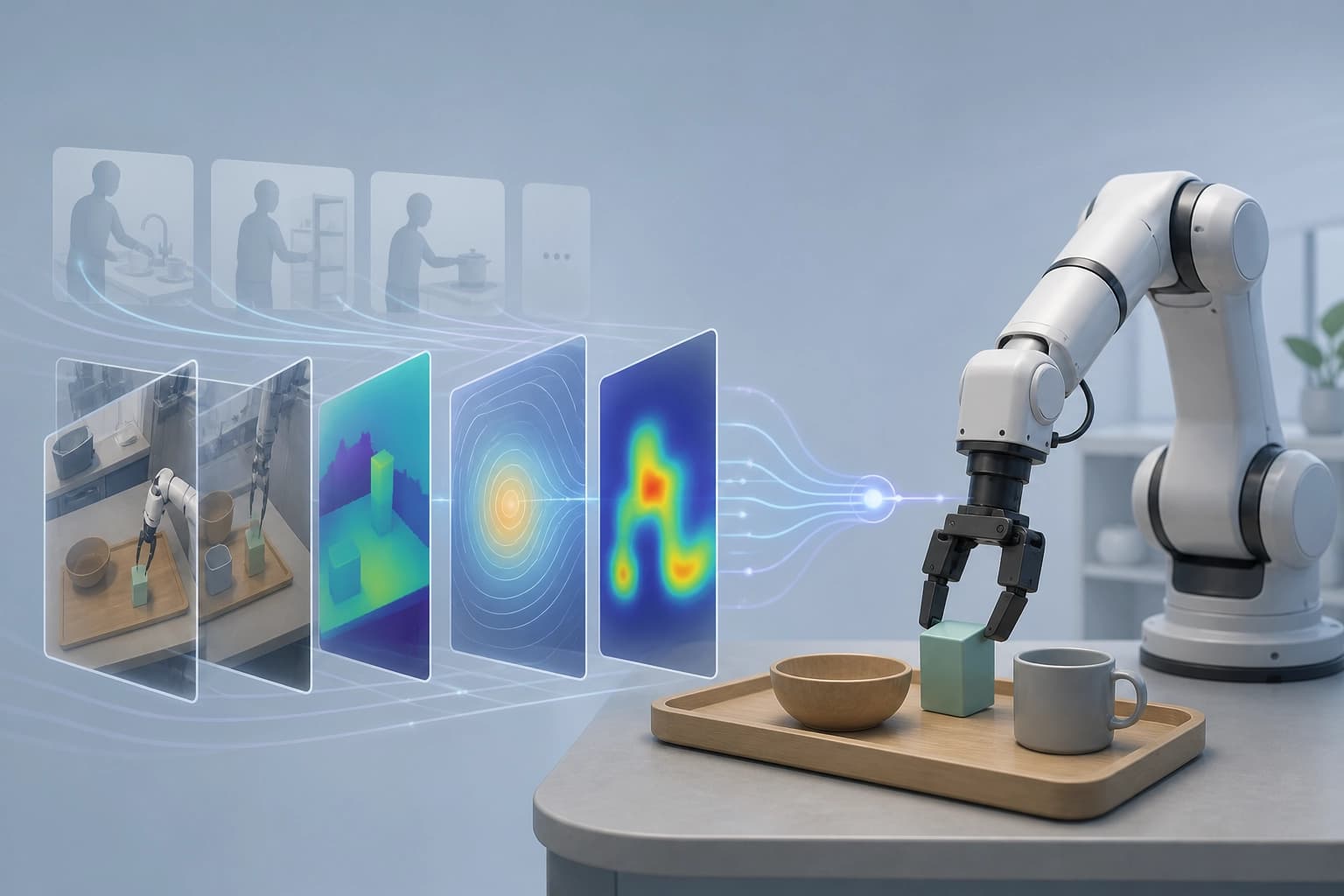
AffordanceWAM: Affordances as an intermediary between scene prediction and manipulator control
The work describes a generative model that jointly predicts future RGB observations, scalar fields, affordance heatmaps, and continuous robot commands, using human videos to broaden interaction diversity without action annotations or retargeting. On RoboCasa, CALVIN ABC→D, and real-world tasks, the approach delivers consistent gains over RGB-only and robot-data-only baselines.
9 November 2026