
AutoResearch Research Pipeline: Insight First, Verification Second — No Hallucinations
A new approach combines hypothesis generation with experimental validation: the system collects insights, and agents then run them through real experiments and independent audits. On the RSICD benchmark, this raised Recall from 32.84 to 34.69 and reduced the number of questionable results from 11–27 to five.

Autonomous Research: Speed Without Guarantees
Modern AI systems are capable of autonomously conducting long research cycles: formulating hypotheses, running experiments, and analyzing results. But as practice shows, automation by itself does not make the result scientific. An architecture without built-in verification mechanisms easily produces plausible but unfounded conclusions—what are called "hallucinations."

This is precisely the problem that AutoResearch solves—a two-stage pipeline that separates the birth of an idea from its verification. The development is described in the paper "AutoResearch: Insight In, Hallucination Out" (arXiv:2608.17906, v2 from August 23, 2026, DOI: 10.48550/arXiv.2608.17906; authors—Yiming Ren, Xiang Liu, Qumeng Sun, Xiao Zhang, Jiahao Li, Haoyang Zhang, Junjie Wang).
Idea Generation: Insight First
In the first stage, the system continuously collects new research signals and matches them against accumulated knowledge. Instead of immediately rushing into experiments, AutoResearch looks for transferable mechanistic insights—patterns that can be applied to another task. Generation involves multiple models, and then cross-review kicks in: proposed ideas undergo mutual verification. This filter weeds out weak hypotheses before they even reach execution. The outcome of the first stage is a well-founded and testable research plan, not just a set of bold guesses.
Idea Execution: Verification Before Conclusion
The second stage turns the plan into real experiments. Coordinated agents work here: they break tasks into individual steps, run experiments, diagnose errors, and adjust the approach when necessary. The key point is an independent evidence review before a result is deemed reliable. This mechanism allows the system to distinguish genuine findings from measurement artifacts and to decide whether to continue a direction, revise it, or stop altogether.
What the Benchmark Showed
The developers tested AutoResearch on several classes of tasks—cross-retrieval, system optimization, and machine learning. Everywhere the system demonstrated measurable progress, but the RSICD benchmark was especially telling.
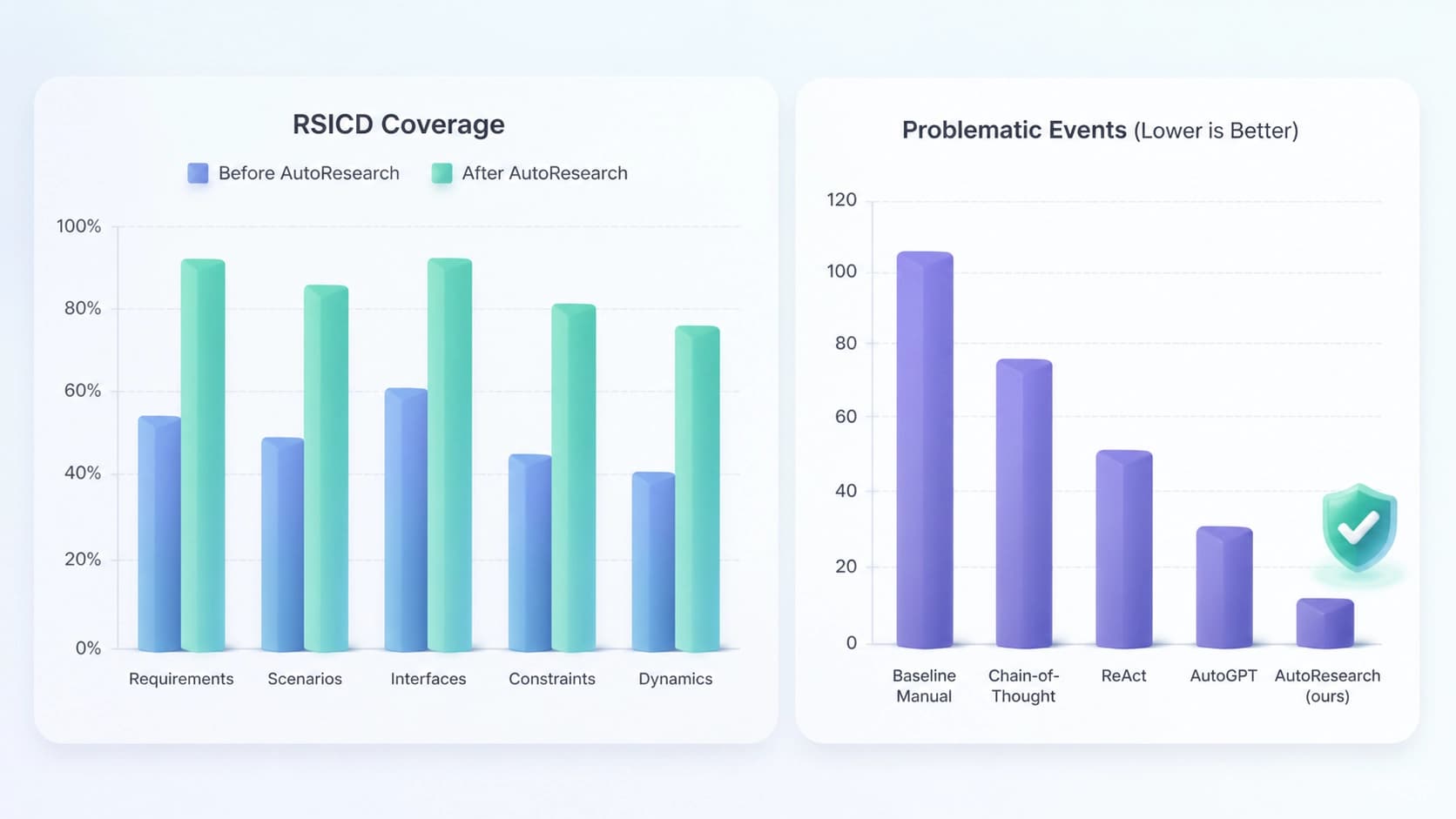
The idea generated by AutoResearch increased the average Recall from 32.84 to 34.69. At the same time, the audit revealed only five problematic events in the system's operation, whereas other autonomous research systems had between 11 and 27. This confirms the main stated principle: "insight is substantiated before experimentation, conclusions—before acceptance."
Why This Matters
AutoResearch shows that autonomy can be combined with scientific rigor. Separating the generation and verification stages is a simple yet effective pattern: first let the idea mature under cross-review, then run experiments with independent quality control. This approach not only reduces the number of errors but also makes the research process itself more transparent. If such pipelines become widespread, trust in the results of AI research will grow noticeably.
Frequently asked questions
Related materials
All materials
Validating Candidates Costs More Than Generating Them: Honeypots Against LLM Vulnerability Hunting
The study examines the cost asymmetry in agentic vulnerability discovery: generating candidate versions is cheap, while confirming them through reachability analysis, execution, and PoC development consumes most of the budget, making verification a potential standalone target for defense. The proposed RedHerring—repository-adapted decoys with a hidden certificate—reduced the number of real vulnerabilities found by 38.7–60.4% at equal cost across 33 OSS-Fuzz projects; even after the agent was warned, the reduction remained at 37.2%.
9 November 2026
Checking LLM Hallucinations via SQL-Based Source Representation Without Fine-Tuning
The study examines whether an LLM can apply a basic symbolic skill—building a SQL database from source documents—to ground its outputs in sources without supervision when detecting hallucinations. On RAGTruth and DiaHalu, this neuro-symbolic pipeline proves more accurate than direct prediction and comparable to state-of-the-art methods, without requiring domain-specific fine-tuning.
9 November 2026
MathAdv: What the Final Accuracy of Machine-Generated Proofs Conceals
A diagnostic suite of tasks spanning 13 undergraduate and graduate mathematics topics evaluates machine-proving systems in Lean 4 not only by their final results, but also by their subject-matter mastery, the quality of their informal reasoning, and their robustness to rephrased conditions. A component-by-component analysis shows that translating a problem into formal form remains the main obstacle, and that success depends heavily on the area of mathematics and how the problem is framed.
9 November 2026