
The Contribution of AI Stems to the Hybrid Mix: Moving from Binary Classification to Continuous Regression
The authors propose estimating the share of synthetic stems in a track as a continuous coefficient α in the range [0,1], rather than classifying the entire composition as AI- or human-generated. On mixtures with known proportions, a regression CNN achieved an MAE of 0.076 and an R² of 0.85, though the method’s sensitivity depends on the instrument, and the previous binary detector produces biased estimates on mixed material.
Why Binary Classification Does Not Describe a Hybrid Mix
A binary detector answers the question: is it AI or human? In an experiment, a CNN model achieved >99% accuracy on fully AI-generated or human-performed tracks.
A hybrid mix contains both types of content at once. A binary label does not show the share of AI energy.
Limitations of the binary approach:
- on mixed material, the output increases along with the AI stem energy contribution;
- the output remains a noisy and poorly calibrated estimate;
- a binary label does not provide a continuous scale.
Practical criterion: for a mix with human-performed and AI-reconstructed stems, a binary answer is insufficient.
Continuous Regression of AI Energy Ratio α
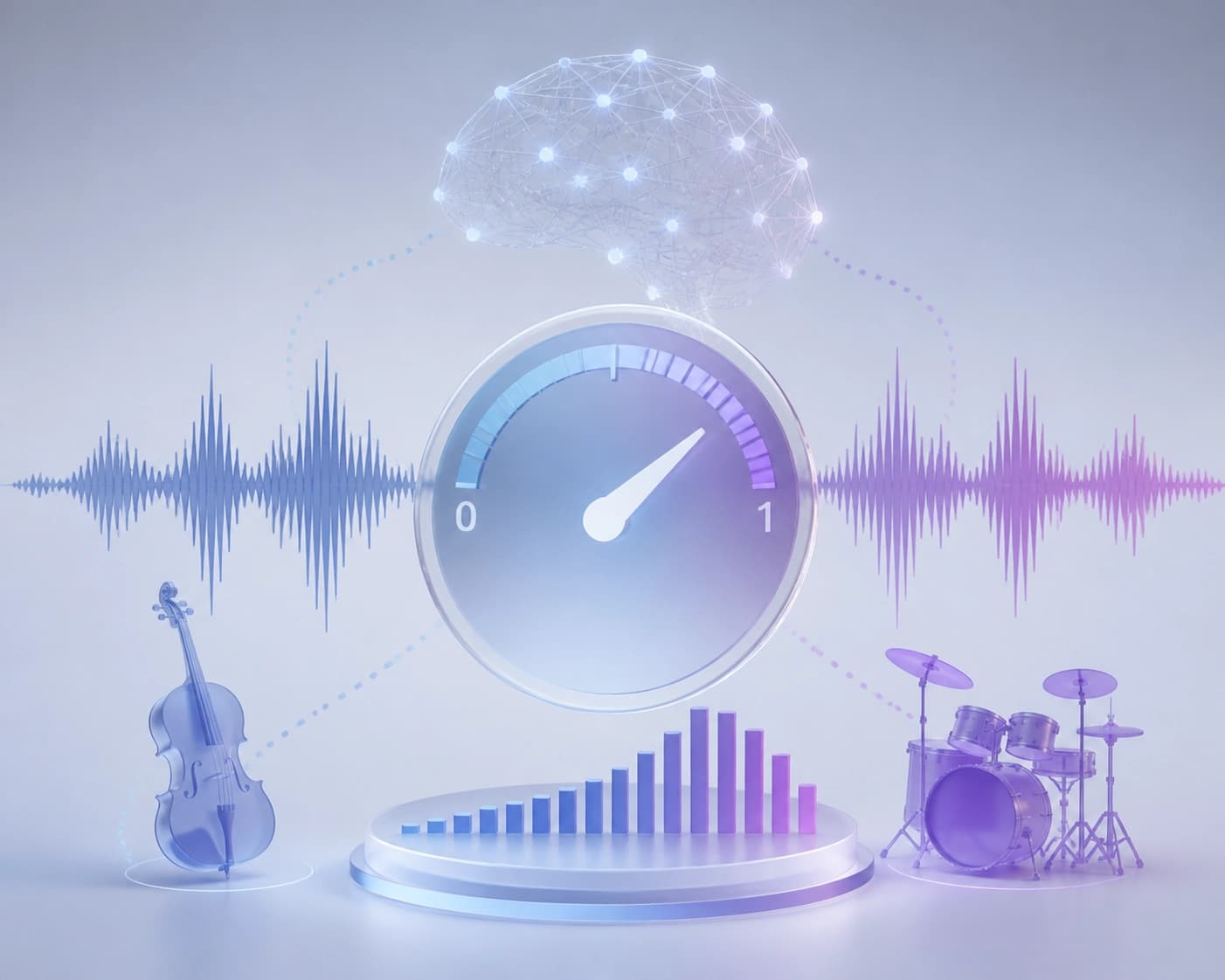
The authors propose treating AI music detection as regression of the continuous AI energy ratio α in [0, 1]. The model predicts not a label, but the share of AI energy in the mix. The CNN model for α regression achieved MAE = 0.076 and R^2 = 0.85 on held-out mixtures from the same pipeline.
| Approach | Output | Evaluation on a hybrid mix |
|---|---|---|
| Binary classification | AI or human label | Does not provide a continuous estimate |
| α regression | Continuous α in [0, 1] | MAE = 0.076 and R^2 = 0.85 on held-out mixtures from the same pipeline |
Conclusion: regression provides a quantitative estimate of the share of AI energy. Practical criterion: interpret MAE and R^2 within the same pipeline in which the model was trained.
Experiment Data and Pipeline
The experiment uses a multi-track music dataset. Human-performed and AI-reconstructed stem mixtures are assembled from it. AI-reconstructed stems are obtained using a neural audio codec. The proportions of each type of content are known.
Stages:
- assemble a multi-track music dataset;
- create mixtures of human-performed and AI-reconstructed stems;
- obtain AI-reconstructed stems using a neural audio codec;
- record the known proportions of content;
- train a CNN-based model and test it on held-out mixtures from the same pipeline.
Conclusion: the regression metrics apply to mixtures from the same pipeline. Practical criterion: do not transfer MAE and R^2 to another pipeline without separate validation.
Detector Sensitivity to Instruments
Detection sensitivity depends on the instrument. It reflects the instrument's frequency composition.
Detectability factors:
- drums and guitar carry strong codec artifact signatures;
- vocals and bass are less detectable.
Practical criterion: when interpreting α, take the mix's instrumental composition into account. For mixes dominated by vocals and bass, the detector is less able to distinguish the AI contribution.
The Role of Regression in Workflows
The authors characterize the regression approach as a promising first step toward detecting AI music in realistic music production workflows. The paper was accepted to the ISMIR 2026 conference.
Practical criteria:
- α regression provides a quantitative estimate of the share of AI energy;
- the approach remains an initial step, not a universal detector;
- apply it within a known pipeline and taking the instrumental composition into account.
Conclusion: α regression is useful for analyzing a hybrid mix, but requires context.
Frequently asked questions
Related materials
All materials
Checking LLM Hallucinations via SQL-Based Source Representation Without Fine-Tuning
The study examines whether an LLM can apply a basic symbolic skill—building a SQL database from source documents—to ground its outputs in sources without supervision when detecting hallucinations. On RAGTruth and DiaHalu, this neuro-symbolic pipeline proves more accurate than direct prediction and comparable to state-of-the-art methods, without requiring domain-specific fine-tuning.
9 November 2026
MathAdv: What the Final Accuracy of Machine-Generated Proofs Conceals
A diagnostic suite of tasks spanning 13 undergraduate and graduate mathematics topics evaluates machine-proving systems in Lean 4 not only by their final results, but also by their subject-matter mastery, the quality of their informal reasoning, and their robustness to rephrased conditions. A component-by-component analysis shows that translating a problem into formal form remains the main obstacle, and that success depends heavily on the area of mathematics and how the problem is framed.
9 November 2026
AffordanceWAM: Affordances as an intermediary between scene prediction and manipulator control
The work describes a generative model that jointly predicts future RGB observations, scalar fields, affordance heatmaps, and continuous robot commands, using human videos to broaden interaction diversity without action annotations or retargeting. On RoboCasa, CALVIN ABC→D, and real-world tasks, the approach delivers consistent gains over RGB-only and robot-data-only baselines.
9 November 2026