
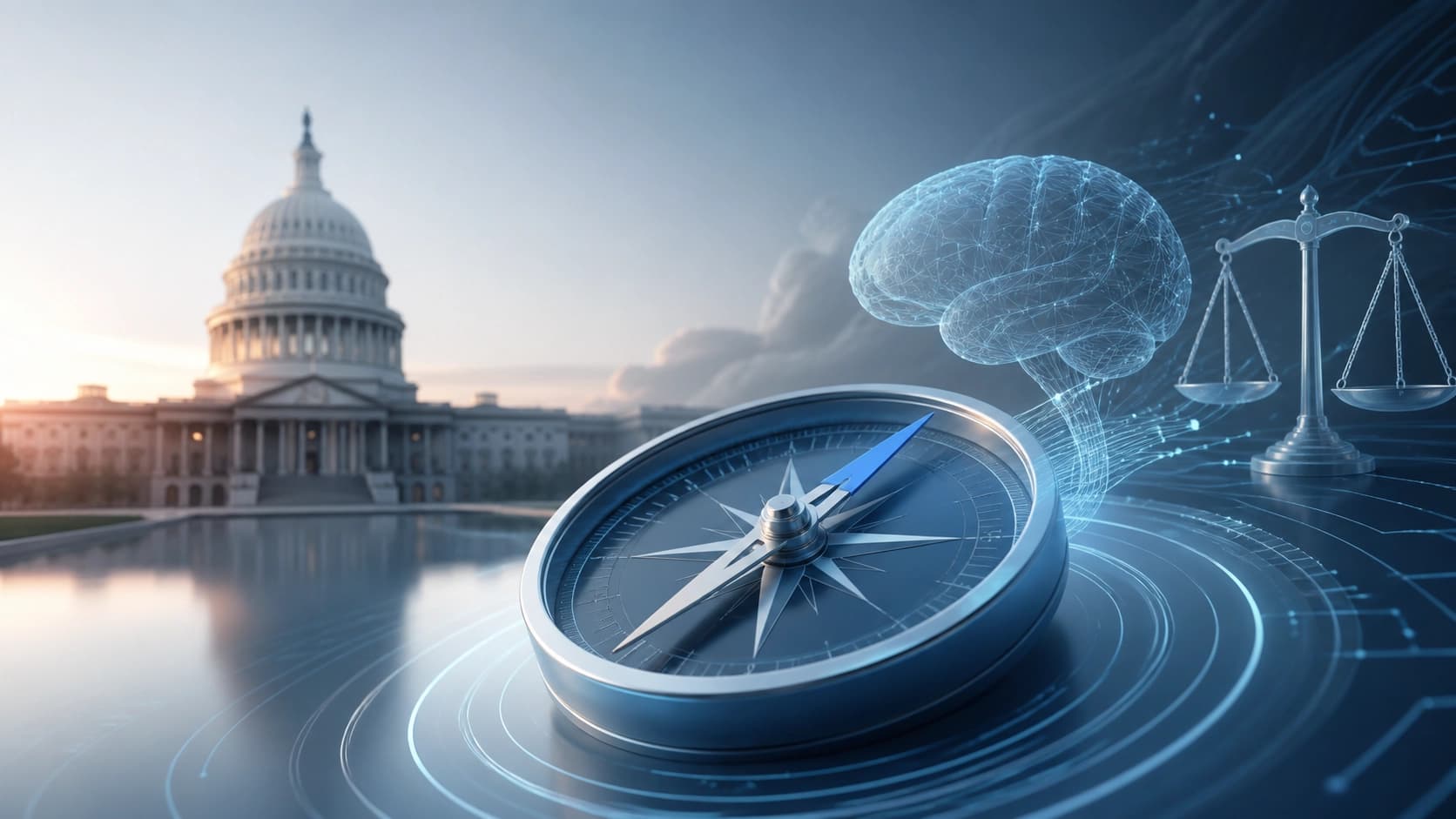
Washington has recently noticeably shifted both its rhetoric and practical steps in the field of artificial intelligence. Instead of the cautious building of restrictions that dominated before, speed, technological leadership, and national security have come to the forefront. This is not just a change in emphasis — it is a new political vector that will affect developers, users, and international relations alike.
Why Washington is changing course
For a long time, the US administration's approach was built around the idea of "responsible AI": experts demanded bias testing, mandatory explanations from algorithms, and strict frameworks for high-risk applications. However, business and part of the political establishment believed that this path was holding back innovation and ceding the initiative to China. Now the priority has changed: the state is trying to become not an overseer, but an accelerator.
The main driver of change is competition. The rapid progress of Chinese models, including open-source ones, has shown that multi-layered approvals and permitting procedures cannot keep up with reality. That is why Washington is betting on deregulation, easier access to data, and support for American companies in order to set global standards before someone else writes them.

New state policy priorities
The change of course does not mean that regulation is becoming a thing of the past entirely. Simply, the center of gravity is shifting from protection against hypothetical risks to creating conditions for growth. Washington highlights three key directions: developing its own technologies faster, providing government support for critical infrastructure, and making federal agencies themselves active consumers of AI.
Deregulation and accelerating innovation
The first thing that stands out is the rejection of a whole range of previously adopted requirements. Instead of mandatory impact assessments and "kill switches" for dangerous models, voluntary standards and self-regulation are being proposed. The idea is that developers themselves understand their products better, and the state will intervene only in clear cases of discrimination or security threats.
In parallel, Washington insists that American companies have preferential access to data and computing power. In particular, support for national data centers, creating chip reserves, and developing proprietary models for government tasks are being discussed. This is no longer a matter of scientific progress, but a matter of economic sovereignty.
Infrastructure and energy for AI
The key bottleneck for AI is not so much algorithms as electricity, cooling, and network bandwidth. The new vector assumes the government will simplify data center construction, speed up connections to power grids, and partially subsidize the modernization of generation. Unlike the previous approach, where environmental restrictions often prevailed, the "green" agenda now must be combined with uninterrupted power supply for AI infrastructure.
A separate item is federal procurement. It is expected that government agencies will begin adopting AI on a large scale for document processing, intelligence analysis, logistics forecasting, and even drafting initial responses to citizens. This will create a huge market for developers, but will require a revision of security standards.
Using AI in the public sector
To demonstrate the seriousness of its intentions, pilot projects are being launched right inside government structures. For example, generative AI is being used to reduce the bureaucratic burden: instead of long reports, employees prepare brief summaries, and chatbots handle routine requests. Of course, this is not a full-fledged "autopilot" — key decisions remain with people, but the very fact that the state recognizes the benefits of such tools shows a change in attitude.
As an example, consider the assistant Claude, which is already used in some agencies to summarize public comments. Such practices have not yet become widespread, but the vector is obvious: instead of bans and pauses, the public sector is trying to learn and adopt.
Claude

What this will change for business and society
The obvious plus of the new course is speed. Companies will be able to release models and services without lengthy approvals, and access to resources will become easier. For small businesses, this means the emergence of affordable solutions that previously required licenses and certifications. Competition between platforms will increase, and users will get more choice.
However, deregulation also has a downside. Without a control system, there is a higher risk of biased models, errors in medical and financial recommendations, and vulnerabilities that malicious actors can exploit. Moreover, the intensifying race with China pushes toward data sharing between government agencies and the private sector, which affects privacy. Washington, it seems, is willing to consciously accept these risks in exchange for accelerating its leadership.
The international dimension is also important. America is trying to export its new approach through alliances and trade agreements. If earlier partners were imposed a high regulatory bar, now the bet is on "governance through innovation": whoever implements first sets the standard. Other states, including European ones, will be forced to respond — either by softening their own norms or by seeking alternative blocs.

In the end, the new policy is not just the repeal of previous decrees, but a strategy of proactive technological sovereignty. The next year or two will show whether it will be possible to combine speed and reasonable safeguards, but all signals indicate: the era of cautious regulation in Washington is paused. Now the phrase "move fast and open new horizons" sounds from government officials not as a metaphor, but as a direct call to action.