What is Simcenter PhysicsAI and why is it fast
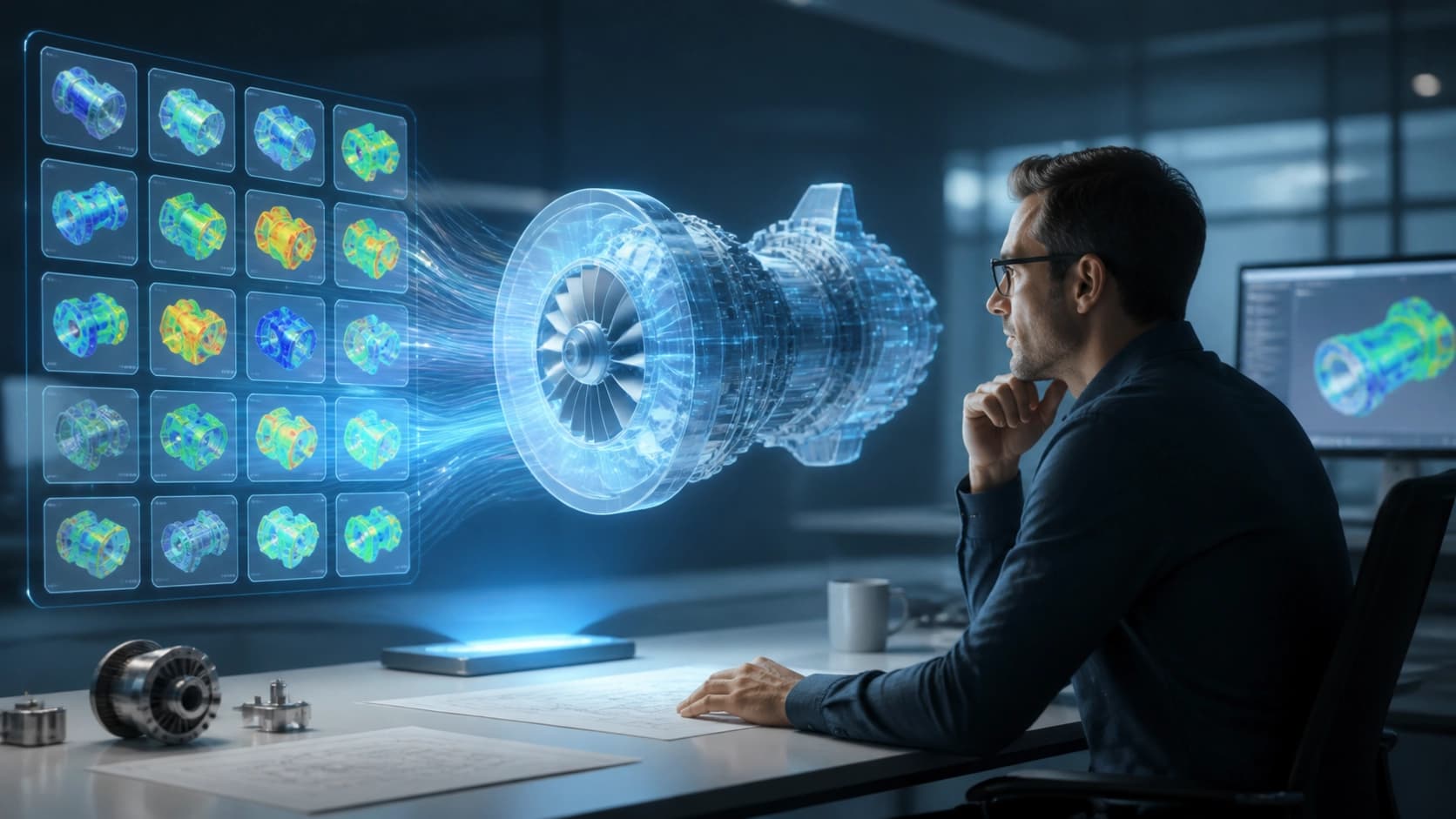
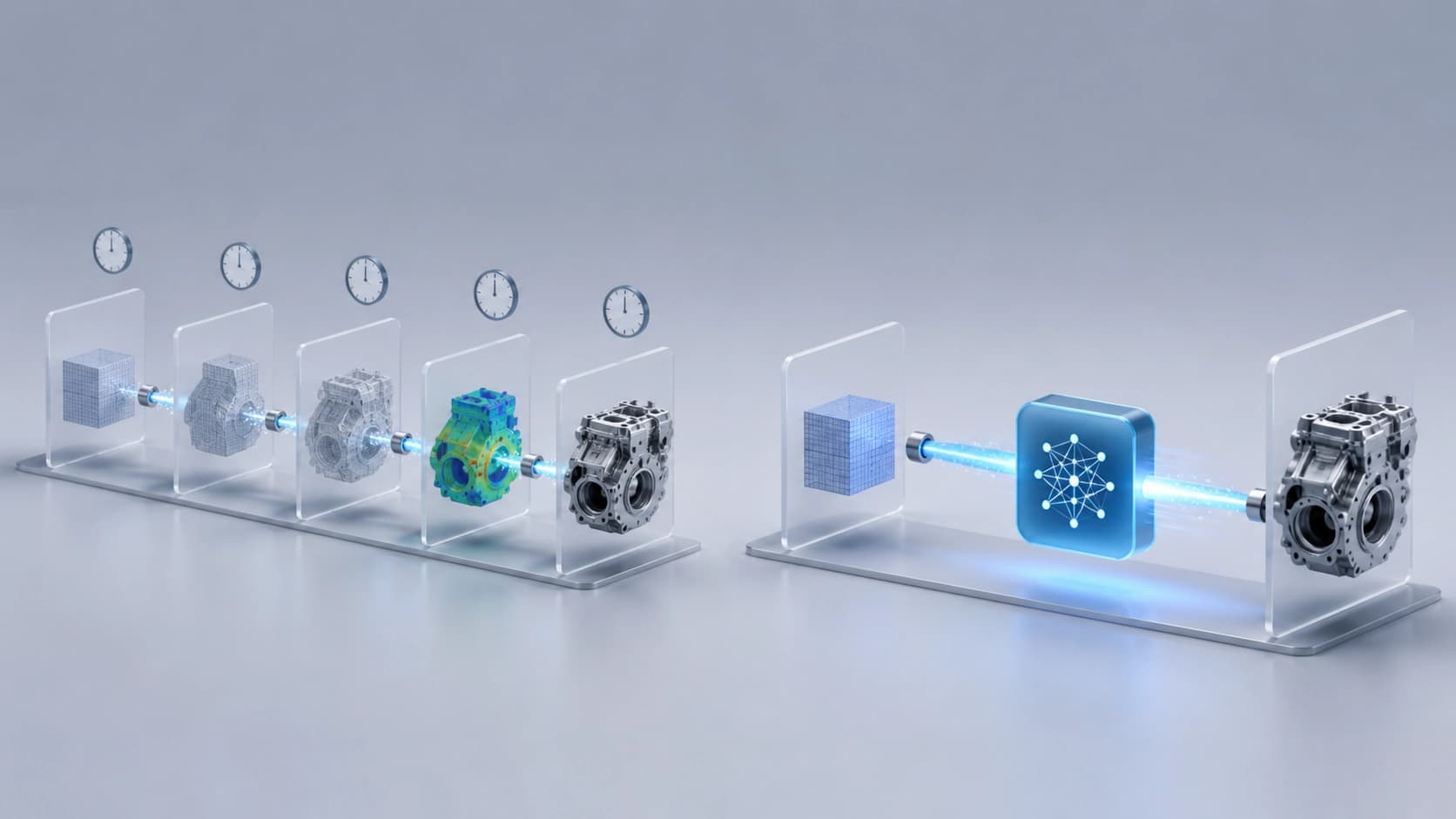
Simcenter PhysicsAI is a Siemens product from the Simcenter family, built on the principles of geometric deep learning. Its key idea is not to run every calculation from scratch, but to leverage accumulated data from previous simulations. The model is trained on this data and, given a new design, produces a prediction of the required parameters almost instantly.
This approach cuts the time needed to evaluate a design variant from hours to seconds. According to Siemens, the difference in speed can reach three orders of magnitude — in other words, up to 1000 times faster than a traditional solver. Of course, such performance opens up tempting prospects, but it also has a downside.
High speed is not synonymous with high accuracy
Sam Mahalingam, head of Siemens Digital Industries Software, answers the question about using physics-based AI in safety-critical systems with complete frankness: "No, it's not suitable." This is worth remembering for anyone hoping to fully automate calculations and shift responsibility onto an algorithm.
With a sufficiently large volume of training data, a surrogate model can produce results close to a physics solver, with a spread of 1–3%. However, Mahalingam himself emphasizes: a surrogate will never be more accurate than the simulation it was trained on. Any errors and assumptions in the solver are automatically transferred to the model. This is why physics-based AI has an objective accuracy ceiling it will never exceed.
That is precisely why Siemens views this tool not as a replacement for validation, but as a mechanism for rapid preliminary screening. Final confirmation always remains with classical solvers.
How Siemens proposes using physics-based AI: a filter, not a final verdict
A typical scenario looks like this. An engineer runs dozens or even hundreds of variants through the fast surrogate, selects 2–3 promising ones from that set, and passes them on for detailed refinement with a traditional physics solver. Only after full verification can the design be approved for production. The engineer's role does not disappear — it changes, shifting from routine calculations to meaningful selection of directions.
In a notable case with Continental involving airbags, physics-based AI was used exclusively at the stage of finding initial variants. According to Mahalingam, a production recommendation based on AI alone never happens under any circumstances.
Another example is a project with Magna. There, a broad search was first conducted in the Simcenter HEEDS environment, then promising variants were solved in Simsolid — a solver that works without mesh generation. The resulting simulation data was used to train the physics-based AI model. If data was insufficient, it was generated synthetically in advance, again relying on Siemens simulators.
Importantly, safeguards are built into the system. If a model was trained on one type of shape and is fed a radically different one, it states outright: "I can't predict this, it's a completely different shape." Such an honest refusal is preferable to silently producing an incorrect result. This reduces the risk of an engineer unknowingly "shooting themselves in the foot" by trusting an unsuitable model.

Why the engineer stays at the helm
Siemens consistently positions physics-based AI as a powerful but strictly limited tool. It is useless beyond the scope of its training data and is not intended for making final decisions. The company is betting that engineers will trust a system that honestly communicates its boundaries more than one that presents wishful thinking as fact.
Human validation remains a mandatory step. The physics solver still "holds the pen" for everything that must be reliable, as Mahalingam put it figuratively. A thousand-fold speedup is an impressive way to accelerate exploration, but the final word always rests with the engineer.