New Samsung Health AI Models Learn to Understand Body Signals from Wearables
Samsung is betting on preventive medicine, and fresh developments in artificial intelligence are expected to bring that moment closer. Samsung Research America's research division has introduced two foundational AI models designed to analyze biosignals collected by smartwatches and other wearable devices. These models are meant not just to record metrics, but to extract useful health insights from them—continuously and without human intervention.
The work is part of the broader Connected Care concept that Samsung discussed at the Health Forum in July 2026. The idea is to combine data from wearables, traditional medicine, and partner services into a single system capable of anticipating problems before they become serious. The new models are the technical foundation for this approach: they learn to understand how different body signals relate to each other, and to do so directly on the device.
Why conventional algorithms fall short with biosignals
Data from wearables is not just step counts and heart rate. It consists of complex time series, including electrocardiograms (ECG), photoplethysmograms (PPG), sleep stage information, and motor activity. Such signals are highly context-dependent: the same heart rate can mean stress, physical exertion, or the onset of illness. Training classical models on all these nuances is difficult—especially when labeled medical data is scarce.
That is why the researchers turned to self-supervised learning. The model itself finds patterns in large volumes of unlabeled data, and these insights can then be applied to specific tasks—such as predicting cardiovascular risks or classifying sleep stages. This approach has already proven successful in text and image processing, and now it is being adapted for biosignals.
The xMAE model: learning to see the heart through pulse
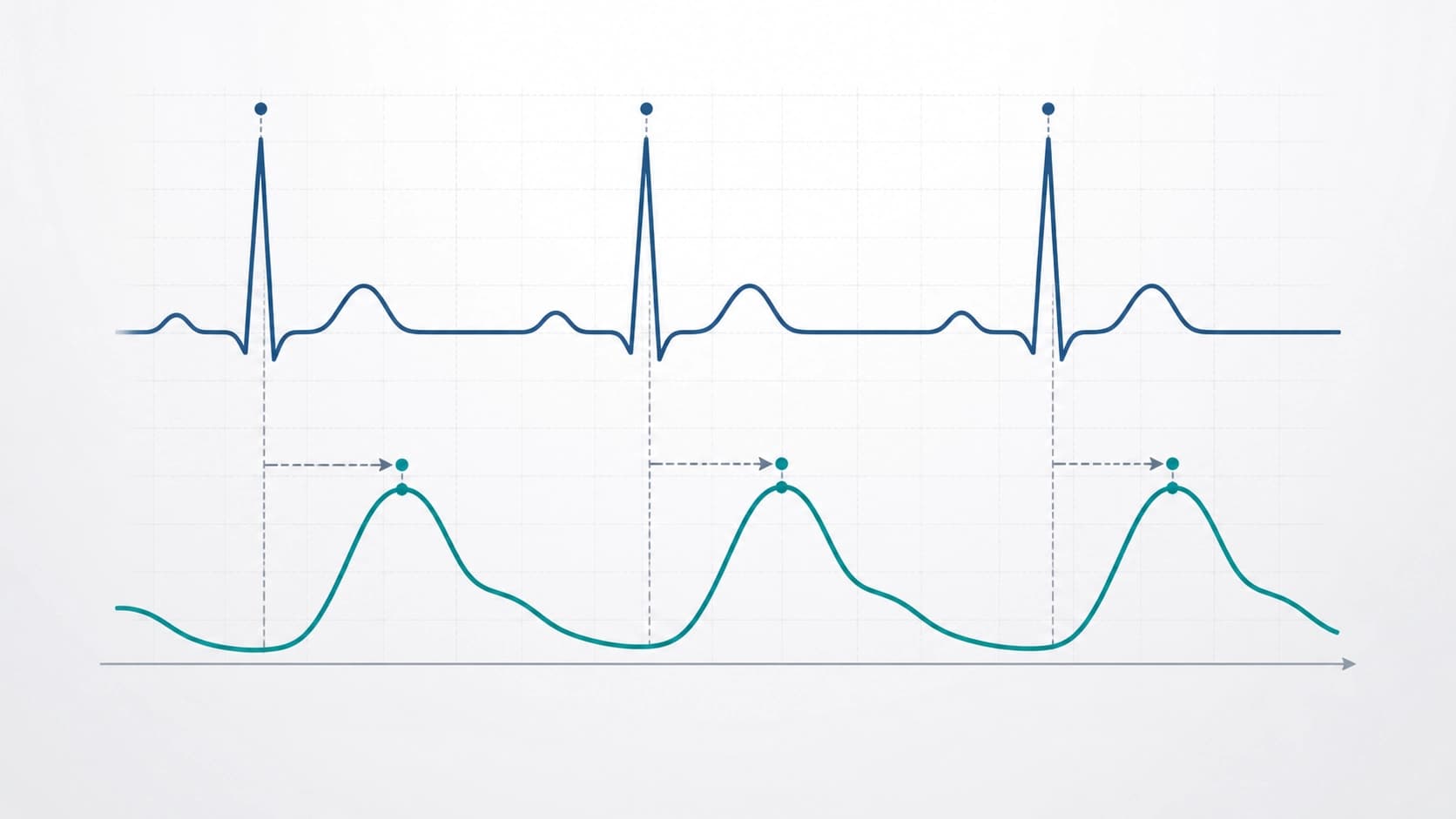
The first model is called xMAE (Physiology-Aware Masked Cross-Modal Reconstruction). Its key feature is the ability to link different types of signals. Specifically, xMAE learns the relationship between continuous PPG data and ECG signals.
As a reminder: ECG directly measures the heart's electrical activity and allows assessment of rhythm, variability, and detection of anomalies such as atrial fibrillation. But on wearables, taking an ECG requires stopping and placing a finger on an electrode—it does not work passively. PPG, on the other hand, continuously measures blood flow changes through an optical sensor. However, there is a delay between the heart's electrical impulse and the pulse wave—like the gap between lightning and thunder. The challenge is to understand how to reconstruct one signal from the other.
xMAE solves this problem: it learns to reconstruct "masked" segments of ECG from PPG data. The model was pretrained on about 9,400 hours of simultaneous ECG and PPG recordings. As a result, the model can estimate cardiovascular characteristics from continuous PPG without the need for separate manual measurements. This makes heart monitoring nearly invisible to the user.
In tests, xMAE outperformed unimodal models and several existing multimodal learning approaches in 15 out of 19 evaluation tasks. These tasks include predicting cardiovascular disease, detecting abnormal lab results, and determining sleep stages. Moreover, the learned features proved robust to changes in device and sensor placement, paving the way for a unified model across different wearable gadgets.
The HiMAE model: compact analysis across multiple time scales
The second model—HiMAE (Hierarchical Masked Autoencoder)—addresses a different challenge. Biosignals change at different rates: heart rhythm fluctuates every second, while sleep patterns unfold over minutes and hours. To capture both types of patterns, HiMAE uses multiple encoders that analyze short and long data segments separately. This allows the model to adapt to the appropriate time scale depending on the task—for example, analyzing heart rate variability or predicting sleep quality.
HiMAE's training is also built on reconstructing masked data fragments, so it does not require a large labeled dataset. At the same time, a single pretrained model can handle different types of tasks: classification, numerical prediction, and even data generation.
HiMAE's key advantage is efficiency. It achieves high accuracy with a smaller model size than existing alternatives and performs computations in under 1 millisecond on a smartwatch-class processor. This means analysis can actually run on-device without sending data to the cloud. For the user, this translates to privacy and instant response—for example, to an abnormal heart rhythm.
What's next
According to Sharani Desai, head of digital health algorithms at Samsung Research America, these models are just the foundation. In the future, the approach will be extended to other biosignals and health features while continuing to work on devices with limited sensors and computational resources. Subbu Venkatraman, head of the digital health research lab, adds that the key contribution of the work is demonstrating the viability of health foundation models for capturing relationships between signals and temporal structures.
Both models have been accepted for publication at prestigious conferences—ICML (xMAE) and ICLR (HiMAE)—underscoring the scientific significance of the work. But most importantly, this is a step toward wearables becoming more than just a step counter, evolving into a personal health assistant that notices problems before the person does.