
What are DeepSeek-R1 and OpenAI O1
DeepSeek-R1 is an open reasoning model developed by the Chinese company DeepSeek AI. It is distributed free of charge, including commercial use, and is available in two versions: DeepSeek-R1-Zero and the regular DeepSeek-R1. The model attracted enormous attention: in just the first week after release, its GitHub repository collected more than 163,000 stars — a rare case for a research project. Much of this buzz stems from the fact that an open development is showing results comparable to closed giants.
Its main competitor is OpenAI O1 from OpenAI. It is a proprietary model designed for complex chains of reasoning and available by subscription. Unlike its free open counterpart, O1 requires monthly payments — up to $200 per month for full access. At the same time, DeepSeek-R1 is trying to prove that an expensive closed system is no longer the only option for tasks that require "thinking."
Performance: where one outshines the other
To assess real capabilities, DeepSeek-R1 and OpenAI O1 were run through standard benchmarks covering logic, math, and programming. The results surprised many.
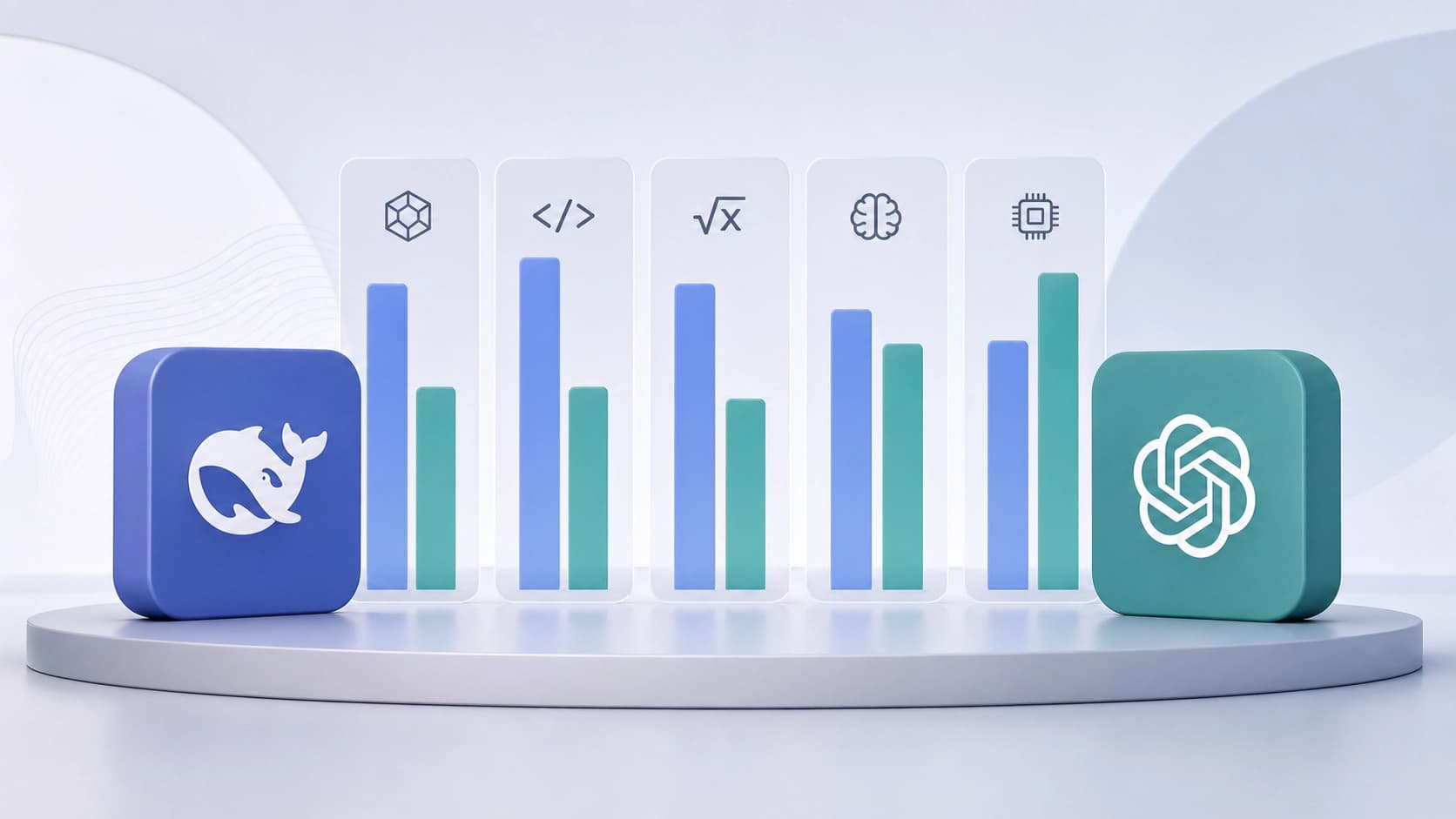
- AIME 2024 — olympiad-level math problems: DeepSeek-R1 came out ahead.
- Codeforces — competitive programming: the models showed near parity.
- Math-500 — a broad set of math examples: DeepSeek-R1 had the advantage again.
- MMLU — general knowledge and reasoning: O1 slightly edged out its rival, but the gap was minimal.
- SWE-Bench — solving real-world engineering tasks from GitHub: DeepSeek-R1 slightly outpaced O1.
These numbers show that in pure math and logic the open model is actually stronger, while in general knowledge it lags a little — but not critically. For the user, this means DeepSeek-R1 is a genuinely serious tool for analytics, scientific computing, and programming, not just a "free alternative."
The cost factor
Here the difference is striking, and for many it will be the deciding factor.
DeepSeek-R1, both as a web chat and as an open-source solution, is available with no payments at all. OpenAI O1, by contrast, has pricing tiers that reach $200 per month for full functionality. Even when using the API, the situation doesn't favor the closed model.
- Input tokens for DeepSeek-R1 cost $0.14 per million, for O1 — $7.50 (more than 50 times more expensive), and for O1 Mini — $1.50.
- Output tokens for DeepSeek-R1 cost $2.19 per million, while O1 charges $60.
As a result, for the same amount of work, costs can differ by tens of times. For startups, research groups, and anyone looking to embed reasoning into their products, DeepSeek-R1 looks practically unrivaled — unless you factor in closed enterprise solutions with individual discounts.

Practice: reasoning in real-world tasks
Benchmarks are fine, but what matters more is how the models behave in real scenarios. The authors of one test took several typical non-logical tasks and compared the answers.
- Logic task: both models handled it correctly, with no errors in their reasoning.
- River crossing math problem: both tools arrived at the optimal 17-minute plan. Their wording didn't match exactly, but the essence of the solution did.
- Writing a video script for the Kling AI service: here DeepSeek-R1 performed better. It correctly grasped the request and produced a structured, useful script. OpenAI O1, meanwhile, interpreted the task differently and delivered a far less practical text.
This outcome comes not only from mathematical ability, but also from how the model handles ambiguous instructions. DeepSeek-R1, judging by the results, manages context better and doesn't overfit to an "expected" answer — it actually analyzes the request.

Verdict
If budget and openness are the main criteria, DeepSeek-R1 is the obvious winner. It's free, delivers results no worse than O1 — and in some tasks, even better. What's more, the open-source model can be fine-tuned and deployed on your own servers, which is critical for companies with confidentiality requirements.
Choosing OpenAI O1 makes sense only if you need maximum versatility within the OpenAI ecosystem, for example in combination with their other APIs, or if near-perfect MMLU results are the deciding factor. But even then, paying hundreds of times more seems justified only for a very narrow range of tasks.
For most users who need "thinking" models for math, logic, data analysis, and coding, DeepSeek-R1 is a way to get high quality for free and without restrictions on commercial use. It's exactly these kinds of projects that change the market: a strong open alternative lowers the price of intelligence as a service overall.