
Problem: Different signals age at different rates
Multimodal recommender systems long ago stopped relying solely on click history. They mix in the content of the item itself—description, image, audio—alongside "user–item" interactions. The logic is simple: the more information channels, the more accurate the prediction. In practice, it's more complicated: the contribution of each channel isn't constant; it changes over time, and each at its own rate.
The authors of arXiv:2608.10983 (Pengyu Zhang, Yangqin Jiang, Klim Zaporojets, Congfeng Cao, Paul Groth; first version—August 11, 2026, second—August 24) call this modality time-scale mismatch. Their example: closer to Valentine's Day, when choosing chocolate, people read the ingredients less and look more at the packaging and the audio accompaniment of the card. Textual features lose weight, visual and audio ones gain. Two weeks later, the proportion changes again.
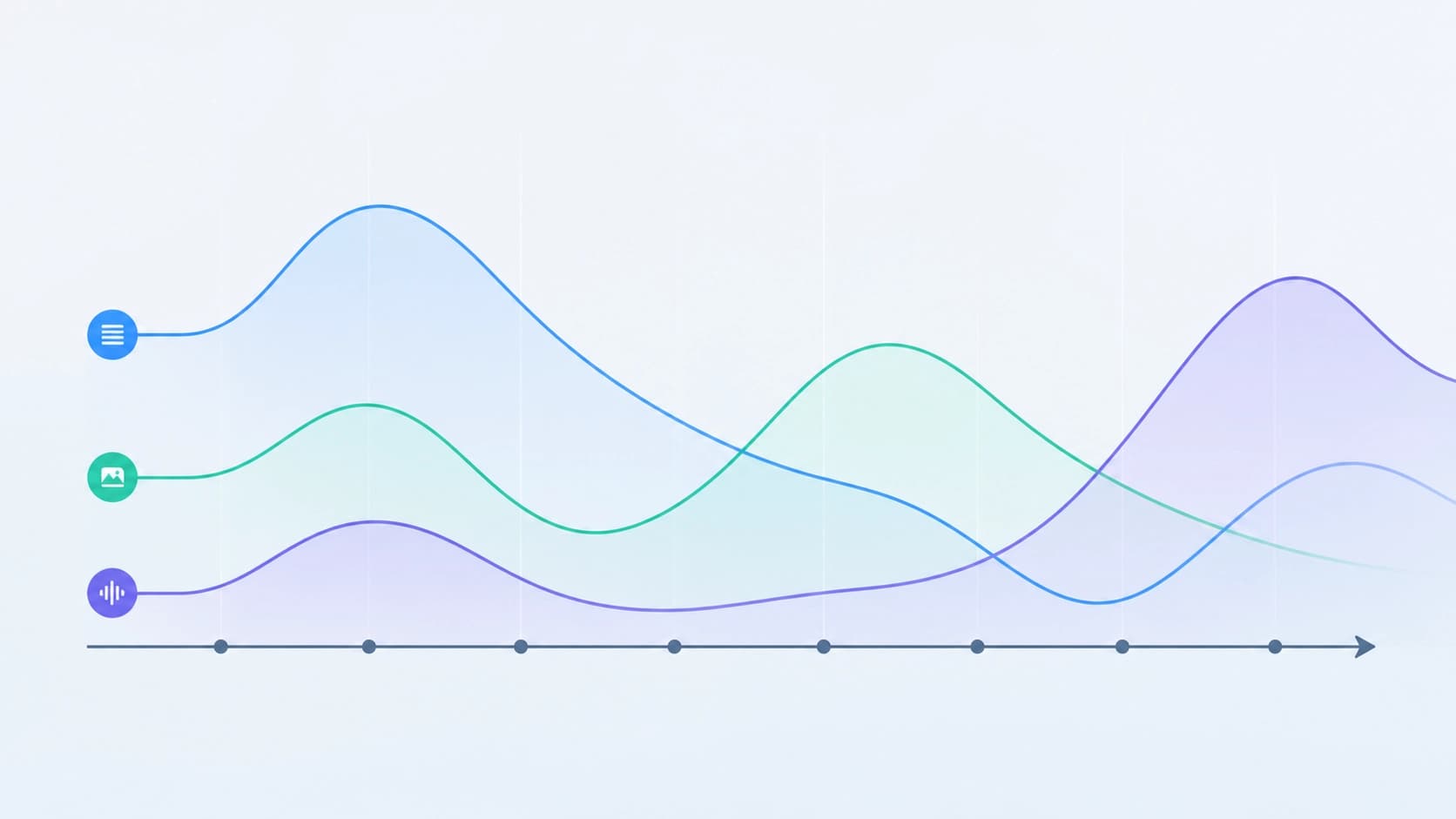
Two separate tasks grow out of this observation. First: people have different behavioral tempos, and one user needs one proportion of modalities while another needs a completely different one. Second, less obvious: a modality that has lost its relevance doesn't just stop helping—it starts actively harming, feeding outdated and misleading signals into the model.
TimeRoute: routing for a specific user
The solution to both tasks is assembled into a single diffusion architecture—TimeRoute. Its point is the rejection of universal fusion coefficients, which were the standard for years: supposedly, text always weighs 0.4, image—0.35, and the rest—negligibly.
A personal distribution instead of shared weights
The key element is the temporal modality router. It aggregates a specific user's behavior into a compact temporal profile and turns it into a personal distribution of weights across modalities. That is, the question "what should be looked at first here" is decided not globally for the entire system, but separately for each temporal behavior profile.
Two denoising horizons
The second part is the diffusion graph reconstructor. The same temporal profile is fed into it via Feature-wise Linear Modulation (FiLM), and denoising is split into two streams of heads: long-term and short-term. Slow trends and fast bursts are processed by different branches, and this is fundamental—mixing them in a single channel means losing exactly the distinction that all of this was started for.

Why is diffusion needed specifically here? It allows filtering out modal edges before they enter the propagation graph. An outdated connection isn't weakened after the fact—it isn't built at all. This is a fundamentally different approach than weighting an already-finished graph.
Experiments: three datasets, ten runs
The authors tested the system on three datasets—short videos from TikTok, Amazon-Baby, and Amazon-Sports. Each result is averaged over ten random initializations, which is fairly strict for recommender benchmarks: the variance between runs here usually eats up half the gain.
The improvements over strong baselines are consistent across Recall@K, Precision@K, and NDCG@K. The most notable recorded result is a gain of up to 9.8% in P@20 on Amazon-Baby. Importantly, the gain isn't a one-off and isn't tied to a single metric: it shows up across the entire set of measurements.
Attribution: testing the mechanisms, not just the numbers
A separate part of the work is controlled attribution studies. This is an attempt to answer a question that often stays behind the scenes: what exactly produced the gain—the proposed idea or a random coincidence in the architecture?
The conclusions turned out to be harsh. The improvements require both the new mechanisms and the temporal input simultaneously. If you feed the same temporal profile to a conventional backbone without changing the routing procedure, there will be no gain. And if you feed random noise to the router, the result will be no better than completely removing the router from the model.
Put simply, what works isn't the mere presence of temporal data in the system, but the specific combination of "profile → modality distribution → controlled denoising reconstruction." Remove any element—and the construction falls apart.

What this means in practice
The main idea of the work goes beyond recommendations. Multimodality is usually perceived as accumulation: add another data source—and it gets better. TimeRoute reminds us that sources compete with each other, and their ratio is just as tunable a quantity as any model weights.
The second practical takeaway concerns obsolescence. In recommender systems, it's customary to combat old signals at the level of user preferences—recomputing history, forgetting long-ago clicks. Here the same problem is raised to the level of modalities: what can become outdated isn't a person's taste, but the relevance of an entire information channel. And it's more logical to combat this at the entrance to the graph, rather than after the garbage has already spread throughout the entire structure.
The third point is the personalization of the distribution. The idea that modality proportions should be derived from a specific person's temporal profile, rather than set once for the entire platform, looks transferable. The same principle applies wherever heterogeneous signals converge: search, feed ranking, catalogs mixed by content type. The authors have open-sourced the code, so testing the approach on your own data is quite feasible.