

Molecular science has long been considered one of the most promising — and most challenging — domains for AI. It is the subject of the arXiv preprint 2608.23104 "Molecular LLM Agents: From Architectural Design to Scientific Autonomy": 25 pages, categories cs.CL and cs.AI, version v1 dated August 24, 2026, and a revised v2 dated August 25. The author team is Jiatong Li, Wengyu Zhang, Weida Wang, Yuxuan Ren, Wei Liu, Chenyang Mao, Yuqiang Li, Yatao Bian, Changmeng Zheng, Xiaoyong Wei, and Qing Li. What makes the work interesting is not another benchmark record, but an attempt to bring order to the terminology: what exactly counts as a molecular agent, what components it is assembled from, and how independently it can act.
How a molecular agent differs from an "ordinary" one
Conversational assistants and coding agents live in a world of text, repositories, and web pages. The tools they operate almost always accept and return something that can be read with the eyes. With chemistry, this trick does not work: a molecule is not a paragraph.
A domain agent has to deal with several incompatible data types at once:
- symbolic notations such as SMILES — compact strings where a single wrong character turns a drug candidate into a different substance;
- molecular graphs, where what matters is not only the atoms but also bond order, charges, and stereochemistry;
- three-dimensional conformations — because a molecule's properties are determined by its shape, not just its formula;
- spectra and simulation results — long numerical series from which meaning must be extracted;
- measurements from a "wet" laboratory, that is, data from real experiments with a substance rather than with a file.
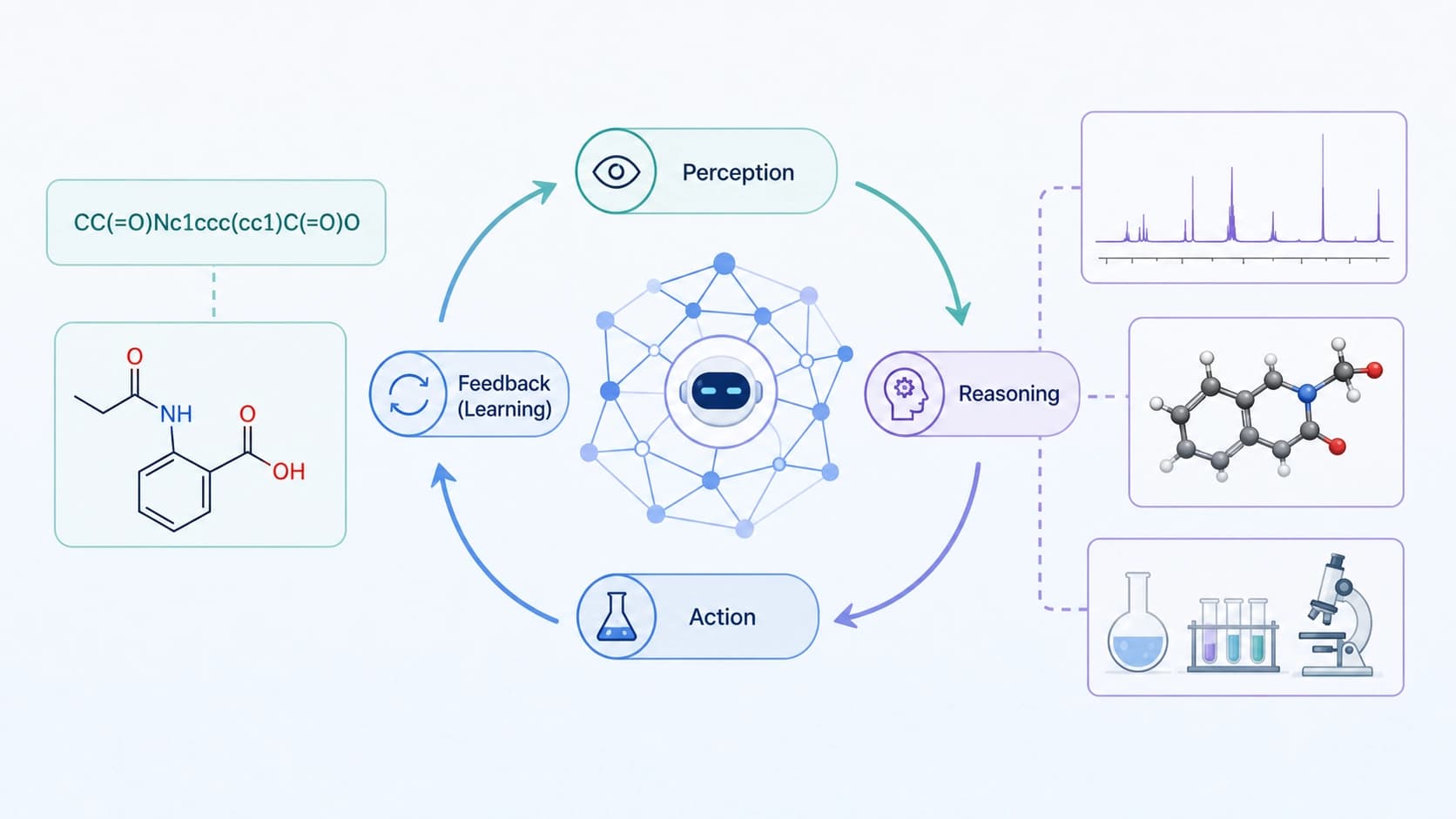
Hence the authors' main point: the capabilities of such an agent are built not from a single successful model, but from several pillars at once. What is needed is chemically correct perception of molecular objects, an agentic framework with a language model at its center, tools tied to a specific domain, and a feedback channel — computational or experimental. On top of this is layered the ability to plan and to call the right tool at the right time.
An architectural view: what a molecular agent is assembled from
The first of the article's two perspectives is engineering-oriented. The authors break the construction down into four layers and propose viewing any existing project in exactly this way.
Perception: a molecule as an object, not as a paragraph
Language models are trained on text, so at first they see a SMILES string as a set of tokens and easily "hallucinate" nonexistent valences. This is where pairing with domain models helps: for example, AlphaFold shows how a specialized architecture solves a narrow molecular task more accurately than a general-purpose one. For an agent, this means a simple thing: before reasoning, it must be able to validate — to check whether the molecule exists at all, whether its graph matches the formula, and whether stereochemistry was lost in translation between formats.
Framework, toolboxes, and training
The second and third layers are the "brain" and the "hands." The language model plans and decides which computation to run; the domain toolbox gives it docking, quantum-chemical calculations, database searches, and property prediction. A good example of this approach is the ChemCrow agent: the value there is created not by the model itself, but by the carefully described tools it calls.
The fourth layer is training and optimization. An agent can be fine-tuned on trajectories of successful solutions, or one can simply improve the descriptions of tools and the strategy for selecting them. The second path is cheaper, and the authors clearly imply: half of the failures in this field are not about a weak model, but about a poorly designed feedback loop.
The ladder of scientific autonomy: L1–L4
The article's second perspective is that very "ladder of autonomy," borrowed from the logic of levels in engineering systems. It is needed so as not to argue abstractly about whether an agent is "smart," but to understand how many decisions it actually takes on itself.
L1 — an assistant with a fixed scenario
Here a human sets the sequence of steps, and the model performs individual operations: convert a structure, compute descriptors, propose options. There is almost no autonomy, but predictability is maximal.
L2 — an adaptive computational agent
The agent decides on its own which tool to call and in what order, replans when an error occurs, and works in a fully digital loop. This is today's mainstream: the risk is limited to a spoiled calculation rather than a spoiled sample.
L3 — an agent that takes real experimental results into account
The most interesting and the most risky level. The agent not only plans but also receives feedback from a physical laboratory — spectra, chromatograms, synthesis data — and adjusts its plan accordingly. Examples of this class of systems exist: Coscientist demonstrated synthesis planning involving laboratory automation. But it is precisely here that the cost of an error ceases to be abstract: a wrong step consumes reagents, instrument time, and, in the worst case, people's safety.
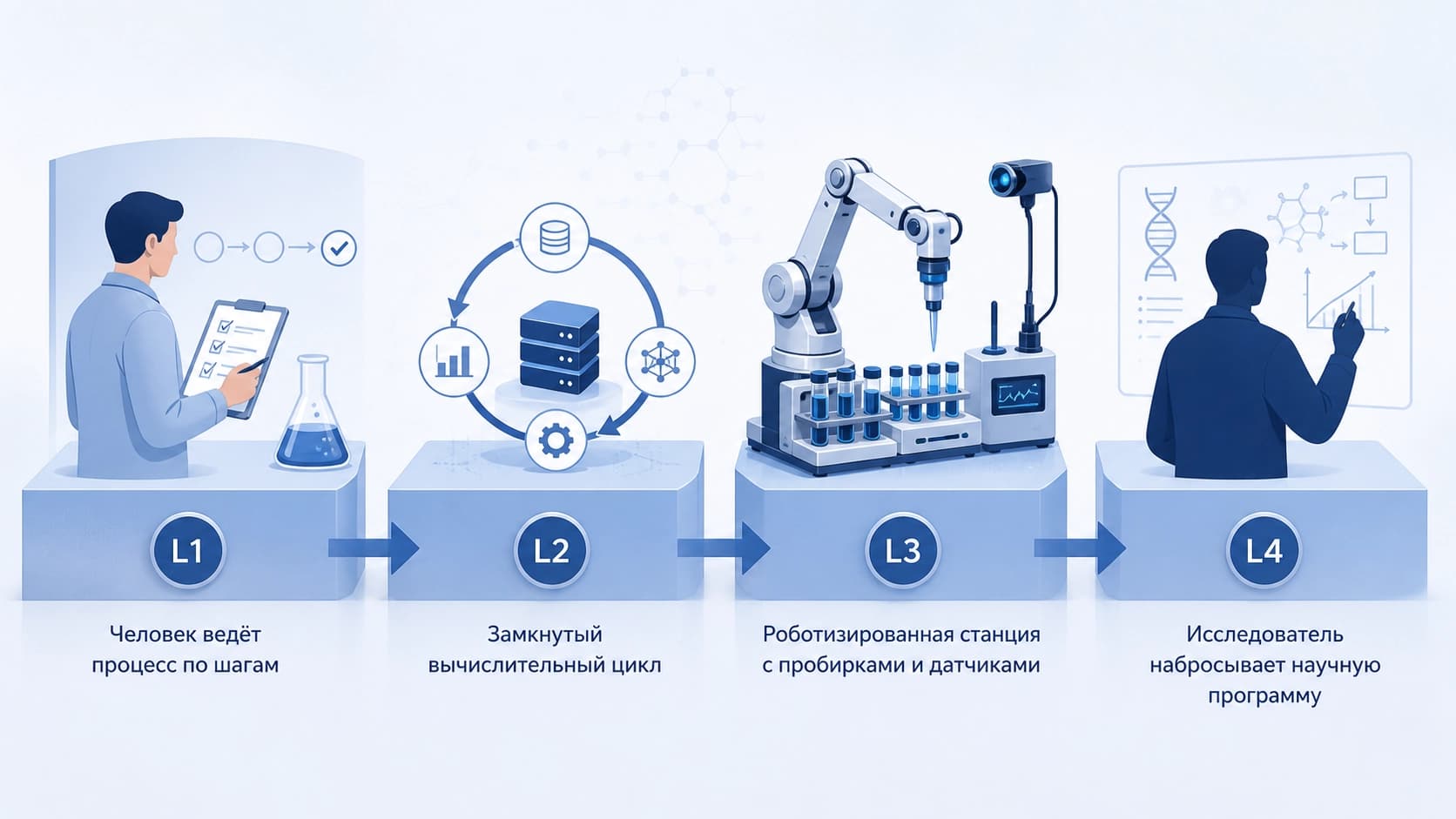
L4 — an agent that shapes the scientific agenda
The top rung is when the system itself chooses which hypotheses to test, which directions to consider priorities, and where to look for gaps in the literature. For now this is more a guideline than a description of working solutions. But it is precisely this that sets the direction: the difference between a "fast executor" and a "co-author who frames the problem" is fundamental, and it is worth pinning down in words rather than by intuition.
Why such a framework is needed
The practical value of the two perspectives lies in the ability to compare the incomparable. If two agents both call themselves "autonomous," but one runs in a simulator while the other controls a synthesis robot, these are systems of a different class of responsibility.
The authors propose using the framework for three tasks:
- Diagnostics. By breaking an agent down into layers, one can see where its weakness lies: in molecular perception, in tools, or in planning.
- Risk assessment. The higher the rung, the more serious the consequences of a failure — and the more important checks become before action rather than after.
- Design. Understanding which level of autonomy is actually needed for a task saves one from the temptation to build L4 where a careful L2 would suffice.
Limitations and what remains unresolved
An honest caveat: the ladder is a conceptual model, not a measured scale. It helps one think, but it does not replace validation, certification, and reproducibility of results. Moreover, chemistry tolerates "almost right" poorly: a typo in text is annoying, but in a structural formula it is already a different substance.
A separate unresolved question is data. Feedback from a real laboratory is expensive and rare, and without it an L3 agent remains theory. The second question is interpretability: a chemist needs to understand why the system proposed this particular synthesis route, otherwise there will be no trust.

In brief, the main points
Molecular LLM agents are not just "chemistry plus a chatbot." They are a separate class of systems in which a language model acts as a dispatcher between graphs, spectra, computational packages, and laboratory equipment. The work arXiv:2608.23104 is useful primarily for its vocabulary: four architectural layers and four rungs of autonomy provide a common language for discussing what such agents can already do, what they lack, and where the boundary lies between a useful acceleration of routine and a decision that is better left to a human.