
Timestamps Instead of Ordinal Indices: T-RoPE Reworks Rotary Positional Encoding for Generative Recommenders
The authors propose replacing event-index-based rotary positional encoding with angles computed from timestamps, using trainable coefficients, multi-scale frequencies, and non-stationary key rotations. The method outperformed baseline solutions on five public benchmarks and in an industrial experiment, while an online test showed increased conversion and order volume at a linear additional cost.

The Indexed RoPE Problem in Recommendations
Standard RoPE rotates representations based on the ordinal index of an interaction. This index does not encode calendar time. The authors of T-RoPE show that RoPE with timestamps is invariant to time shifts. The model cannot distinguish seasonal contexts.
This is a limitation for sequential recommendations. Event order is not the same as event timing. Shifting a window should not change the prediction, but seasonal context does. Indexed RoPE does not capture this difference.
Practical criterion: if the base model is insensitive to time shifts, indexed RoPE alone is not enough.
T-RoPE Architecture
T-RoPE replaces index-based rotation with timestamp-based angles. The method preserves the RoPE interface. Authors: Yang Liu, Noel Loo, Ali Khanafer, Shuying Sun, Akshay Soni, Zhong Wu, and Linjun Yang. The paper was submitted on 24 Sep 2026, arXiv:2609.30576.
Key components:
- learnable temporal coefficients;
- multi-scale frequency banks;
- shifted query alignment;
- non-stationary key rotation.
T-RoPE breaks invariance to time shifts. This distinguishes it from standard RoPE with timestamps.
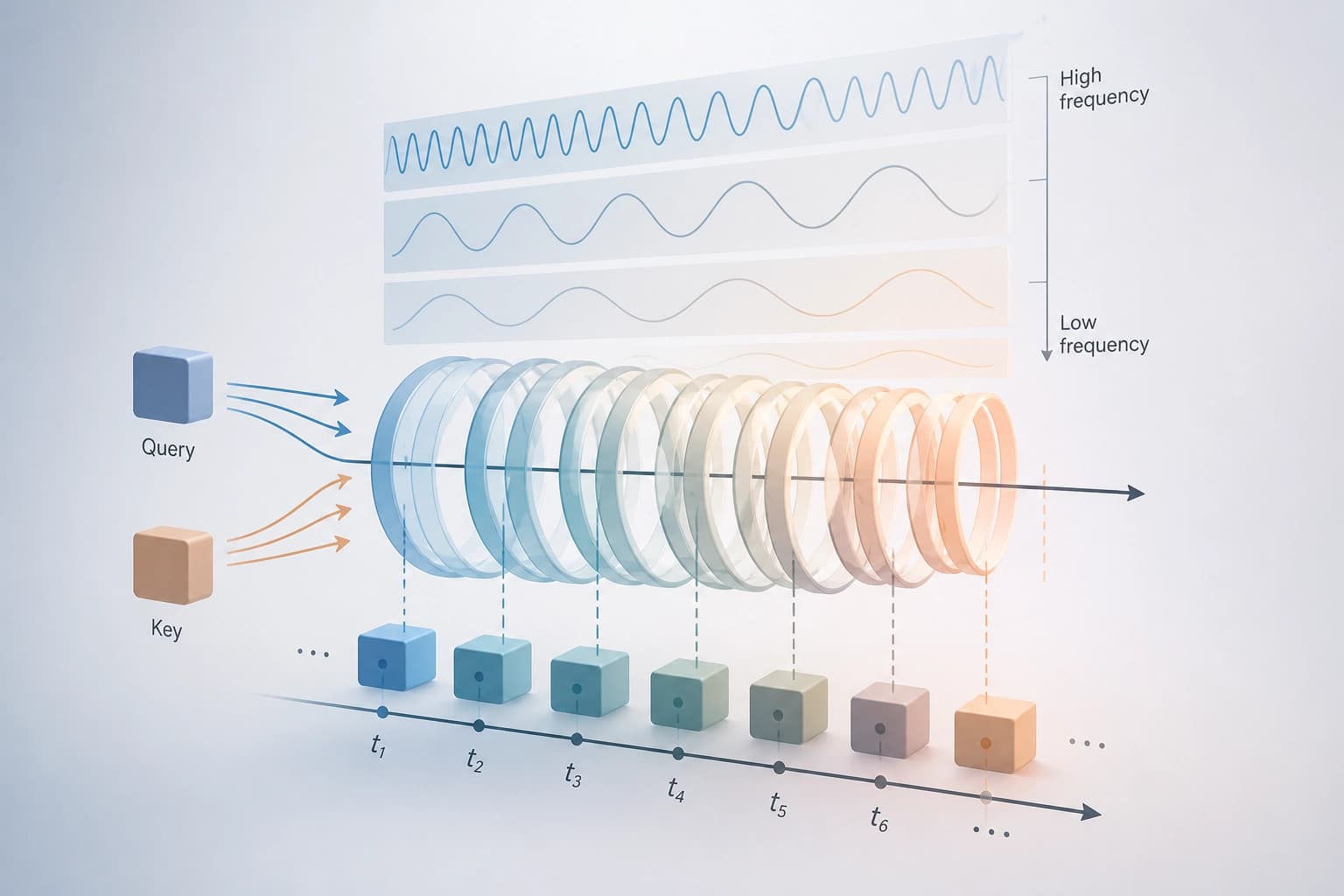
Practical criterion: the preserved RoPE interface makes it possible to test T-RoPE in an existing generative recommendation model.
Results on Public Benchmarks
T-RoPE achieved the best results on every metric across all five public benchmarks. Comparison with the strongest baseline:
| Dataset | Metric | Improvement |
|---|---|---|
| PixelRec, sparse data | HR@10 | 78–130% |
| Amazon Books | metrics | 8–12% |
The gains are larger on sparse data. On Amazon Books, the improvement is smaller, but still positive.
Practical criterion: with sparse interactions, T-RoPE delivers the largest margin in HR@10.
Ablations and Industrial Dataset
The industrial e-commerce dataset contains more than 6B interactions. On this dataset, T-RoPE improved all metrics over the HSTU + Time RAB baseline by 13–82%.
Ablations showed the contribution of each component:
- multi-scale frequencies: +56% NDCG@50;
- non-stationary keys: +4%.
Multi-scale frequencies account for most of the gain. Non-stationary keys contribute less, but their impact is positive.
Practical criterion: multi-scale frequencies are the priority component to test.
Online A/B Test and Cost
An online A/B test in the Shop app showed positive changes. Conversion increased by 0.33%, and the number of orders by 0.63%.
The additional cost of the forward and backward passes scales linearly with sequence length and head dimension. The increase in cost is predictable.
Practical criterion: the method is suitable for production if the linear increase in compute cost is acceptable.
Selection Criteria
T-RoPE is worth considering when the following conditions apply:
- the base model uses RoPE and is insensitive to time shifts;
- seasonal contexts in the sequence matter;
- the data is sparse or contains long sequences;
- compatibility with the existing RoPE interface is needed;
- a linear increase in the cost of forward and backward passes is acceptable.
The method does not replace the base architecture. It changes how positions and time are encoded. If timestamps already carry useful signal, T-RoPE provides a way to use it without changing the interface.
The evaluation criterion is a comparison of T-RoPE with the current RoPE on production data. Key metrics: HR@10, NDCG@50, conversion, and number of orders.
Frequently asked questions
Related materials
All materials
OpenCollab: programmable agent coordination, controlled execution environment, and policy compliance metric
The framework brings together the specification of agent interaction structures, a shared environment for experiments, and detailed event tracing, while the newly introduced Adherence metric reflects how closely actual execution follows the declared schema. In benchmarks, the Duo configuration achieves a new state of the art, while the single-agent variant uses the fewest tokens.
11 November 2026
Toollery: Choose tools for LLM agents from tens of thousands of options without fine-tuning
Toollery builds a search index from descriptions of skills and tools, then passes the model only a limited set of candidates for each query. In experiments with libraries containing tens of thousands of functions, the approach helps maintain selection quality at a fixed top-K, although the overall effect depends on the workload profile and the provider’s caching.
11 November 2026
WILSON: combining magnifications and patient slides for pathomorphological analysis and report generation
The preprint introduces WILSON, a vision-language model that encodes images of whole slides and series of slides from a single patient at different magnifications, rather than just a single “best” slide. Without task-specific fine-tuning, it outperforms specialized and larger slide models on a range of metrics while requiring substantially less compute, and its diagnostic descriptions received higher ratings from pathologists.
11 November 2026