
Star S301 has approached the black hole at the center of the Galaxy closer than any other: its orbit will reveal the rotation of Sgr A*
The star S301, discovered with ESO's telescope, orbits Sagittarius A* on an extremely elongated orbit and accelerates to 25,000 km/s at its pericenter. Observations of this motion will make it possible to measure the spin of the central black hole and test its geometry within about ten years.
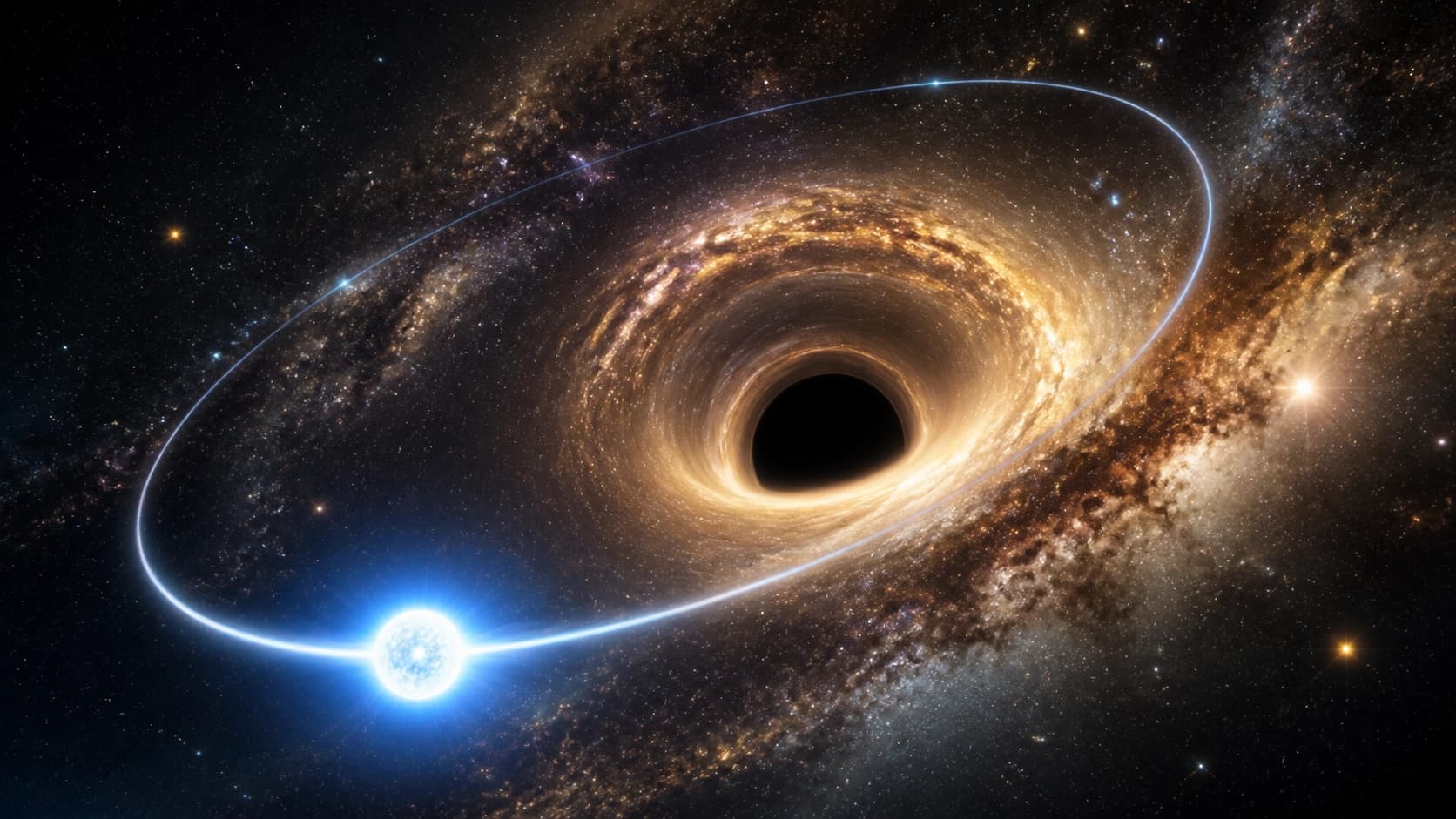
At the center of the Milky Way lies a supermassive black hole that astronomers know by the designation Sgr A*. It was discovered back in the 1970s, but for a long time the object remained just a point on the map of the sky: neither its mass nor its size could be measured directly. Everything we know about Sgr A* has been obtained indirectly—through the motion of the stars that orbit it. Based on this data, the black hole's mass is close to 10^37 kilograms, making it a true giant even by galactic standards. A direct image was only obtained in the last few years, and now scientists have the opportunity to study this object in much greater detail than before.
Star S301: a record-breaker among orbits
The GRAVITY instrument, mounted on the Very Large Telescope of the European Southern Observatory, is used to observe the region around Sgr A*. The device combines the light of four mirrors into a single system, providing resolution comparable to the capabilities of a hypothetical telescope 130 meters in diameter. It was GRAVITY that allowed a team of astronomers to track the motion of stars near the black hole's event horizon starting in 2017. In 2023, the observations yielded an unexpected result: a star, designated S301, was discovered that behaves completely differently from the others.
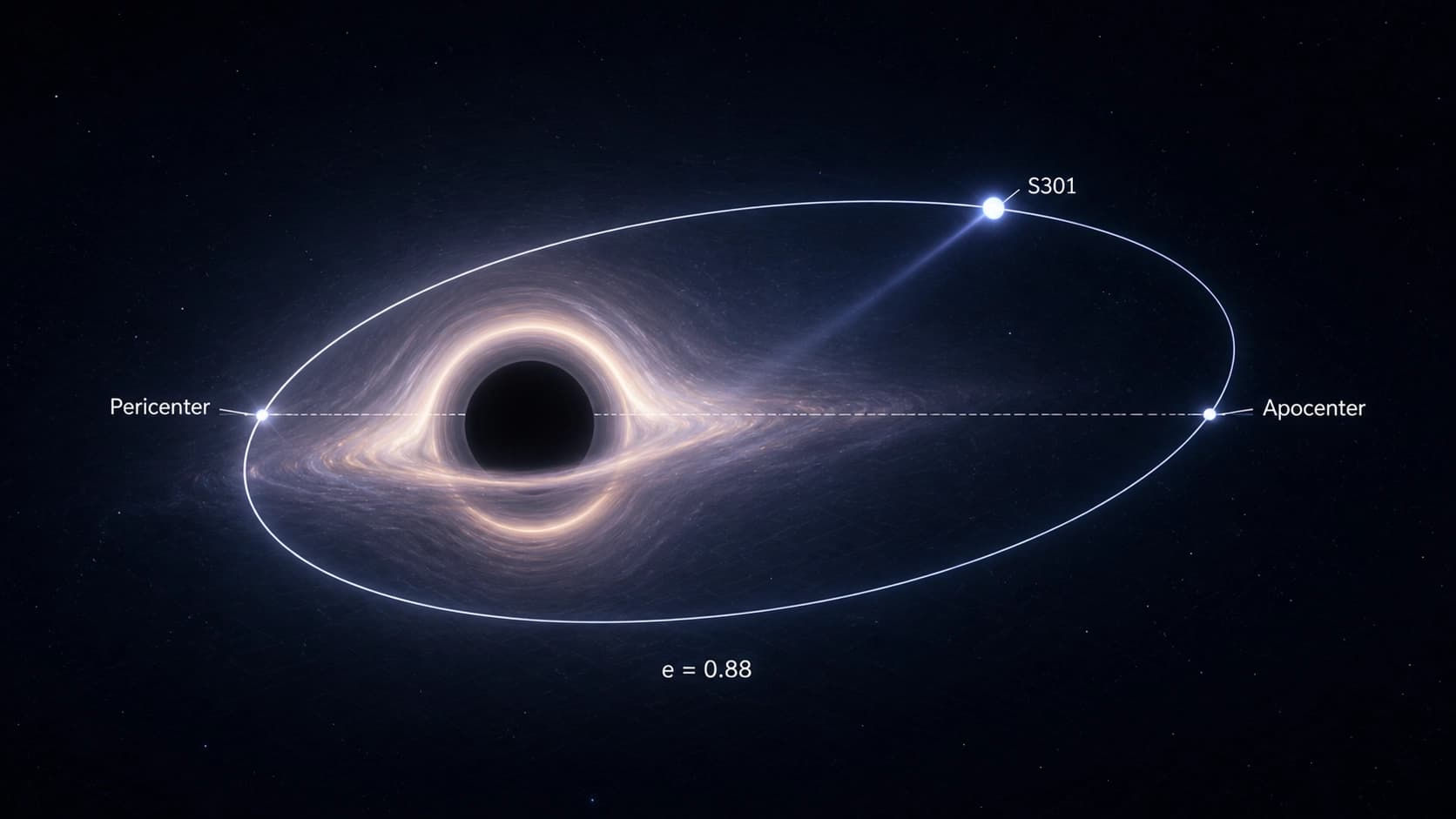
S301's orbit turned out to be extremely elongated. Its orbital period is only 8.7 years—more than three years faster than any known star in this region. The orbit's eccentricity, that is, the degree of its deviation from a circle, is 0.9832. For comparison, even Pluto, which is considered the champion of elongation among the planets of the Solar System, has a figure of only 0.25. In essence, S301's orbit is so close to parabolic that the star is literally on the verge of escaping the black hole's gravitational grip.
At the point of closest approach, which astronomers call the pericenter, S301 accelerates to a speed of about 25,000 kilometers per second—more than eight percent of the speed of light. The distance to the black hole at this moment shrinks to roughly 11 astronomical units, only slightly more than the distance from the Sun to Saturn. According to the researchers, S301 passes ten times closer to Sgr A* than any other known object. The star is almost one and a half times larger than the Sun, and had it been more massive, the black hole's gravity would most likely have torn it apart. The fact that S301 remained intact suggests that we are observing a rare case where nature seems to have deliberately selected parameters that allow the star to survive.
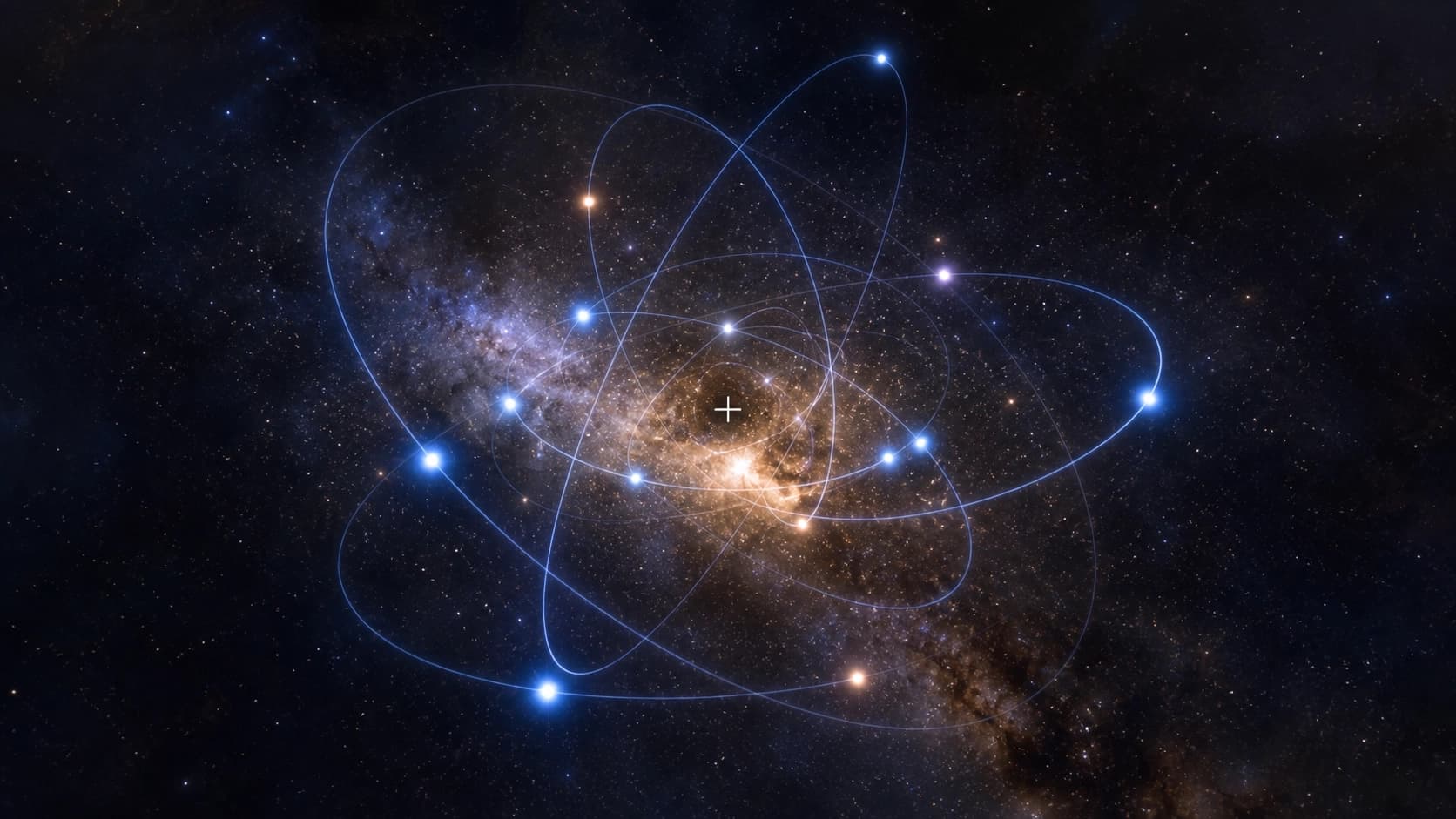
The origin of S301 is probably unusual as well. Astronomers believe the star was once part of a binary system that came too close to Sgr A*. The black hole's powerful gravitational field could have disrupted the pair, flinging S301's companion away and sending the star itself onto a new, much tighter orbit. This explanation is consistent with the observed dynamics and helps us understand how such extreme trajectories form at the center of the galaxy.
What S301's orbit will tell us about the spin of Sgr A*
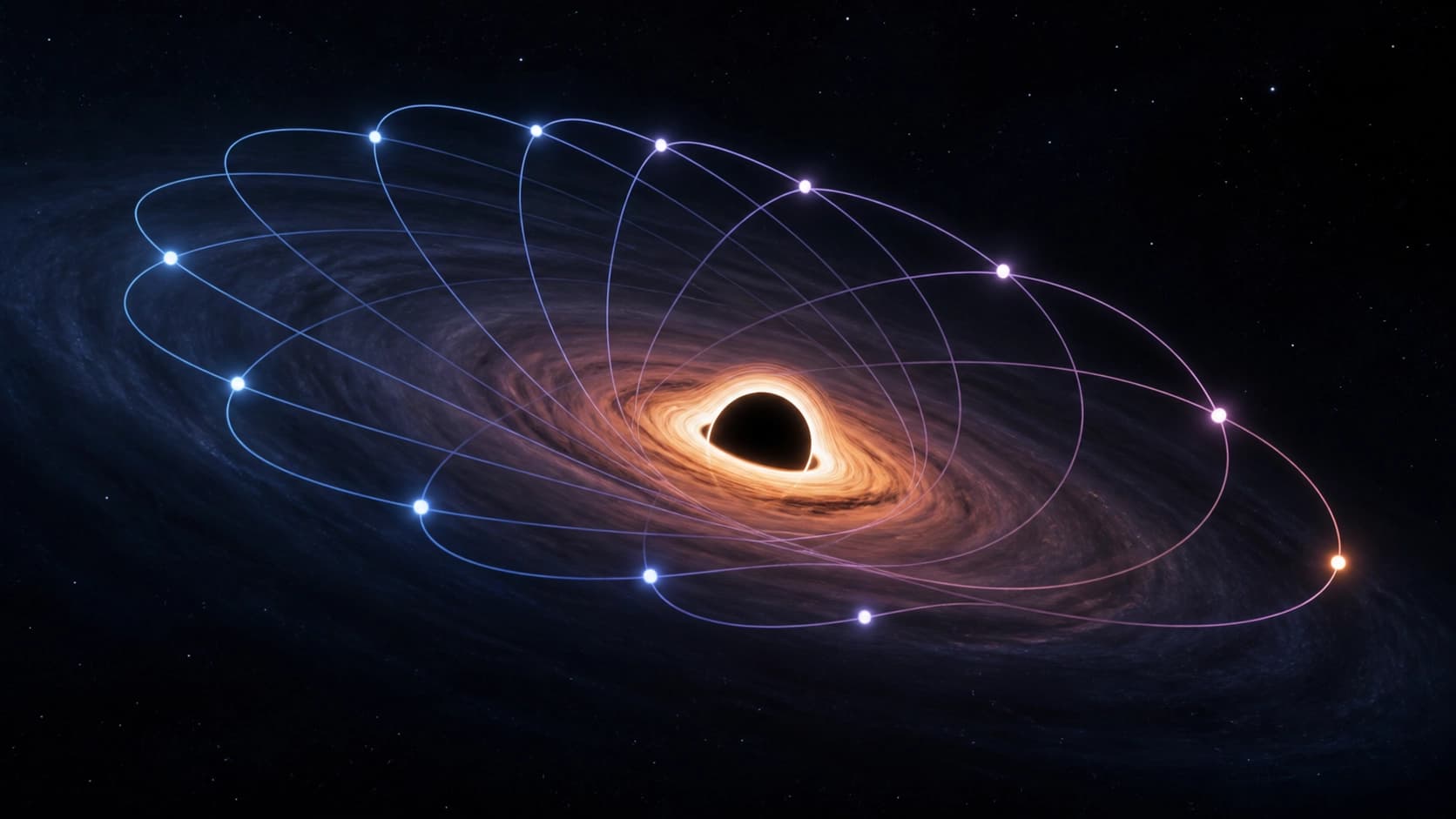
Such a tight orbit is already a scientific sensation in itself, but the main value of S301 is that it provides an opportunity to measure something that was previously inaccessible: the black hole's spin. According to the general theory of relativity, a rotating massive object drags spacetime itself along with it. For a black hole, this manifests in the fact that the orbit of any body passing close enough gradually rotates—the so-called precession. The magnitude of this effect directly depends on how fast the black hole is spinning.
The problem is that precession rapidly decreases with distance: it diminishes in proportion to the cube of the orbital radius. For most stars known around Sgr A*, this means that a noticeable shift in the pericenter would only accumulate over thousands of years of continuous observation. S301 is so close that the precession effect should become measurable within ten years. According to the researchers' estimates, even existing instruments are capable of tracking this star's orbit with sufficient precision to estimate the spin of Sgr A*.
If observations confirm the theory's predictions, it will become a crucial step in understanding not only Sgr A* but also the physics of black holes in general. Further improvements in telescope resolution or the accumulation of a longer data series will allow scientists to go even further—to test whether the black hole is a perfectly spherical object or whether its gravitational field has additional features beyond mass and spin. Such tests will open a new level of precision in studying the most extreme objects in the Universe and, perhaps, bring us closer to answering the question of how spacetime is structured under extreme conditions.
For now, S301 remains a unique object—the only known star capable of telling us about the rotation of Sgr A* without additional technical tricks. All that remains is to patiently observe it, and in about ten years, we may obtain one of the most accurate portraits of the black hole at the center of our Galaxy.
Frequently asked questions
Related materials
All materials
Checking LLM Hallucinations via SQL-Based Source Representation Without Fine-Tuning
The study examines whether an LLM can apply a basic symbolic skill—building a SQL database from source documents—to ground its outputs in sources without supervision when detecting hallucinations. On RAGTruth and DiaHalu, this neuro-symbolic pipeline proves more accurate than direct prediction and comparable to state-of-the-art methods, without requiring domain-specific fine-tuning.
9 November 2026
MathAdv: What the Final Accuracy of Machine-Generated Proofs Conceals
A diagnostic suite of tasks spanning 13 undergraduate and graduate mathematics topics evaluates machine-proving systems in Lean 4 not only by their final results, but also by their subject-matter mastery, the quality of their informal reasoning, and their robustness to rephrased conditions. A component-by-component analysis shows that translating a problem into formal form remains the main obstacle, and that success depends heavily on the area of mathematics and how the problem is framed.
9 November 2026
AffordanceWAM: Affordances as an intermediary between scene prediction and manipulator control
The work describes a generative model that jointly predicts future RGB observations, scalar fields, affordance heatmaps, and continuous robot commands, using human videos to broaden interaction diversity without action annotations or retargeting. On RoboCasa, CALVIN ABC→D, and real-world tasks, the approach delivers consistent gains over RGB-only and robot-data-only baselines.
9 November 2026