
ST-EVO: multi-agent systems learn to build communication in space and time on their own
The new approach allows LLM agents not only to adapt communication structure to the task but also to restructure it mid-dialogue, accumulating experience. Across nine benchmarks, ST-EVO showed accuracy gains of 5 to 25% compared to previous methods.

Why multi-agent systems stop working according to a script
Large language models can team up: one agent collects data, another checks facts, and a third formulates the final answer. Until recently, such connections were designed in advance: the developer specified who talks to whom and in what order. This works well while tasks are similar. But as soon as a complex, non-standard request comes in, the rigid scheme starts to get in the way: some agents sit idle, others run into each other's mistakes, and the reasoning chain becomes too long or too short.
The solution is the so-called self-evolving multi-agent systems. Instead of a static template, they adapt their workflow on the fly: assigning roles, rearranging the order of steps, and deciding which agents should communicate right now. It is to this class that the research approach called ST-EVO belongs.
Spatial and temporal evolution: why one dimension is not enough
Most current self-organization algorithms for agents develop communication in only one of two directions.
Spatial evolution answers the question "who to talk to": the system changes the topology of connections between agents to fit the current request. It can add a new participant, remove an unnecessary one, or redistribute subtasks among the executors.
Temporal evolution answers the question "in what order to act": the system lengthens, shortens, or rearranges reasoning stages to better match the structure of the task.
Each dimension on its own improves system performance, but not completely. Spatial tuning ignores accumulated experience and process dynamics; temporal tuning does not account for who exactly each next step is addressed to. The authors of ST-EVO propose looking at both dimensions simultaneously and planning communication in space and time: what matters is not only which agents take part in the dialogue, but also at what point they join the discussion.
How the agent communication "schedule" is built
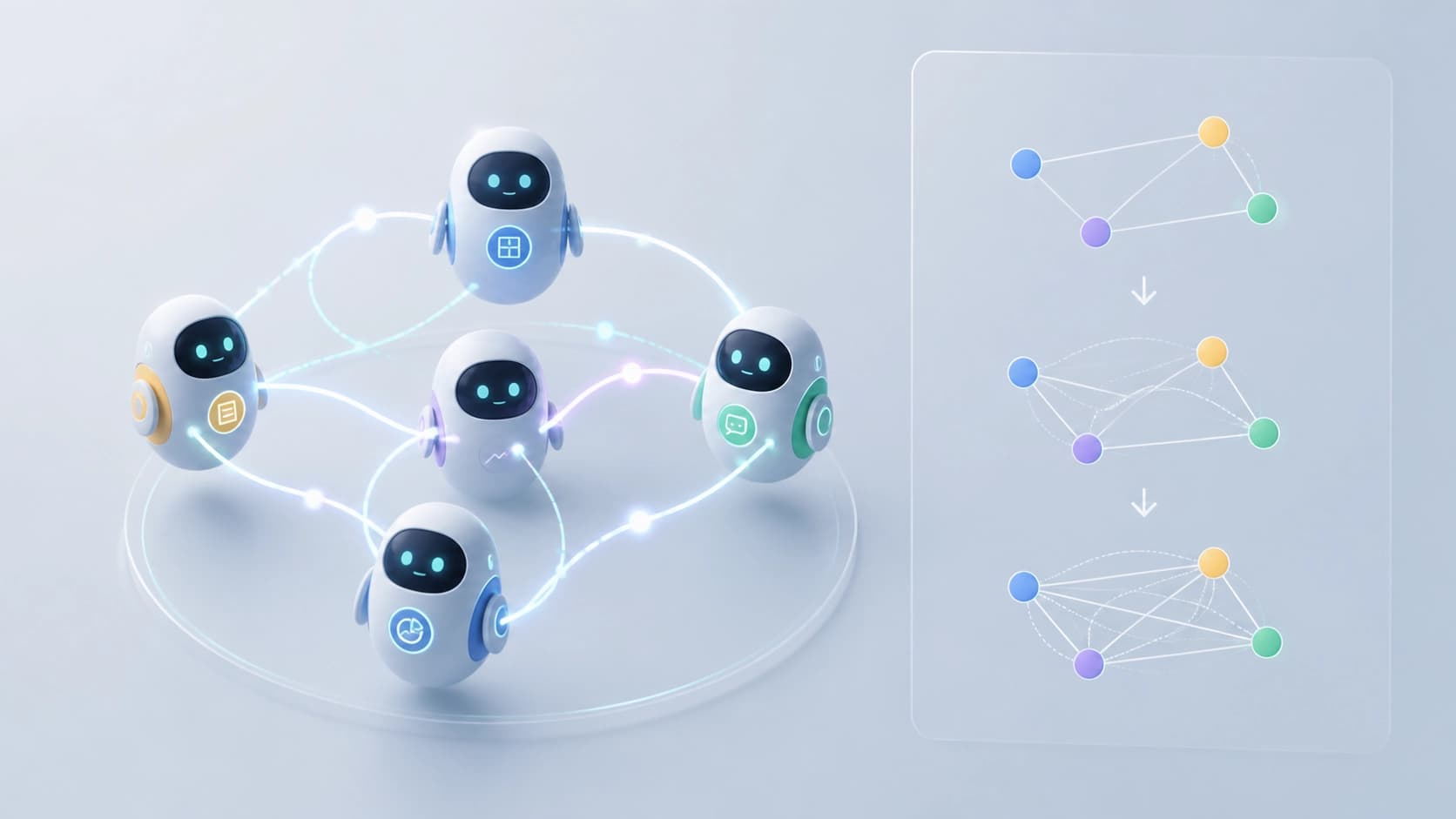
Inside ST-EVO, a planner based on flow matching is responsible for restructuring interactions — a generative approach that can smoothly transition one distribution of possible structures into another. Instead of iterating over all connection options, the system predicts which dialogue scheme variant will be next. Such a planner operates not at the level of individual "utterances" between agents, but at the level of dialogue routing: it decides between which participants communication should occur at a given moment.
An important detail is the system's ability to sense its own uncertainty. If an agent is unsure about an intermediate result, ST-EVO can adjust the data transmission route: for example, redirect the request to another agent, add an extra verification step, or completely change the role distribution. Additionally, the system receives self-feedback: after completing tasks, it accumulates successful and unsuccessful scenarios so that next time it can find an effective communication topology faster.
What the experiments showed
The researchers tested ST-EVO on nine benchmarks covering different types of tasks — from data analysis to complex reasoning. Almost everywhere, the approach achieved state-of-the-art results: accuracy gains ranged from approximately 5% to 25% compared to alternative methods. This variation is explained by the fact that for some task types, replacing a static scenario with a dynamic one yields more benefit than for others.

What this means in practice
ST-EVO looks not just like another way to "slightly tweak agents," but like a step toward full self-organization of complex systems. If development continues in this direction, over time the difference between a designed process and the actual behavior of agents will become almost imperceptible. Systems will be able to decide for themselves when to restructure, whom to bring into the conversation, and how to use past experience — without the need to manually describe all possible scenarios.
Frequently asked questions
Related materials
All materials
Checking LLM Hallucinations via SQL-Based Source Representation Without Fine-Tuning
The study examines whether an LLM can apply a basic symbolic skill—building a SQL database from source documents—to ground its outputs in sources without supervision when detecting hallucinations. On RAGTruth and DiaHalu, this neuro-symbolic pipeline proves more accurate than direct prediction and comparable to state-of-the-art methods, without requiring domain-specific fine-tuning.
9 November 2026
MathAdv: What the Final Accuracy of Machine-Generated Proofs Conceals
A diagnostic suite of tasks spanning 13 undergraduate and graduate mathematics topics evaluates machine-proving systems in Lean 4 not only by their final results, but also by their subject-matter mastery, the quality of their informal reasoning, and their robustness to rephrased conditions. A component-by-component analysis shows that translating a problem into formal form remains the main obstacle, and that success depends heavily on the area of mathematics and how the problem is framed.
9 November 2026
AffordanceWAM: Affordances as an intermediary between scene prediction and manipulator control
The work describes a generative model that jointly predicts future RGB observations, scalar fields, affordance heatmaps, and continuous robot commands, using human videos to broaden interaction diversity without action annotations or retargeting. On RoboCasa, CALVIN ABC→D, and real-world tasks, the approach delivers consistent gains over RGB-only and robot-data-only baselines.
9 November 2026