
Spiking neural networks are usually discussed in the context of energy efficiency: sparse events instead of dense multiplications, sparse activity instead of a constant clock. But this class of models has a second resource that almost always remains untapped: the membrane potential, continuously changing over time. A recent paper proposes viewing it not as an intermediate variable, but as a full-fledged belief state — and building decisions about what to consider next on top of it.
The problem: a point cloud is scanned along the same route every time
When a spiking network is applied to 3D data, scene fragments are usually traversed in a predetermined order — the same for all inputs. The traversal order does not depend on what exactly is in the point cloud. The result is a strange asymmetry: the most characteristic feature of spiking computation, the temporal evolution of the membrane potential, has no effect on which data the network sees or when it stops. The decision is made "outside" the dynamics, not within them.

Active Spiking Perception: the membrane is in charge of selection
The Active Spiking Perception (ASP) method unfolds recognition into an iterative loop. The network observes one fragment, updates the state of LIF (leaky integrate-and-fire) neurons, and reads its membrane potential as the current hypothesis about the class — a running belief. It is this hypothesis that determines which fragment will come into view next, and a noticeable lead of the frontrunner by margin serves as a signal for early stopping.
The idea is simple, but it changes the role of the potential: it ceases to be a service quantity between layers and becomes an interface through which the network "explains" to itself what it lacks for an answer.
How the selection policy works
A lightweight Slice-Selection Policy module is responsible for the choice. Candidates for the next look are drawn from farthest-point sampling and scored by two things: the current state of the membrane and precomputed geometric descriptors. Training is end-to-end via straight-through Gumbel-Softmax, and at inference the scheme degenerates into a plain argmax. The overhead is modest — on the order of 2% of the backbone's parameter count.
Why this is not just a heuristic
The authors provide a theoretical foundation for the design. First: the mechanics of leaky integration can be viewed as a recursive update of the log posterior probability in a Bayesian filter — that is, the accumulation of potential is equivalent to the accumulation of evidence. Second: the stopping rule provides distribution-free selective risk, and without a penalty for multiple comparisons at the moment the network decides to stop observing. Third: carrying the streaming state between steps is equivalent to recomputing from scratch over the prefix of observations — provided the drift of finite precision is bounded.
What the experiments showed
On ModelNet40 the method achieves 90.62%, on ModelNet10 — 93.28%. That is 1.7 percentage points below the strongest spiking baseline, and the baseline uses a larger backbone. So peak accuracy is not the paper's main argument. The argument is different: ASP adds a certified anytime interface that none of the compared approaches provides.
The mechanism also scales to dense predictions: 83.21 instance mIoU on ShapeNetPart and 48.50 mIoU on S3DIS Area 5. The authors call the latter result the first spiking one on this dataset.
A separate storyline is transferability. If the learned fragment selection is replaced with a fixed one, the same logic keeps working on a foveated non-spiking transformer. So the policy is not a property of a particular spiking architecture, but a standalone technique.
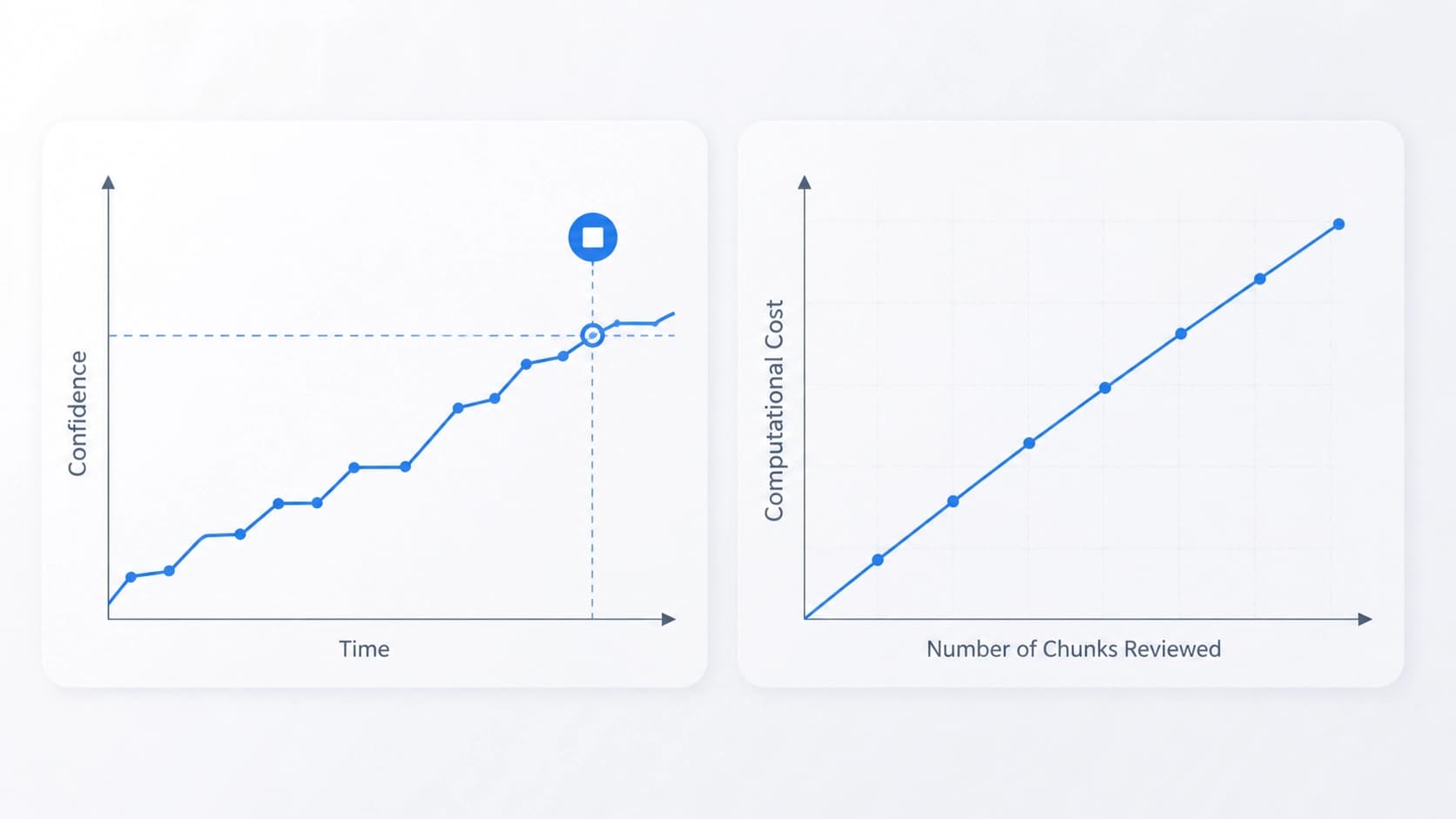
The threshold as a knob for computation
Inference cost grows strictly linearly with the number of observations — a consequence of the network processing fragments one at a time. The confidence threshold becomes a measurable regulator: raising it can make the model look longer and more accurately, lowering it yields an answer faster. The authors estimate the gain at a range from 2.8x to 1.35x lower energy consumption relative to comparable variants. The practical meaning is obvious: the same solution suits both a server scenario, where accuracy matters, and an onboard one, where the budget matters more.
Limitations and where to go next
At least one bottleneck is honestly stated: one of the classes in S3DIS cannot be recognized at the crop size used. The authors do not hide this, but provide the prediction that would remove the problem — in essence, a hint for the next iteration of the work.
Bottom line
The main value of the work is not in the benchmark numbers, but in the shift of framing. The membrane potential here is not a byproduct of integration, but a belief state from which both the choice of action and the stopping criterion are derived. Three consequences grow out of this: an anytime mode with certified guarantees appears, cost becomes linear and controllable by a single parameter, and the selection policy itself turns out to be transferable to other architectures, including non-spiking ones.
In other words, spiking models have turned out to have not only an energy resource but also a "decision-making" one. And it can be used without rewriting the backbone from scratch.
Technical details are laid out in the arXiv preprint arXiv:2608.19232 (cs.NE, cs.AI, cs.LG; ACM I.2.10, I.5.1, I.2.6), version v1 dated August 4, 2026, v2 — August 22. The length is 28 pages, 9 figures, 17 tables, and appendices A–J.