
SPACE: adaptive ellipsoids for robust forecasting of multivariate time series
A new conformal method, SPACE, builds joint prediction regions based on the current cloud of predictive samples and dynamically adjusts the calibration window. This allows it to more accurately maintain the stated coverage level even when the data distribution shifts.

Introduction: why ordinary intervals are unreliable
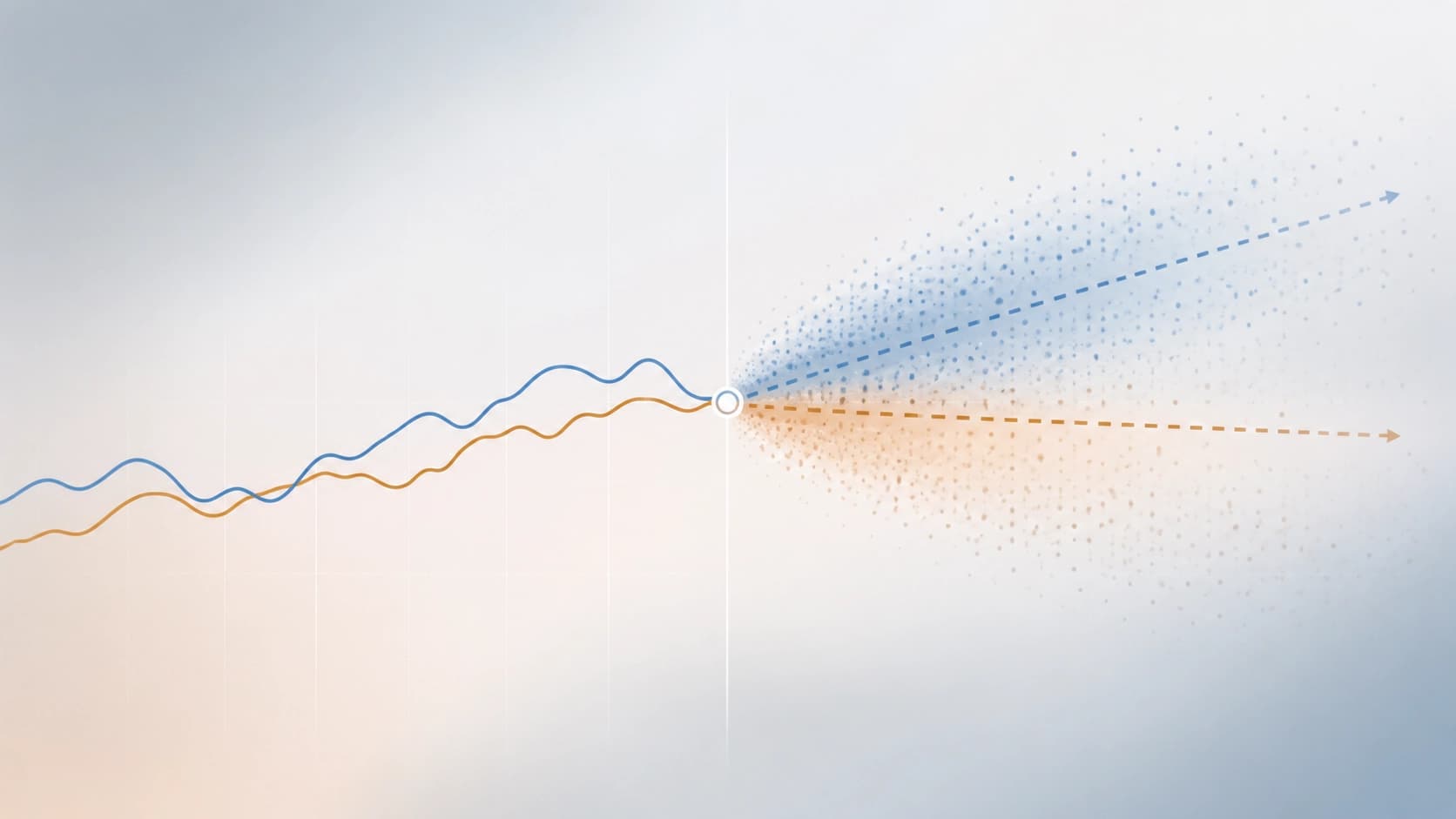
When a model forecasts multiple time series simultaneously, it often returns not a single point value but an entire distribution of possible scenarios — for example, as a set of samples. This is convenient for uncertainty analysis, but practical decisions require clear boundaries: "with 95% probability the metric will fall within such a range." The simplest way to build them is to take empirical quantiles from the samples for each series separately. However, this approach yields only a set of independent intervals, ignoring the correlation between series. Moreover, these intervals have no formal guarantees: the actual coverage frequency can deviate noticeably from the stated one, especially when the data distribution changes over time.
How SPACE builds adaptive ellipsoids
A group of researchers — Baishi Li, Kelvin J. L. Kwa, and Ke-Wei Huang — proposed the SPACE method (Sample-cloud Predictive Adaptive Conformal Ellipsoids). It is a universal wrapper that can be attached to any probabilistic model generating predictive samples. Instead of deriving the shape of the region from historical errors, SPACE looks at the current cloud of samples the model has produced for the present moment.
Estimating covariance from samples
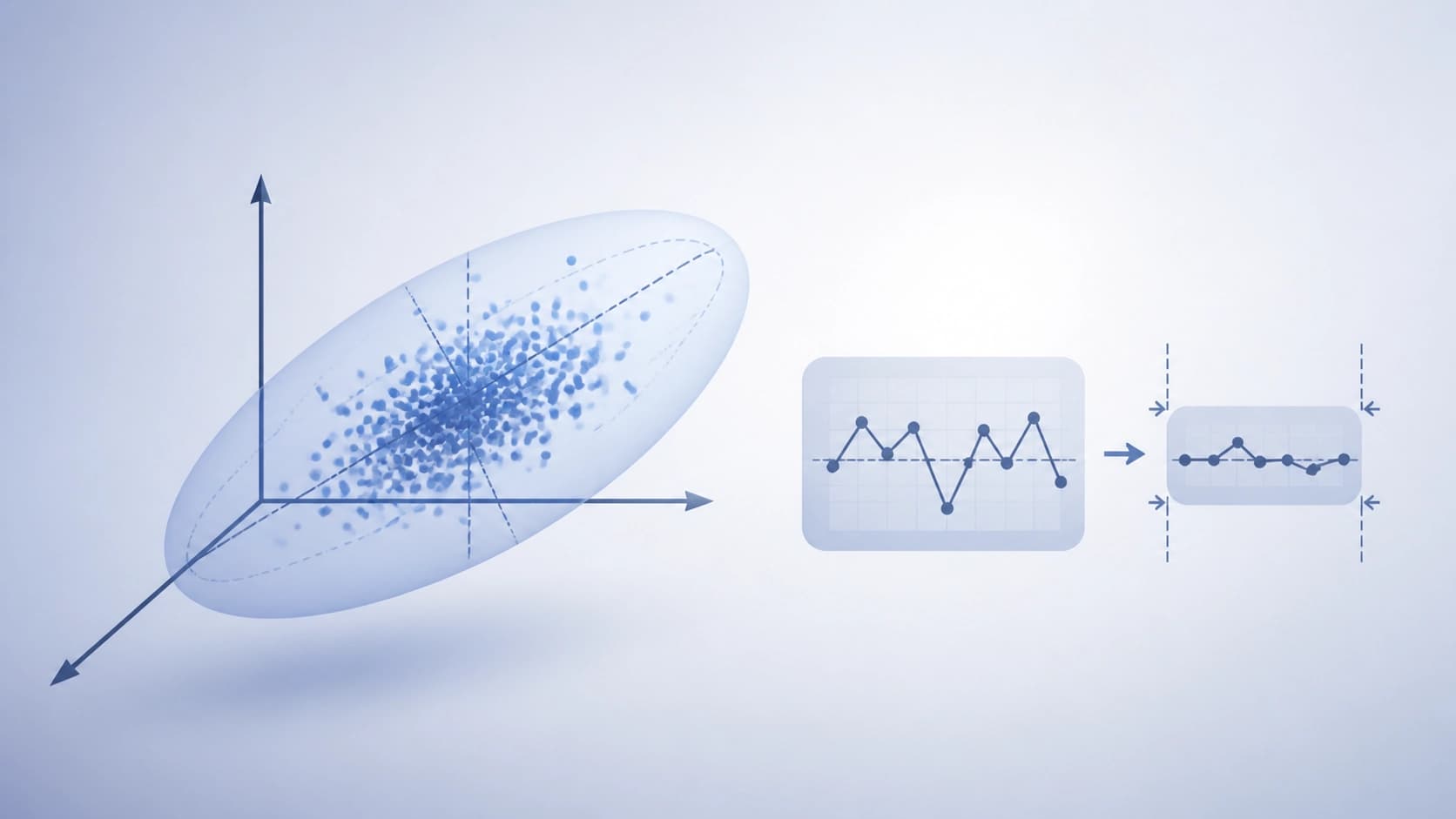
The key idea is to compute the local covariance structure directly from the current set of predictive points. This structure shows how values are scattered across each series and how they are interrelated. Based on it, an ellipsoid is built — a multidimensional "blob" oriented along the main directions of dependence between series. Such a shape is far more accurate than a rectangle of independent quantiles: it does not capture empty zones where samples rarely fall, and at the same coverage level it requires less space.
Dynamic radius calibration
However, an ellipsoid built from current samples is not enough — its size needs to be calibrated so that actual coverage matches the target (e.g., 90%). SPACE solves this with a dynamic scheme for selecting a lookback window. The algorithm itself decides how many recent errors to account for: if the distribution is stable, the window lengthens to use more data; if a shift has occurred, the window shortens to avoid contaminating calibration with outdated information.
Results and comparison
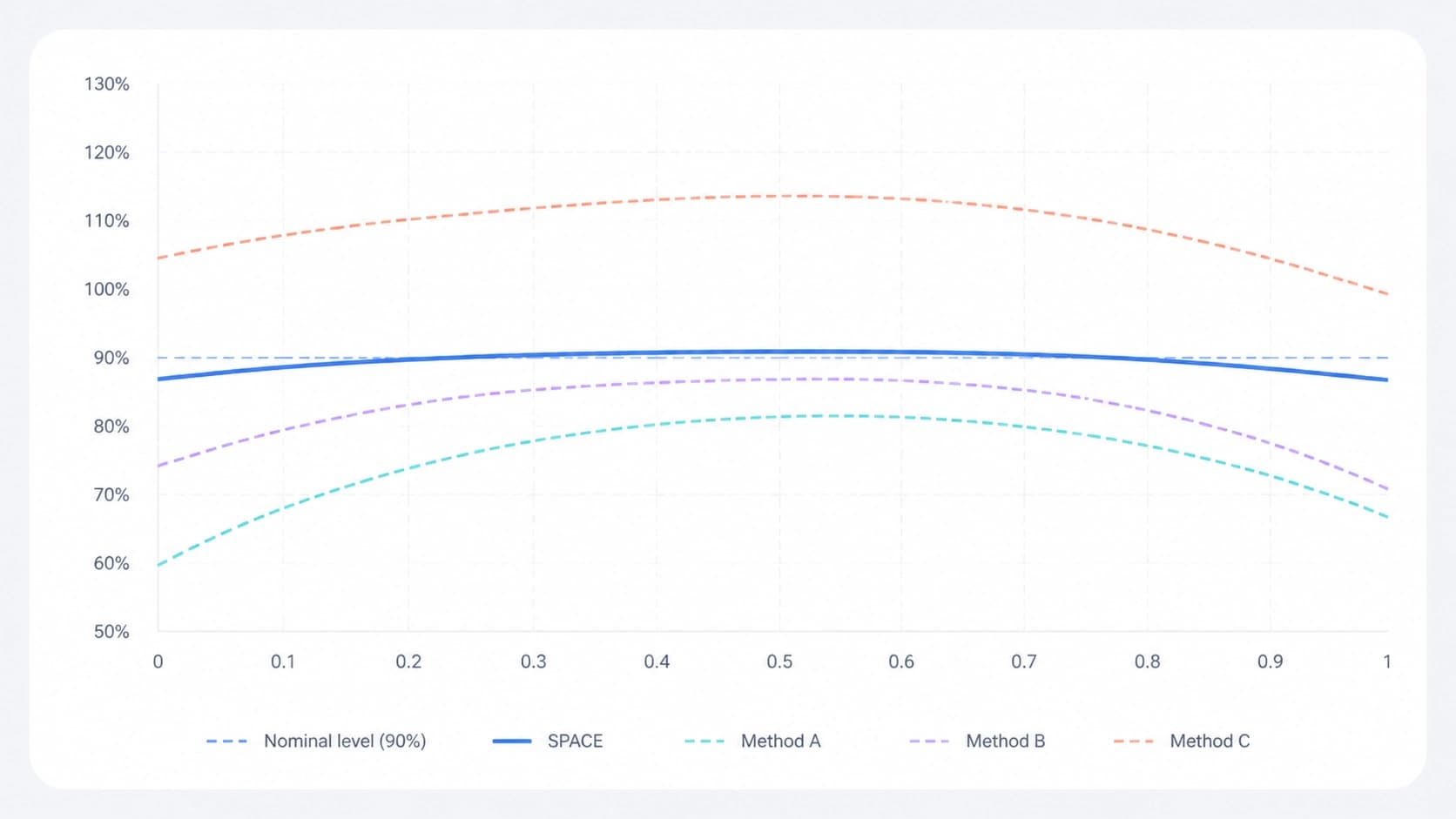
In experiments on various multivariate datasets and with different probabilistic models, SPACE was compared with existing conformal methods that use fixed or accumulating windows of historical residuals. The results consistently show that SPACE brings actual joint coverage and rolling coverage closer to the nominal level. If 90% is stated, then over time roughly 90% of new observations indeed fall inside the region.
At the same time, it achieves a better trade-off between coverage completeness and efficiency: the region does not inflate to meaningless sizes but remains sufficiently compact. Compared with competing wrappers, SPACE either provides more accurate coverage at the same area or requires a smaller area while maintaining target coverage.
Practical significance
For business and engineering, honest prediction intervals are a matter of decision quality. An interval that is too narrow leads to underestimating risks; one that is too wide devalues the forecast. SPACE helps build multivariate regions that retain guarantees even during unstable periods. This is especially important for financial markets, logistics, technical system monitoring, and inventory management, where changes happen quickly and any delay in algorithm adaptation is costly.
Conclusion
SPACE solves a long-standing problem in conformal forecasting: it stops being a hostage of the past and starts using the information embedded in the current prediction. Dynamic radius calibration makes the method robust to regime shifts, and the ellipsoidal shape naturally accounts for correlations between series. This is a practical step forward that makes multivariate probabilistic forecasting more reliable and suitable for real-world tasks.
Frequently asked questions
Related materials
All materials
MathAdv: What the Final Accuracy of Machine-Generated Proofs Conceals
A diagnostic suite of tasks spanning 13 undergraduate and graduate mathematics topics evaluates machine-proving systems in Lean 4 not only by their final results, but also by their subject-matter mastery, the quality of their informal reasoning, and their robustness to rephrased conditions. A component-by-component analysis shows that translating a problem into formal form remains the main obstacle, and that success depends heavily on the area of mathematics and how the problem is framed.
9 November 2026
AffordanceWAM: Affordances as an intermediary between scene prediction and manipulator control
The work describes a generative model that jointly predicts future RGB observations, scalar fields, affordance heatmaps, and continuous robot commands, using human videos to broaden interaction diversity without action annotations or retargeting. On RoboCasa, CALVIN ABC→D, and real-world tasks, the approach delivers consistent gains over RGB-only and robot-data-only baselines.
9 November 2026
Presentation Editing as Controlled Operations: The EditPPT Framework and DeckEdit-Bench Benchmark
The authors break down slide editing into specific objects, permitted actions, and checks to ensure unrelated content remains untouched, rather than relying on free-form code generation. To measure quality, they created DeckEdit-Bench (183 tasks across 28 human-made presentations), and the multi-agent EditPPT framework achieves a 66.7–74.9% task success rate across five base models while preserving over 97% of the content.
8 November 2026