
Director's Eye: Why Storyboarding Is the Bottleneck
Storyboarding turns a script into a sequence of visual shots: where the camera stands, what the characters do, how the angle changes. In short-drama production, this stage directly determines how alive a scene will feel. But professional storyboard artists rely on experience that is hard to put into words. This tacit knowledge is the main reason automation stalls here.
One might think a large language model could be taught storyboarding through examples. However, three obstacles arise along the way:
- Knowledge acquisition. A director's craft is not on the surface: it is implicitly present in examples, and writing it down manually is slow and expensive.
- Knowledge refinement. Hand-crafted rules are not validated in practice. When a model generates a storyboard, it is impossible to tell which rule led to an error, and opaque generation does not allow feedback to be tied to a specific decision.
- Knowledge deployment. Even if a complete set of rules were collected, it would not fit into the model's context. And manually selecting rules for each genre or story group is prohibitively time-consuming.
Because of this, storyboarding remains a "bottleneck" in the industry: it requires expensive specialists and slows down the entire pipeline. If a model could be taught to work with director's rules, short-drama production could be significantly accelerated — this is exactly the problem a new development tackles.

SAGE: Rules That Evolve
A group of eight researchers presented the SAGE framework (Self-Evolving Storyboard Skills via Attribution-Guided Rule Evolution) on arXiv. The paper was published on August 18, 2026, identifier 2608.17468, category cs.AI. The core idea is not to make the model memorize others' examples, but to teach it to extract and update director's rules.
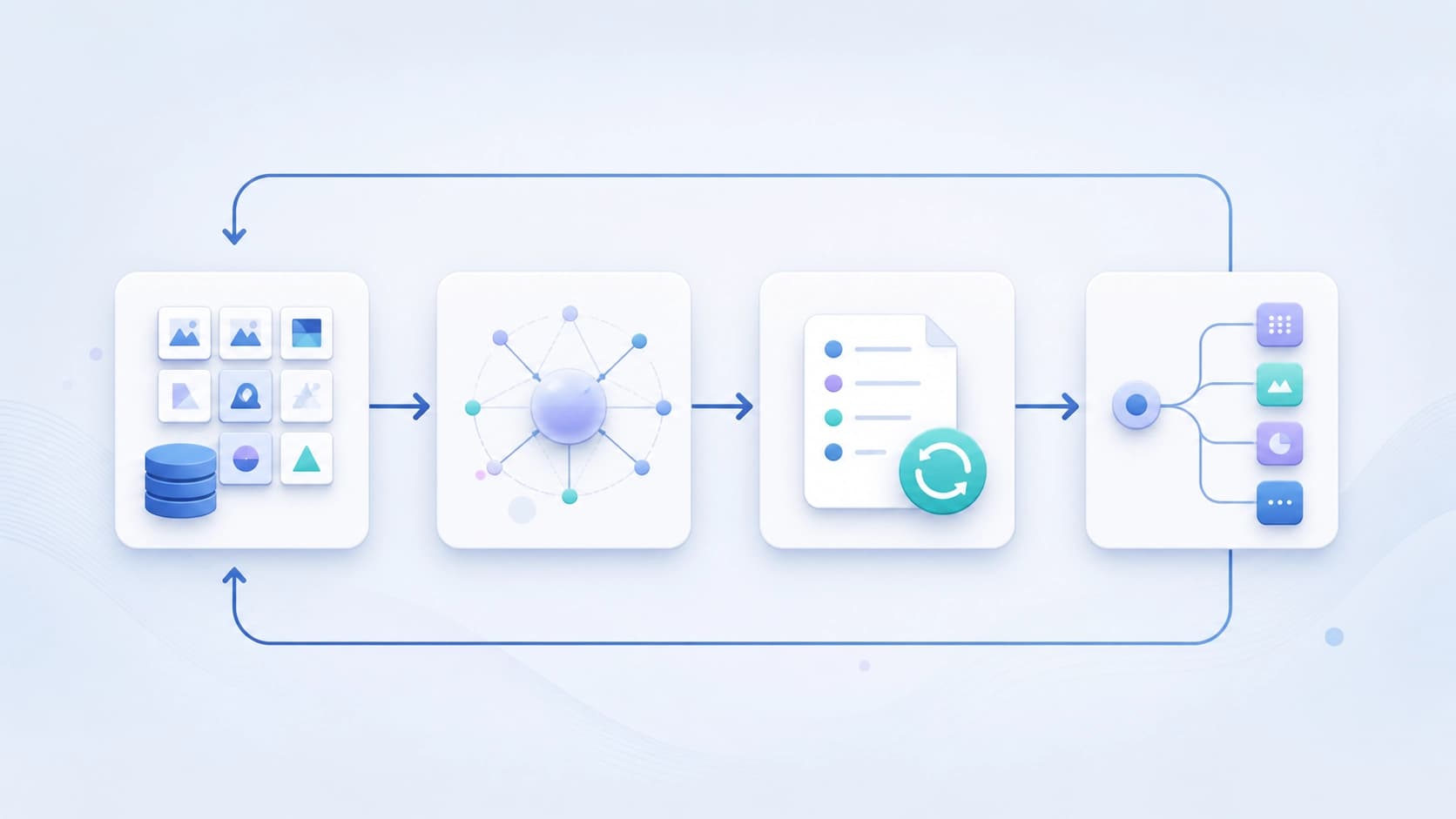
First, SAGE analyzes "script — expert storyboard" pairs and derives rules from them that are not tied to a specific episode. This is similar to how an intern watches a master's work and formulates principles: "in dialogue, keep both characters in frame," "in moments of tension, tighten the shot." Such rules can be transferred across different stories without retraining the model from scratch.
During generation, the model remembers which rules each narrative group used. Why is this needed? If the final storyboard turns out poorly, feedback is attributed specifically to the rules involved in the decision, not to the entire set. This way, the system understands which rule "let it down" and updates only that one. This resolves the opacity problem: every decision can be attributed to specific knowledge.
The evolved rules are collected into scenario packages with a routing index. For each new story, the system itself selects a compact set of rules, requiring no expert intervention. The result is a closed loop: the model learns, attributes errors, evolves rules, and distributes them across tasks. No manual tuning per genre — routing decides which package is needed for a specific scene.
Unlike a simple few-shot prompt, SAGE does not try to fit the entire director's experience into a single request. Instead, it works like a knowledge management system: rules live separately, update as feedback accumulates, and are plugged in only when needed. This makes the process more transparent and scalable.
Numbers That Speak for Themselves
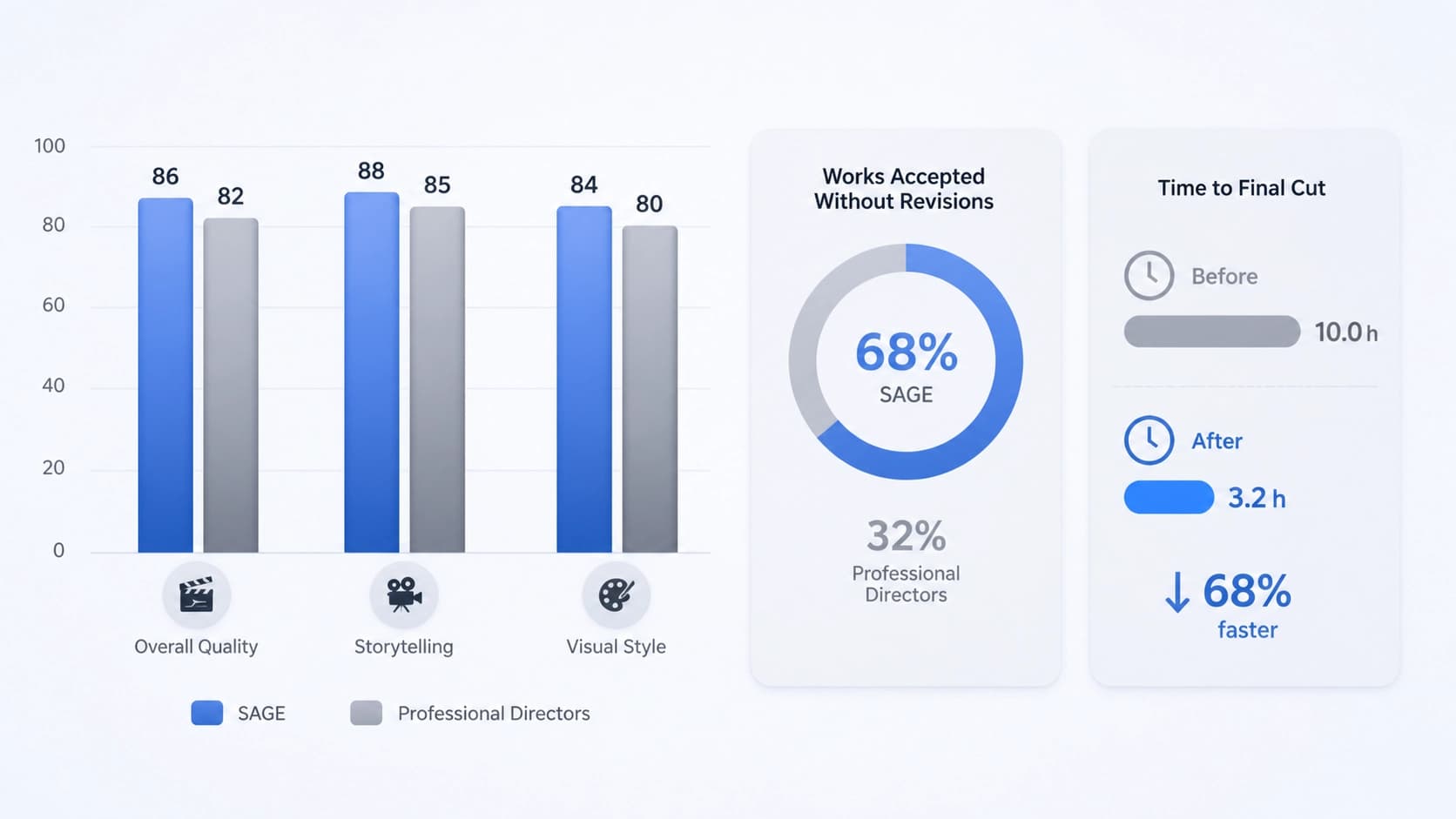
To test SAGE, the researchers used an expert-validated rubric and compared the system against professional directors on 18 test episodes across three genres. The result: 77.8 points for SAGE versus 77.1 for humans. The gap is small, but what matters is that AI has for the first time reached a level above the average professional. Moreover, SAGE did not simply copy others' work — it applied its own rules, which it had developed itself.
It is important to emphasize that the tests spanned different genres, so the result cannot be chalked up to a lucky match with one story type. The system showed consistently high quality across all three directions.
The framework was then deployed in Virtual Film Studio for 14 days. During this time, SAGE produced 1,344 outputs for narrative groups, and 87.2% of them were accepted without significant revisions. This means editors and directors barely had to rework the generated shots — only minor touches were needed. The production team noted that authoring time per episode was reduced by more than 83%. This is not just a lab result but practical confirmation: storyboarding is no longer a bottleneck.
Open Dataset and Prospects
Alongside the framework, the authors released the PROSE dataset — the first public collection pairing scripts with storyboards from professional directors. It contains 68 episodes. This matters for the entire community: now other teams can benchmark their approaches on a unified corpus instead of inventing their own metrics. It also serves as a solid foundation for fine-tuning future models — no need to gather labeled data from scratch.
Publishing PROSE is also a contribution to research reproducibility. Until now, each team used its own private data, making result comparison difficult. Now the community has a common reference point.
Of course, storyboarding is just one stage of production. But the SAGE approach, based on attributing feedback to specific rules, could prove useful in other creative tasks — from editing to animatics. The better a model understands why it made a particular decision, the easier it is to control and improve. Perhaps the next step is transferring this principle to other stages of filmmaking, where there is also plenty of tacit mastery.
The paper spans 11 pages, includes 9 figures and 4 tables. The full version is available on arXiv under identifier 2608.17468.