
Segmenting Mixed Human–LLM Texts: Weighted Huber Profile Losses Instead of Mean Contrasts
A method for detecting RWCP change points is proposed, based on bounded reliability weights and profile gains using the Huber loss function, with a narrowest-over-threshold search in reliability coordinates. Across five retrospective benchmark families, family-macro WindowDiff decreases by 17.6% compared with weighted change point detection, but densely interleaved and jointly written passages remain challenging.

Problem: authorship transitions in mixed text
- Mixed text contains authorship transitions between humans and LLMs.
- The detector produces scores for text units.
- Score reliability varies across text units.
Takeaway: heterogeneous score reliability makes transition detection a distinct statistical task.
Why weighted mean contrasts fail
- Weighted mean contrasts are vulnerable to extreme scores.
- Directly replacing means with robust centers makes it harder to analyze how boundary bias changes the population criterion.
Takeaway: analyzing boundary bias requires an approach that does not directly replace means with robust centers.
RWCP method: three components
The Robust Weighted Profile-Loss Change Point Detection (RWCP) method combines:
- bounded reliability weights;
- profile gains based on the Huber loss function;
- a narrowest-over-threshold search in reliability coordinates.
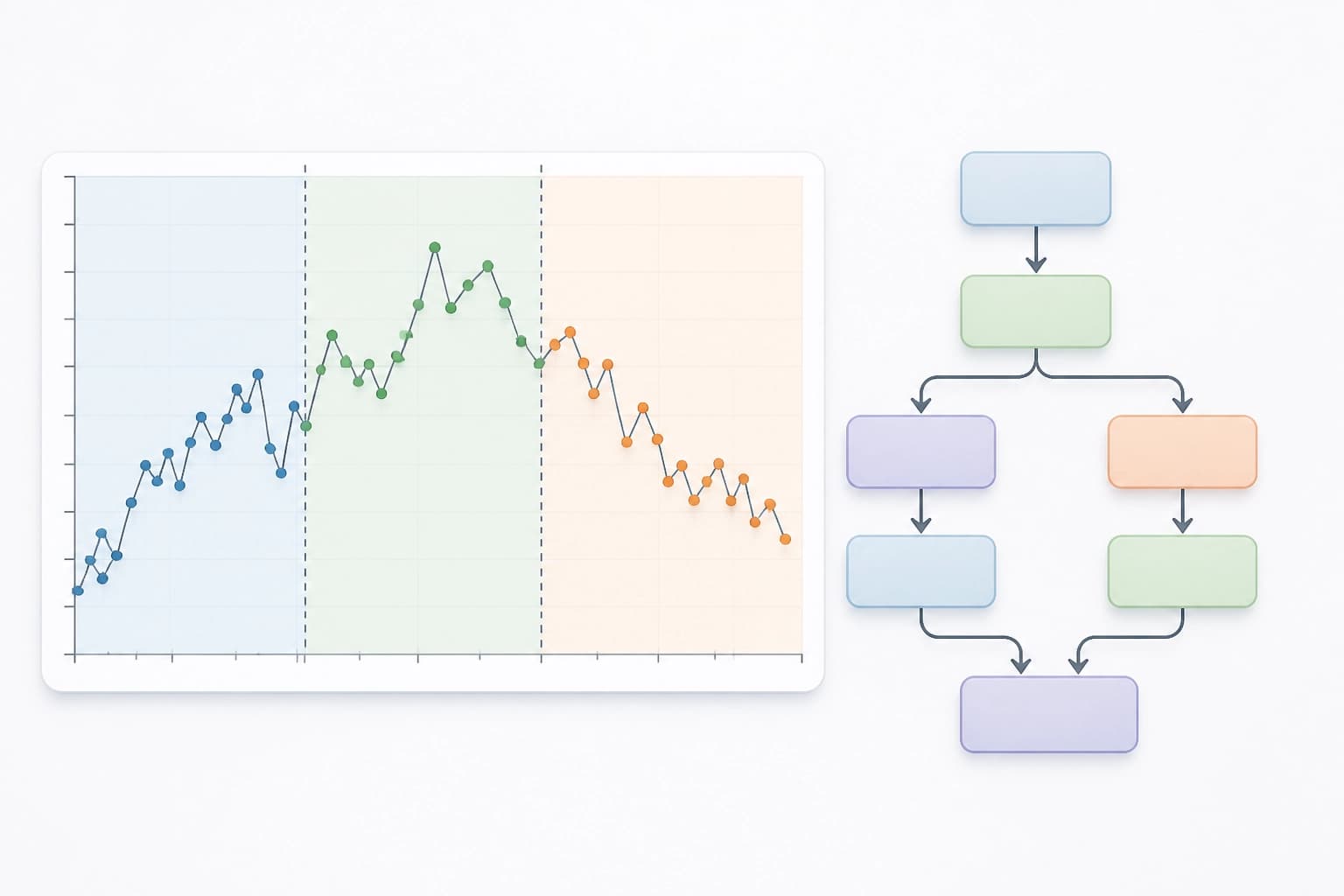
Takeaway: RWCP specifies three concrete components that can be assessed when choosing a method.
Criterion gap analysis and merge cost
- The analysis represents the population criterion gap between the true and a biased partition as a merge cost.
- This analysis does not require an explicit solution for the nonlinear center of a mixed segment.
Takeaway: merge cost provides a framework for analyzing biased partitions.
Change recovery conditions and the quadratic-loss limit
- Explicit conditions concern curvature, distances between changes, and dependence.
- Under these conditions, the core RWCP recovers the number of changes.
- The method localizes change boundaries.
- The quadratic-loss limit yields a squared weighted CUSUM.
Takeaway: the quadratic limit links RWCP to well-known CUSUM statistics.
RWCP-R and benchmark results
RWCP-R is a decoder that uses shared source centers for nonadjacent fragments.
| Method | Key feature | Result |
|---|---|---|
| Weighted change point detection | baseline for comparison | — |
| Core RWCP | bounded weights, profiled Huber losses, narrowest-over-threshold | family-macro WindowDiff reduced by 17.6% |
| RWCP-R | shared source centers for nonadjacent fragments | further reduction in WindowDiff |
| Both fixed configurations | — | miss changes in co-authored and densely alternating text |
Boundary recovery improvement was most pronounced for isolated changes. Both fixed configurations miss changes in co-authored and densely alternating text.
Takeaway: RWCP and RWCP-R improve the metric on retrospective families, but retain a limitation with dense alternation.
Practical selection criterion
- Detector scores are heterogeneous in reliability and contain extreme values — RWCP provides robustness.
- Boundary bias analysis is needed — profiled Huber losses preserve this capability.
- Isolated changes matter — the method shows better boundary recovery.
- Text is co-authored and densely alternating — fixed configurations miss changes.
Takeaway: selection depends on the structure of score noise and the type of fragment alternation.
Frequently asked questions
Related materials
All materials
STAR: Adaptive Normalization of Temporal Context and Service Graphs for End-to-End Incident Management
The STAR framework trains representations from metrics, logs, and traces, using learnable normalization that accounts for multiscale temporal dynamics and dependency structures between services. On two real-world datasets, this pipeline delivers consistent improvements in anomaly detection, failure ranking, and root cause analysis over state-of-the-art baselines.
10 November 2026
Chern–Simons Reservoir Memory: Autonomous Connectivity Dynamics and Density Transport
The article explores how a reservoir preserves the history of input signals both in its density distribution and in its geometric degrees of freedom. A comparison of four mechanisms shows that current creates a separate connected component that alters the subsequent density response, while accounting for all measured features yields a small improvement in decoding pulse order.
10 November 2026
Validating Candidates Costs More Than Generating Them: Honeypots Against LLM Vulnerability Hunting
The study examines the cost asymmetry in agentic vulnerability discovery: generating candidate versions is cheap, while confirming them through reachability analysis, execution, and PoC development consumes most of the budget, making verification a potential standalone target for defense. The proposed RedHerring—repository-adapted decoys with a hidden certificate—reduced the number of real vulnerabilities found by 38.7–60.4% at equal cost across 33 OSS-Fuzz projects; even after the agent was warned, the reduction remained at 37.2%.
9 November 2026