
ReflCtrl: Controlling LLM Self-Reflection via Latent Representations
The authors found a direction in the model's hidden space that separates reasoning-revision steps from steps without it, and built a framework for selective steering on this basis — intervening only at the moments when a new thought begins. On math and general reasoning benchmarks, the method cuts output volume to 43.2% of the original without sacrificing accuracy, outperforming step-by-step steering at every token.
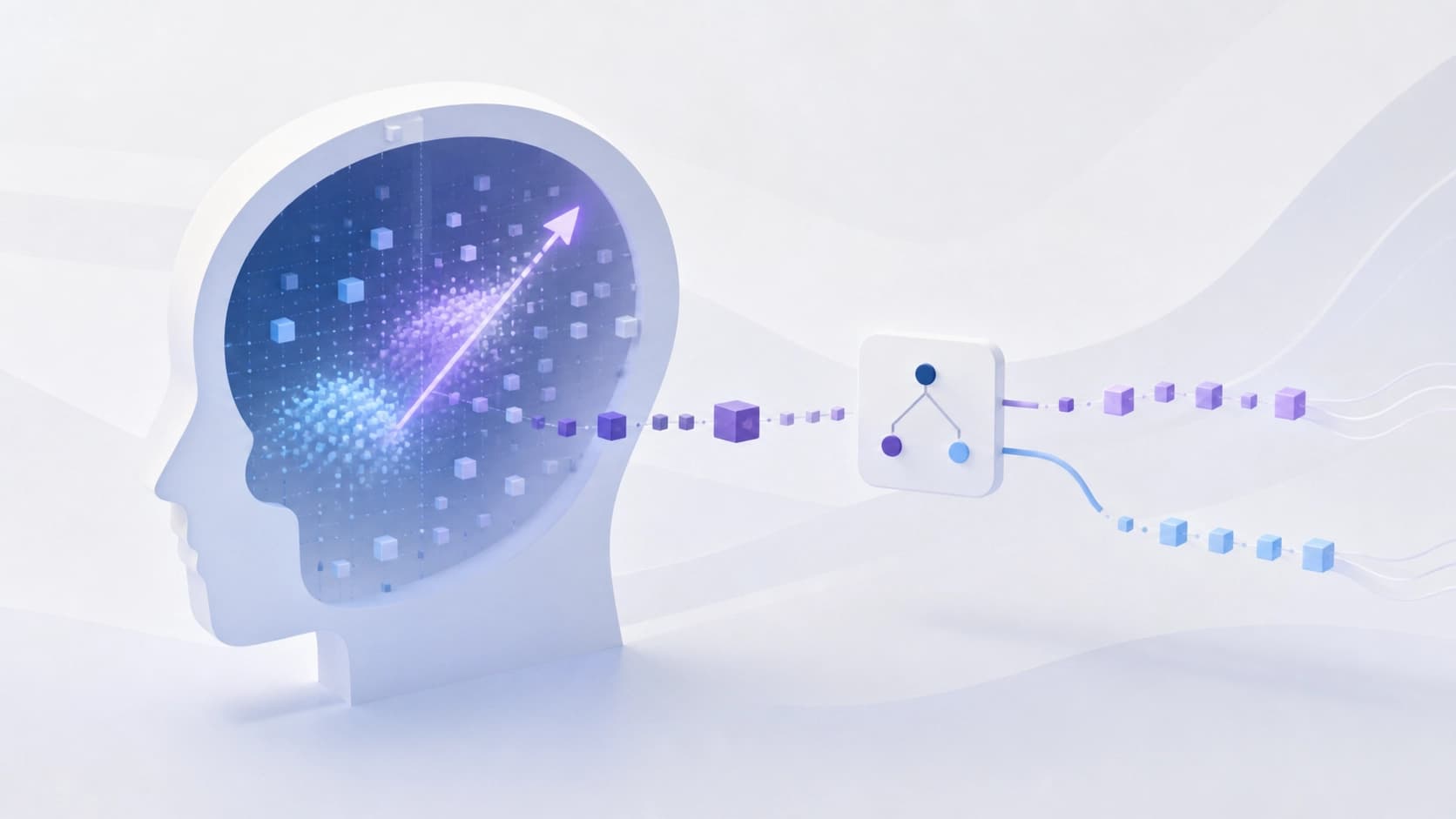
A short chain of thought isn't always the best
Large models trained to "think out loud" win through long chains of reasoning. The harder the task, the more intermediate steps the model writes out before giving an answer. One of the mechanisms considered key to this quality is self-reflection: the ability to look back at steps already taken, notice a mistake, and rewrite the course of the solution.
The problem is that this ability comes at a cost. Every act of revision means additional tokens at inference, and therefore money, time, and compute. At the same time, until recently, no one had properly explained what exactly governs a model's decision to "stop and double-check itself." Self-reflection was something like a black box inside a black box: we know it works, but not how.
The work by Ge Yan, Chung-En Sun, Linbo Liu, and Tsui-Wei Weng (arXiv:2512.13979, accepted at COLM 2026) approaches the question from an unexpected angle — not through prompts and not through fine-tuning, but through the model's latent representations.

The direction of reflection inside the model
What they looked for and what they found
The researchers applied the toolkit of representation engineering to self-reflection — a field that studies not the texts a model outputs, but its internal activations. The logic is simple: if the model "decides" to reflect, that decision is reflected somewhere in its representations. That means it can be found, described, and — most importantly — used.
And so it turned out. In the latent space, a distinct direction was found along which steps with reflection separate from steps without it. In essence, it's an axis of "double-check / don't double-check," and the position of a point on this axis reliably distinguishes the two types of steps.
Reflection is governed by uncertainty
The most interesting observation from the paper: the magnitude of activation along the discovered direction predicts well whether the final answer will be correct. In other words, reflection doesn't switch on randomly or on a schedule — it's tied to the model's internal uncertainty. When the model "feels" that things are slippery, it slows down and revises; when everything is clear, it moves on.
This is an important shift in the picture of the world. Reflection stops being a separate ability that needs to be developed and turns out to be more of a signal — an indicator that the model itself doubts its step.

How ReflCtrl works
If the decision to reflect lives in the activations, it can be influenced directly — by intervening in the representations rather than rewriting the prompt. This is what ReflCtrl is built on: a framework that controls self-reflection through steering — shifting activations along the discovered direction.
The key detail is when exactly to intervene
The naive approach is obvious: add the desired shift at every generated token. It was the first thing that comes to mind — and it's precisely the one that works poorly. Constant pressure on the representations blurs generation quality: the model loses coherence, because the intervention also happens where it's meaningless.
The authors propose a step-level variant. The intervention is applied exactly once — at the very beginning of each new reasoning step. After that, the model generates the tokens of that step freely, without interference. The result is fine-tuning: the frequency of reflection changes, while the flow of thought within a step remains untouched.
It's precisely this combination — rare, pinpoint intervention instead of continuous — that delivers the main gain.

What the experiments showed
The tests were run on benchmarks for mathematical and general reasoning. The results add up to a conclusion that's rather inconvenient for the industry: reflection is often excessive.
- The number of reasoning tokens can be cut by as much as 43.2% of the original volume — while preserving accuracy.
- The effect is especially noticeable on stronger models: the better the model, the more often it double-checks itself needlessly.
- Step-level steering noticeably outperforms traditional per-token steering at comparable token budgets.
The second and third points are connected. A strong model is more confident in its steps, so its reflection more often turns out to be a wasted move — and per-token steering is precisely the approach that suffers from being unable to stop in time.
Why this matters beyond the lab
The economics of reasoning is not an abstraction. Long chains inflate inference bills, increase latency, and limit how many requests can be passed through the available hardware at all. If nearly half of the "thinking" can be removed without loss of quality, that's direct savings at scale.
There's also a less obvious layer. The work shows that a model's behavior can be tuned at the level of representations — more gently and precisely than with prompts, and more cheaply than with fine-tuning. Controllability becomes a separate engineering dimension: not "what to write in the instructions," but "where to shift the activation and at what moment."
Finally, it's a contribution to interpretability. We increasingly understand what exactly happens inside when a model stops and tells itself "let me reconsider."
Open questions
The boundaries of applicability are not yet fully mapped out. Steering along a single direction is a narrow tool: it captures the discovered axis of reflection well, but what to do with other kinds of self-correction is unclear. There's also the question of how transferable the discovered direction is across architectures: each model has its own representations, and it's not a given that a vector that works for one will be useful for another.
The trade-off between savings and reliability on tasks where a mistake is costly is also not entirely clear. Cutting 43.2% of tokens while preserving average accuracy is a strong result, but average accuracy is not the same as the absence of rare catastrophic failures. Finding how to distinguish "excess" reflection from the single instance that saves the answer is probably the next task in this line of research.
Frequently asked questions
Related materials
All materials
Validating Candidates Costs More Than Generating Them: Honeypots Against LLM Vulnerability Hunting
The study examines the cost asymmetry in agentic vulnerability discovery: generating candidate versions is cheap, while confirming them through reachability analysis, execution, and PoC development consumes most of the budget, making verification a potential standalone target for defense. The proposed RedHerring—repository-adapted decoys with a hidden certificate—reduced the number of real vulnerabilities found by 38.7–60.4% at equal cost across 33 OSS-Fuzz projects; even after the agent was warned, the reduction remained at 37.2%.
9 November 2026
Checking LLM Hallucinations via SQL-Based Source Representation Without Fine-Tuning
The study examines whether an LLM can apply a basic symbolic skill—building a SQL database from source documents—to ground its outputs in sources without supervision when detecting hallucinations. On RAGTruth and DiaHalu, this neuro-symbolic pipeline proves more accurate than direct prediction and comparable to state-of-the-art methods, without requiring domain-specific fine-tuning.
9 November 2026
MathAdv: What the Final Accuracy of Machine-Generated Proofs Conceals
A diagnostic suite of tasks spanning 13 undergraduate and graduate mathematics topics evaluates machine-proving systems in Lean 4 not only by their final results, but also by their subject-matter mastery, the quality of their informal reasoning, and their robustness to rephrased conditions. A component-by-component analysis shows that translating a problem into formal form remains the main obstacle, and that success depends heavily on the area of mathematics and how the problem is framed.
9 November 2026