
New record-breaking two-qubit excitation scheme: 12 CNOTs and significantly reduced depth
A researcher presented the first published decomposition of a two-qubit excitation operator into 12 CNOT gates. The solution surpasses previous circuits with 13 CNOTs in gate count and depth, adding only a couple of extra single-qubit transformations.

Quantum algorithms are typically decomposed into a sequence of elementary operations on qubits. Even a gate that seems simple at first glance can become a bottleneck for the entire circuit if it is invoked thousands of times. The double-qubit excitation operator is exactly one of those: it is in demand in quantum chemistry calculations and other applied tasks. A fresh preprint by Irfansha Shaik on arXiv presents a new decomposition of this operator that reduces the number of two-qubit CNOT gates to 12 — fewer than in any other known circuit.
One fewer CNOT
Previously, the minimum number of CNOTs for such an operator was 13. The new circuit breaks this record, using only 12 two-qubit gates. But just as important, the circuit is noticeably "flatter" in depth. Counting only sequential layers of CNOT gates, the new implementation fits into 8 such layers — about 27% fewer than the 11 layers of previous optimized variants. The total circuit depth, including single-qubit operations, is 15, which is roughly a quarter less than the corresponding figure for the best previous circuits (SOTA).
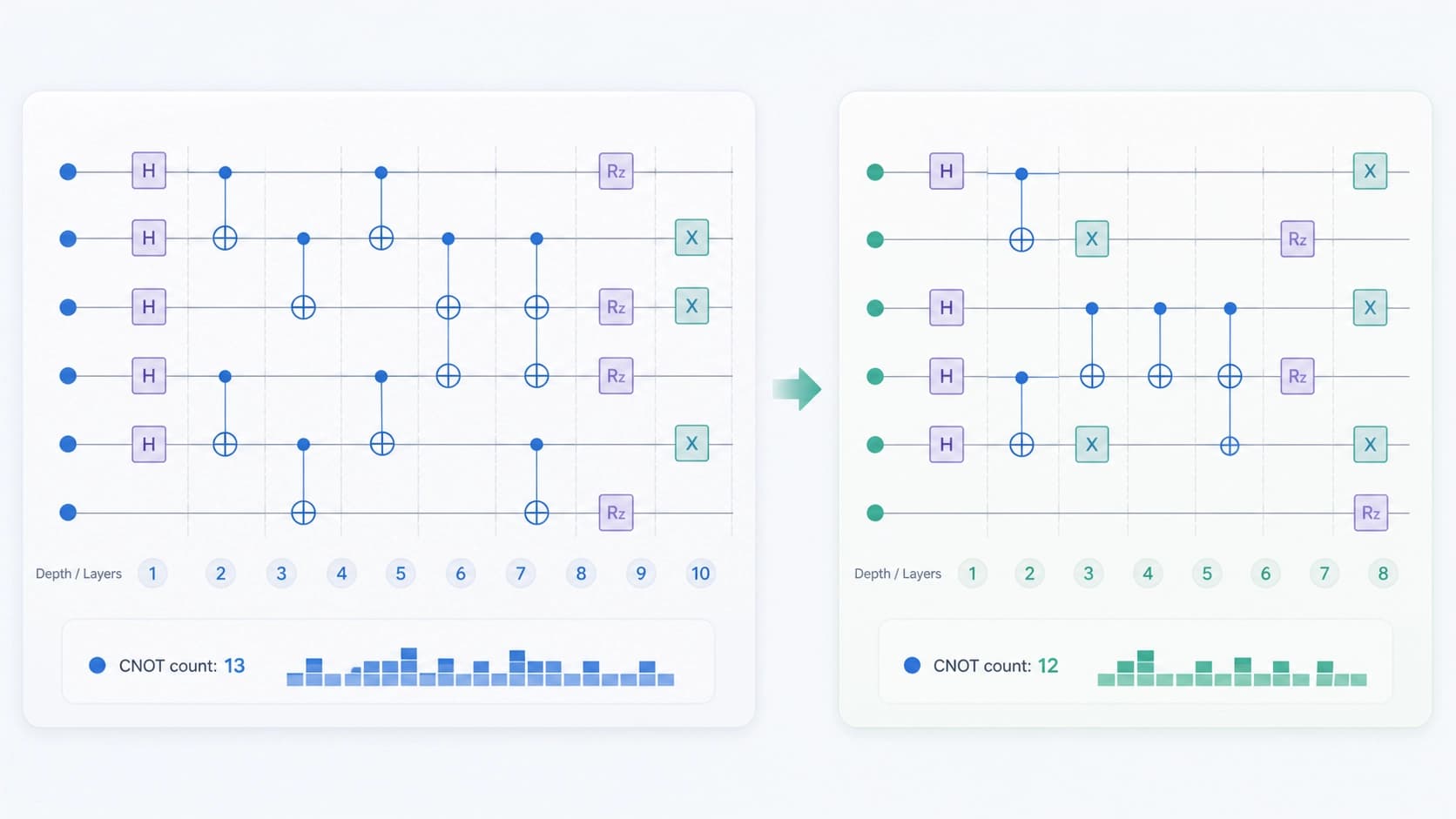
The author also shows that if remapping of output qubits is allowed during physical circuit layout, without changing its logic, the CNOT depth can be reduced even further — down to 7. This corresponds to a reduction of about 36% relative to the original 11 layers. For quantum computing, depth is critical: each sequential operation takes time during which qubits must remain coherent, so any such gain directly increases the chances of successfully completing the computation.
A modest price for optimization
Free improvements in quantum circuits are practically unheard of. To remove one CNOT and reduce depth, the developer had to add two single-qubit gates: there are now 13 instead of 11 in the best of the old circuits. However, this is a modest price. Single-qubit operations are simpler, faster, and have lower error rates, and crucially, they do not increase the number of expensive and unreliable two-qubit interactions. In the overall balance, the gain in depth and in the main source of errors turns out to be far more significant than a couple of extra single-qubit rotations.
Savings at the scale of the algorithm
A distinctive feature of the double-excitation operator is that within practical quantum algorithms it is applied repeatedly. Hundreds or even thousands of calls to it are a common situation for variational methods in quantum chemistry. Every reduction, whether it is one removed CNOT or several depth levels, is automatically multiplied by the number of operator invocations. As a result, the accumulated effect for the entire circuit becomes very noticeable: resource savings grow nonlinearly and help fit complex simulations into the limited capabilities of modern quantum devices.
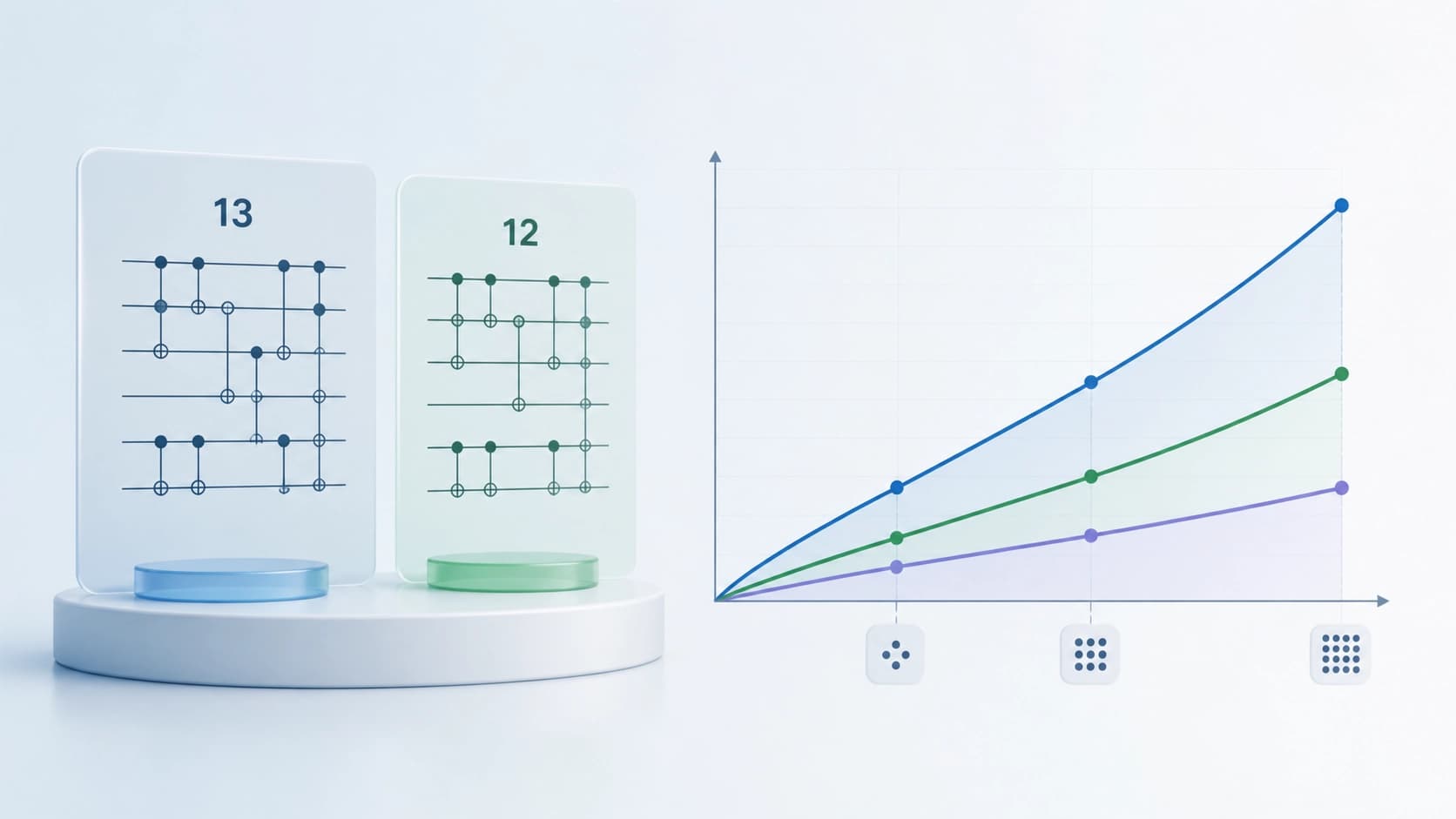
Such incremental progress is another step toward ensuring that quantum simulations of complex systems can be performed without loss of accuracy even on devices with a limited operation budget. It is quite possible that similar optimization techniques will later be transferred to other frequently used primitives, meaning the new result should be viewed not as a one-off improvement, but as part of a broader movement toward more efficient quantum algorithms.
Frequently asked questions
Related materials
All materials
OpenCollab: programmable agent coordination, controlled execution environment, and policy compliance metric
The framework brings together the specification of agent interaction structures, a shared environment for experiments, and detailed event tracing, while the newly introduced Adherence metric reflects how closely actual execution follows the declared schema. In benchmarks, the Duo configuration achieves a new state of the art, while the single-agent variant uses the fewest tokens.
11 November 2026
Toollery: Choose tools for LLM agents from tens of thousands of options without fine-tuning
Toollery builds a search index from descriptions of skills and tools, then passes the model only a limited set of candidates for each query. In experiments with libraries containing tens of thousands of functions, the approach helps maintain selection quality at a fixed top-K, although the overall effect depends on the workload profile and the provider’s caching.
11 November 2026
WILSON: combining magnifications and patient slides for pathomorphological analysis and report generation
The preprint introduces WILSON, a vision-language model that encodes images of whole slides and series of slides from a single patient at different magnifications, rather than just a single “best” slide. Without task-specific fine-tuning, it outperforms specialized and larger slide models on a range of metrics while requiring substantially less compute, and its diagnostic descriptions received higher ratings from pathologists.
11 November 2026