
Why Quantum Research Needs a Strict Critic
Modern language models can write convincing scientific texts, but in the field of quantum computing, persuasiveness quickly stops being enough. An error in calculations or an unjustified claim can be costly, so the growing stream of articles and patents requires not only generation but also careful verification. Traditionally, this work falls on the shoulders of reviewers and experts, but their time is limited. It is at this point that the QuantumNovelty agent appears, offering an unusual combination: it can create artifacts, but most importantly, it can ruthlessly criticize them.
The tool is interesting not for its writing speed, but for its ability to doubt. Instead of trusting its own draft, the system runs it through a series of objective checks and filters out everything that is not supported by data. This resembles the work of an internal opponent who acts not by intuition, but by formal rules.
What This Tool Is
QuantumNovelty is an open-source language agent with skill orchestration. Behind this definition lies a system capable of assembling individual modules into a full-fledged workflow. On the one hand, it prepares drafts of scientific articles, generates sets of candidates on the Pareto front, and creates outlines of patent applications. On the other hand, it launches a virtual panel of reviewers and patent experts on these same materials, which must render its verdict.
Panels of Referees and Patent Experts
Instead of relying on a single "point of view" of the model, the agent simulates an entire collegium. Virtual referees discuss the strengths and weaknesses of the manuscript, while patent attorneys additionally check the application for overlaps with already known solutions. This approach brings automated verification closer to real life, where decisions are made collectively rather than by one person.
Deterministic Gates Instead of "It Seems to Me"
A key feature of QuantumNovelty is the layer of deterministic gates. This is a set of strict algorithms that do not rely on the probabilistic logic of the neural network. Among them:
- Pareto dominance for rigorous comparison of alternatives — options that do not improve any criterion but are inferior in some other way are discarded;
- numerical recalculations based on source files — the numbers in the text must correspond to real data, not appear out of thin air;
- Wilson intervals for honest work with small samples, where conventional error estimates are too optimistic;
- cross-vendor consensus checking — several independent models must agree with a claim before it earns the right to exist.
An important nuance: the gates do not invent anything. They only filter, not letting through claims that have failed verification. Thanks to this, the generative model ceases to be the sole arbiter of truth and enters a system of checks and balances.

How the Verification Was Conducted
The authors did not involve humans for data labeling. Instead, they assembled a special adversarial corpus — a set of texts with deliberately embedded inflated and unjustified claims. The experiment showed that the deterministic gates caught all embedded violations while producing not a single false positive. In other words, the system proved to be both sensitive and careful at the same time.
First Deployment in Real Conditions
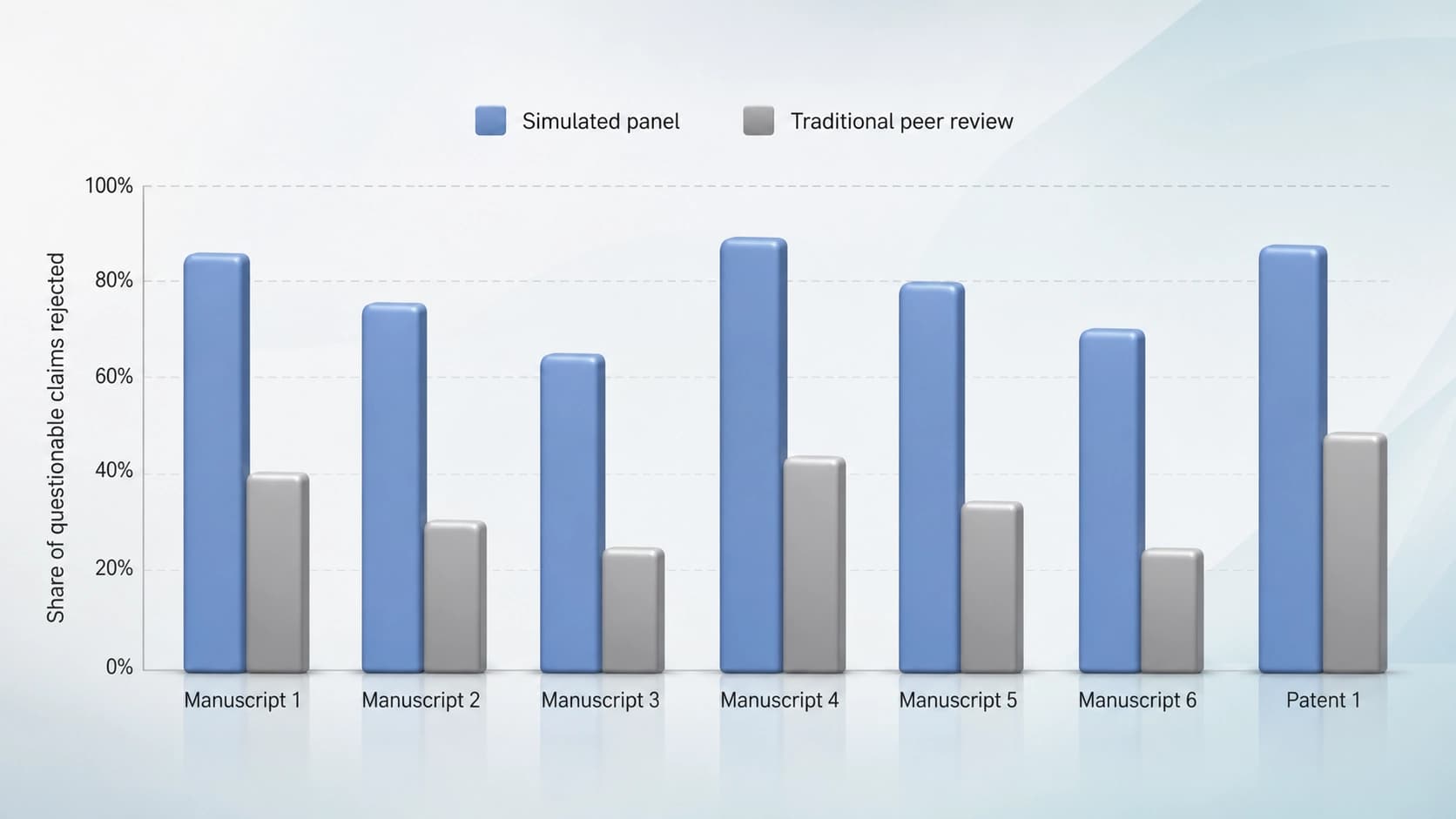
During the first deployment, QuantumNovelty processed six manuscripts and one patent, which was ultimately granted. The entire operation cost about 24 dollars — a sum completely incomparable to the labor costs of professional editors for such a volume of work. Interestingly, the simulated panels behaved directionally more conservatively than public acceptance decisions. On a one-sided sample, this meant that the agent was more likely to leave a contentious passage for revision than to pass it without additional verification.
Limitations: Without Excessive Self-Confidence
It is important to understand that QuantumNovelty is a decision-support tool, not a replacement for live peer review or patent examination. The authors emphasize that they did not compare their system with human experts and do not claim full automation of the process. They also honestly report which mechanisms remained unused on real inputs and do not attempt to hide the boundaries of applicability.
The paper presenting the system was submitted on July 9, 2026, and posted on arXiv with identifier 2608.16900. It covers several categories at once: Physics and Society, Artificial Intelligence, Computers and Society, and Quantum Physics. The author is Shlomo Kashani. This distribution across topics shows that the problem of verifying quantum texts lies at the intersection of physics, computer science, and the social aspects of science.
What This Means for the Future
Perhaps we are on the threshold of a new standard: a scientific article or patent application will be accepted not only by humans but also by automated auditors. QuantumNovelty demonstrates how to combine the creativity of generative models with the strict discipline of formal algorithms. For the quantum domain, where every detail can be decisive, such a balance is especially valuable.
The openness of the agent allows the scientific community to independently study its internal mechanisms and adapt them to their own tasks. Perhaps in the future, such hybrid systems — with a generator and a strict critic inside — will become a familiar tool for everyone working at the forefront of research.