
Quadratic depth dependence: why local entropy grows faster in deep ReLU networks with variational norm
New proof result: for the ReLU architecture of Parhi–Nowak deep-RBV², the minimax risk of Gaussian regression cannot be smaller than the order L²w²log(w)R²/n. The authors construct a local packing with logarithmic cardinality Ω(L² w² log w), which shows that the quadratic contribution of the number of layers is indeed unavoidable.
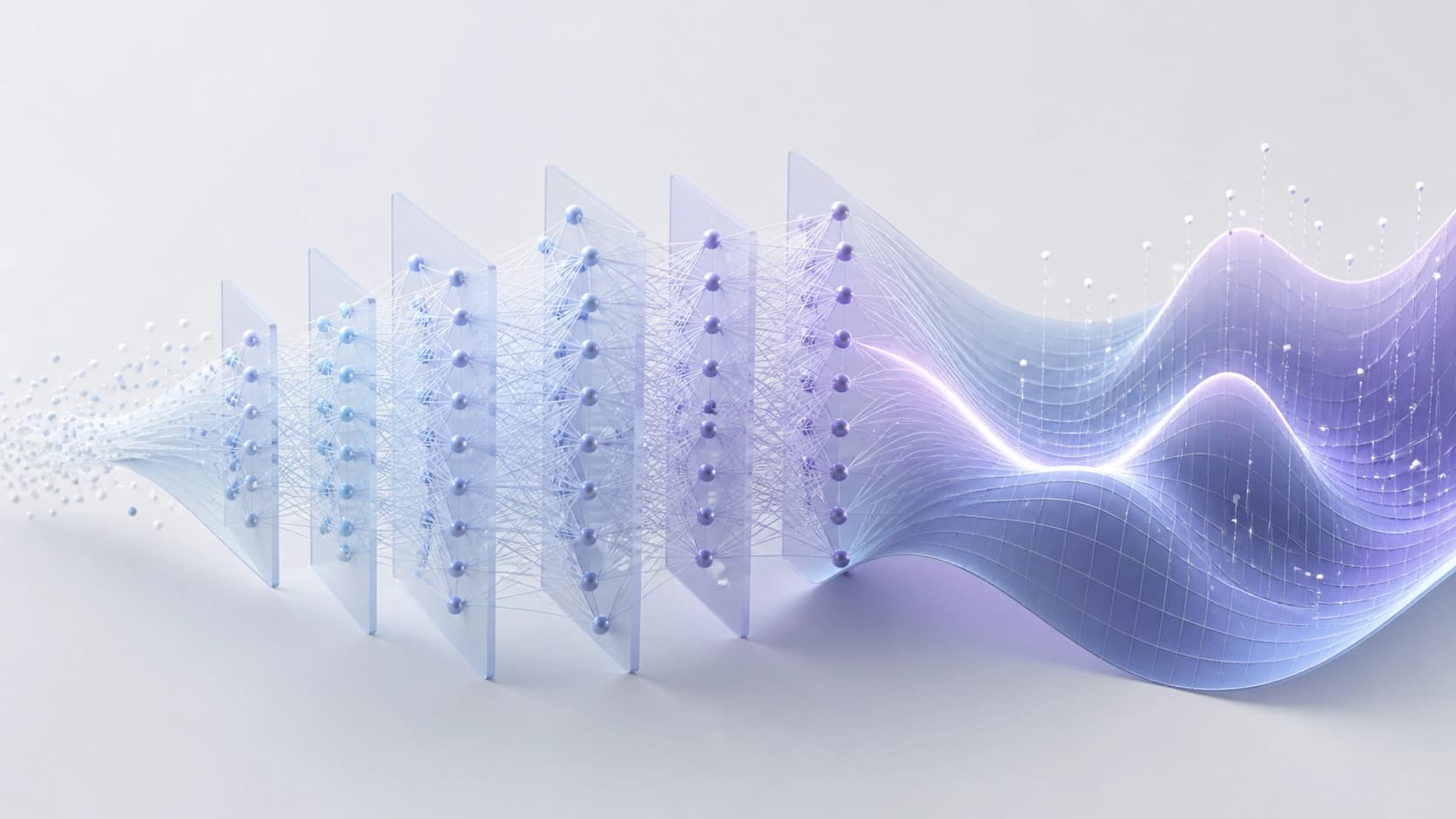
In deep learning, model complexity can be controlled in various ways. One of them is the variation norm: the sum of weight norms across all layers. It bounds the "volume" of the function family and allows for generalization guarantees. However, the question of how accurately these guarantees reflect the true complexity of the network has remained open.
Recent work (arxiv:2608.17434) shows that for deep ReLU networks with the variation norm, the local entropy — the logarithm of the number of distinguishable functions in a ball — grows quadratically with depth. This means that the quadratic dependence of the risk on (L) is not an artifact of upper bounds, but an intrinsic property of the class.

Problem setup and architecture
We consider Gaussian regression with an unknown function from a class defined by the Parhi–Nowak deep-RBV² architecture (a vector-valued version). The parameters are depth (L) and width (w), with (O(L w^2)) parameters in total. The variation budget is the sum over layers (A), and the output bound is (B). For this model, lower and upper bounds on the minimax risk were already known, but they differed by a factor of depth. The new result closes this gap: the quadratic dependence on (L) is exact.
The key idea is to construct a local packing: a set of functions that are pairwise far apart but lie in a small ball of radius (O(\lambda)L^2). The logarithm of the size of such a packing (local entropy) is (\Omega(L^2 w^2 \log w)). This means that for a fixed norm, the number of distinguishable functions grows exponentially in (L^2 w^2 \log w), not just in (w^2).
How the packing is constructed
To obtain such functions, the authors use two ingredients:
- Approximation theorem with bias: any function from the target class can be approximated by a network with bounded coefficients.
- Balanced amplification: multiplying the output of a ReLU network of depth (D) by a number (q) is implemented using a single constant channel, with each coefficient growing only as (q^{1/D}). The cost of this trick is (O(D w^2 q^{1/D})) in terms of the sum of norms.
By combining these techniques, it is possible to "embed" a set of functions into a ball of the variation norm while preserving their pairwise separation. This yields the lower bound on entropy.
Lower bound on the minimax risk
Given the local packing, a standard technique — the Gaussian version of Fano's lemma — yields the lower bound. The radius of the ball is chosen explicitly and depends on the sample size, the output scale (B), and representational constraints. In the special case (A = B = R) and (\sigma \sim R) (up to constants), the minimax risk is at least of order (L^2 w^2 \log(w) R^2 / n).
The upper bound, obtained via the pseudodimension of the finite network, gives (\widetilde{O}(L^2 w^2 R^2 / n)) for unbounded Gaussian responses. The matching of the lower and upper bounds up to logarithmic factors shows that the quadratic dependence on depth is exact. As the radius decreases, there is a transition to a regime where representational constraints begin to dominate.
Practical implications
What does this mean in practice? If we regularize a network with the variation norm, increasing depth requires a substantially larger amount of data or stronger regularization: the complexity of the class grows as (L^2 w^2). This explains why very deep networks tend to overfit under a fixed weight budget.
Moreover, the result shows that the limitation cannot be "bypassed" by simply using a Banach norm instead of a cross-norm — the quadratic dependence is embedded in the structure of ReLU activations and vector-valued layers. This is an important guideline for developing new architectures and regularization methods.
Overall, the work provides an exact answer to the long-standing question about the gap in the bounds and confirms the intuition that depth is not just a parameter but an independent factor of complexity that affects all statistical guarantees.
Frequently asked questions
Related materials
All materials
MathAdv: What the Final Accuracy of Machine-Generated Proofs Conceals
A diagnostic suite of tasks spanning 13 undergraduate and graduate mathematics topics evaluates machine-proving systems in Lean 4 not only by their final results, but also by their subject-matter mastery, the quality of their informal reasoning, and their robustness to rephrased conditions. A component-by-component analysis shows that translating a problem into formal form remains the main obstacle, and that success depends heavily on the area of mathematics and how the problem is framed.
9 November 2026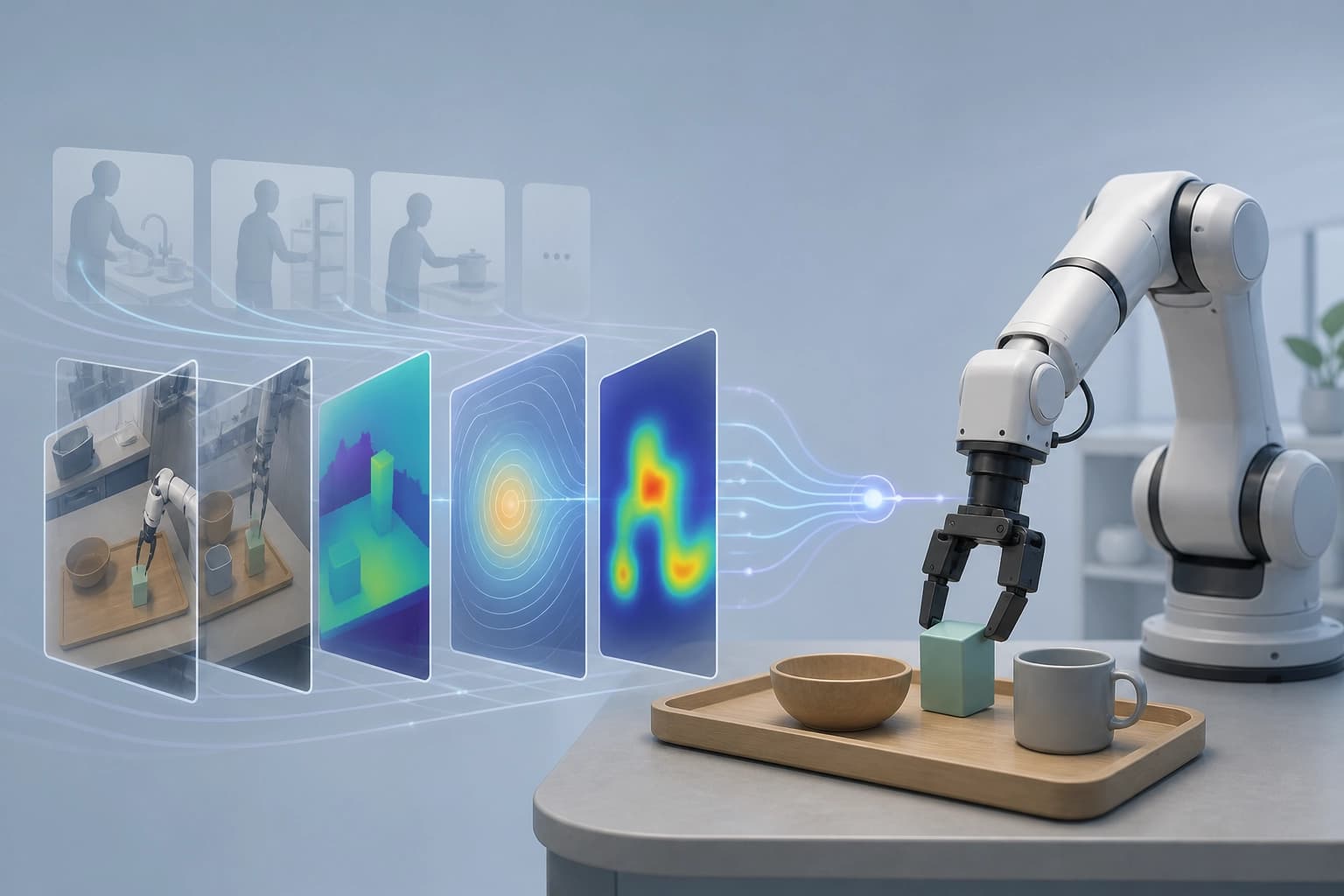
AffordanceWAM: Affordances as an intermediary between scene prediction and manipulator control
The work describes a generative model that jointly predicts future RGB observations, scalar fields, affordance heatmaps, and continuous robot commands, using human videos to broaden interaction diversity without action annotations or retargeting. On RoboCasa, CALVIN ABC→D, and real-world tasks, the approach delivers consistent gains over RGB-only and robot-data-only baselines.
9 November 2026
Presentation Editing as Controlled Operations: The EditPPT Framework and DeckEdit-Bench Benchmark
The authors break down slide editing into specific objects, permitted actions, and checks to ensure unrelated content remains untouched, rather than relying on free-form code generation. To measure quality, they created DeckEdit-Bench (183 tasks across 28 human-made presentations), and the multi-agent EditPPT framework achieves a 66.7–74.9% task success rate across five base models while preserving over 97% of the content.
8 November 2026