The competition between two leading AI labs has long since moved beyond benchmarks and response quality. Now the companies are fighting for the trust of enterprise clients — including their data. The trigger for the latest round was Anthropic's July policy allowing entire conversation sessions to be stored for 30 days. OpenAI responded by announcing a system that detects abuse without saving conversations. Let's break down what exactly has changed and why it matters for business.
30-day storage: why businesses got worried
In July, Anthropic announced that for models falling into the covered models category, conversations and user sessions would be stored for 30 days. This category includes the Mythos line, the Fable model, and future systems of comparable capability. The company explains the decision as a matter of security — the time buffer allows it to catch malicious scenarios that cannot be seen from a single request. Most of Anthropic's services are still covered by Zero Data Retention, so the change applies to a limited set of models.
Enterprises processing large volumes of sensitive data reacted cautiously to the news. Even temporarily stored logs add risk: regulatory requirements, internal privacy policies, and reputational consequences if data is read without the client's knowledge.

Long-term monitoring that remembers nothing
OpenAI has chosen a mirror strategy — the same security goals, but without storage. The new Private Safety Processing system has already been previewed to select customers: it is an automated service that detects potential abuse without storing client data. In essence, it is an extension of Zero Data Retention — the principle most AI companies adhere to, including Anthropic itself (with the caveat about the aforementioned covered models).
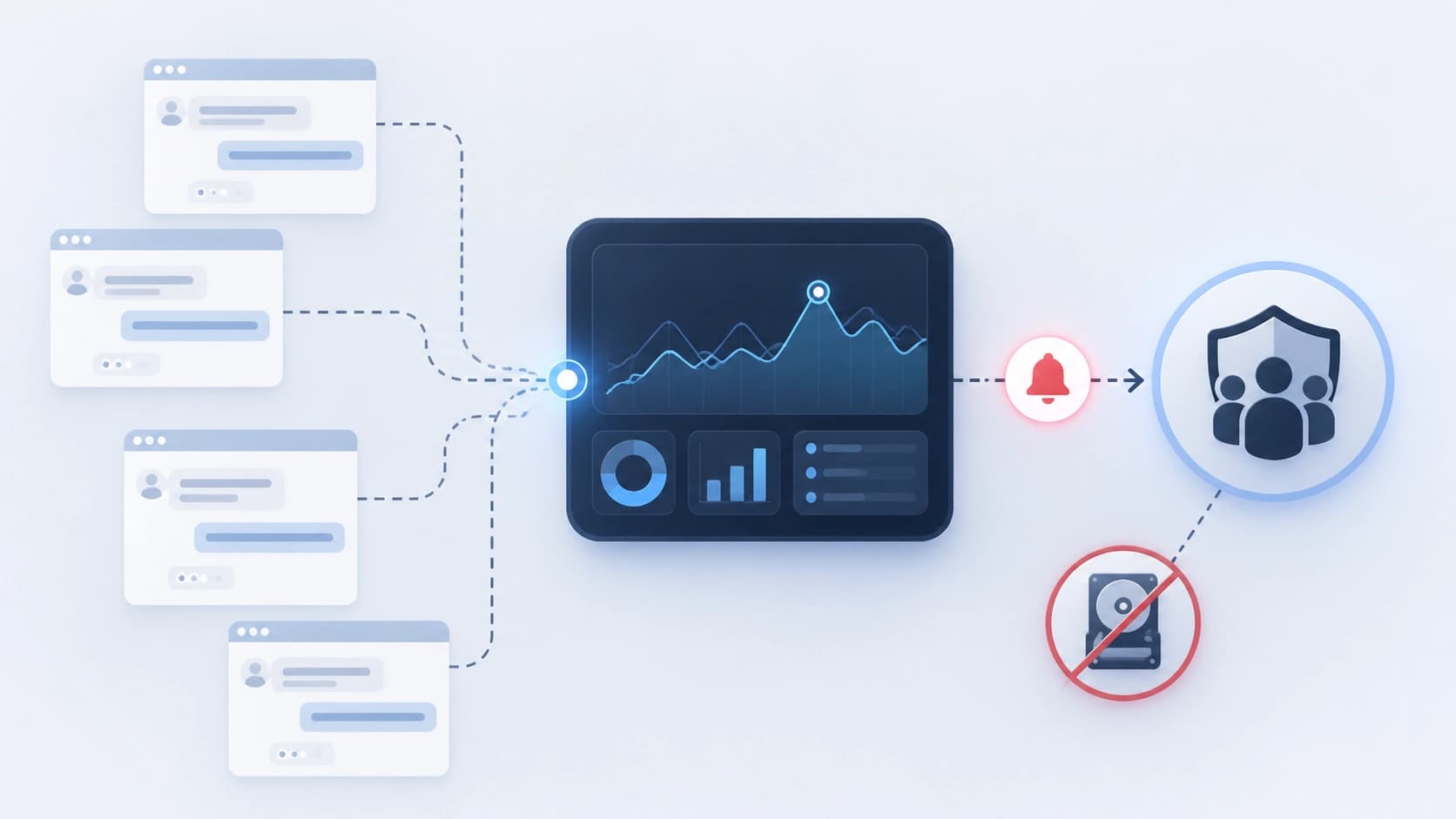
The difference lies in the scale of analysis. In the classic setup, agents check activity within each individual session, and that's it: the content of a request does not settle in the systems. But a bad actor can split malicious actions across dozens of "innocent" conversations. Private Safety Processing evaluates inputs and outputs across many conversations at once: when suspicion arises, the agent correlates events across different sessions and pieces them together into a coherent picture. At no stage does a human review the conversations.
If the system detects an anomaly, only a narrowly defined signal goes to OpenAI — an indication of a specific type of activity. From there, humans make enforcement decisions: they may contact the client and request context, but the client decides what to share. In other words, without the customer's explicit consent, their data does not reach OpenAI.
Anthropic's response: human access under full control
Anthropic does not deny that, under certain circumstances, reviewers may access client data. But the company insists on a strict procedure. Access is only granted through a "controlled path" for a small number of approved specialists, and each review session is recorded in a tamper-proof log. Reviewers physically cannot hide the trace of their visit or alter the record of it.
In essence, we are looking at two philosophies. OpenAI removes the human from the loop and relies solely on narrow automated signals. Anthropic, by contrast, keeps the human but makes every step transparent and verifiable. Businesses are left to choose between "no one sees the data" and "if someone has looked — you are guaranteed to find out."
Why the battle has intensified right now
Competition between the labs is also fueled by finances. Based on recent reports, OpenAI's revenue growth rate in the second quarter lagged behind Anthropic's. At the same time, the scales are still incomparable: Anthropic's annual recurring revenue reportedly reaches $65 billion, and its investors are discussing a potential IPO at a $2 trillion valuation. OpenAI, for its part, is also not abandoning its plans to go public.
In such a situation, privacy becomes a full-fledged market argument. The company that more convincingly explains to enterprise clients what happens to their data will gain an edge in the race for major contracts. This means both labs will continue to tighten their security systems — regardless of which one leads the race for response quality.