
AI helps select the topology of millimeter-wave pixel patch antennas for the desired response
Researchers trained a model to reverse-engineer pixelated patch antennas on a Rogers RT/duroid 5880 substrate for operation in the 22–30 GHz range. A classifier pre-filters unpromising variants, while a hybrid neural network accelerates the search for configurations with the required resonant characteristics.

Custom antennas: how AI selects pixel topology for the millimeter-wave range
Designing millimeter-wave antennas is a finicky endeavor. Requirements for radiation patterns, matching, and bandwidth often contradict each other, and the wavelength is so small that any inaccuracies in geometry change the picture. The classic approach—manually tuning the dimensions and shape of the radiator—takes weeks, especially when a non-standard response is needed.
One way to tackle this challenge is to abandon conventional "smooth" shapes and represent the antenna as a pixel mask: a set of small cells, each either metallic or empty. This yields a vast space of possibilities—millions of combinations. They cannot be manually enumerated. But this is precisely the kind of task that modern machine intelligence handles well.
What is a pixel patch antenna for millimeter waves
In a paper published on arXiv in August 2026, a group of researchers describes a system that automatically draws an antenna pattern to meet a given specification. The focus is on a compact patch antenna designed for frequencies from 22 to 30 GHz—that is, the millimeter-wave range with all its complexities.
The design is a rectangular area divided into a 19×23 pixel grid. Each cell can be a conductor or a void. For the antenna to be controllable, a continuous metallic path must run from the feed line to the radiating region—otherwise, current simply will not reach the required areas.
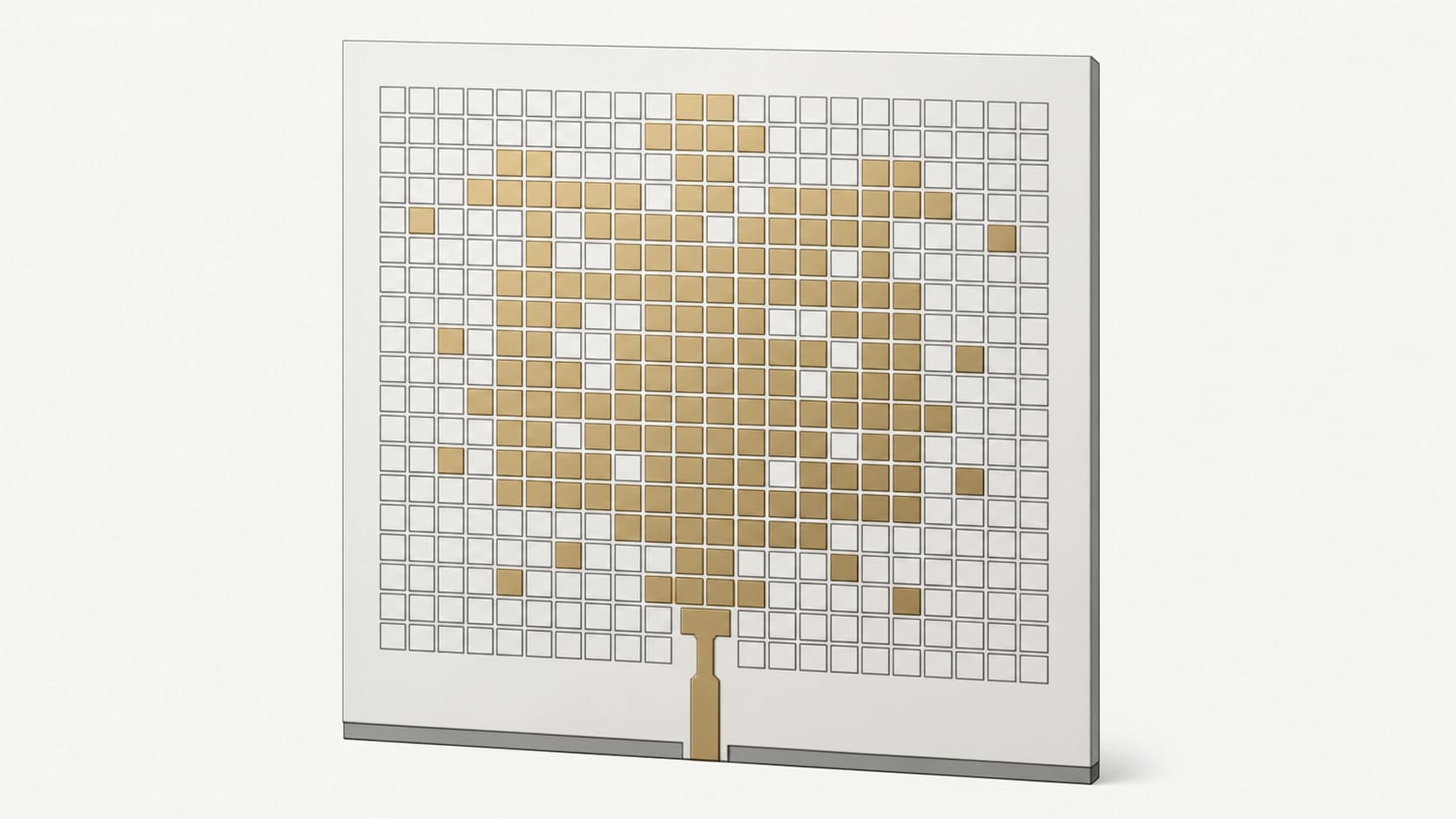
The pixel approach itself has long been known: if enough combinations are enumerated, a pattern with the desired properties would almost certainly be found. The trouble is that each check in an electromagnetic simulator is a full three-dimensional calculation that takes a long time. Millions of options are an unaffordable luxury here.
Initial simulations revealed the imbalance problem
To obtain training data, the authors ran about six thousand full-wave simulations in the CST package on specially generated random pixel masks. It turned out that only about 40% of these masks exhibit resonance at all, meaning they have a reflection coefficient S11 no higher than −10 dB at least at one frequency. In other words, six out of ten random designs are useless—an AI trained on such a set risked learning "uselessness" as the norm.
The classic solution to imbalanced data is simply to collect more successful examples. But where to get them if each simulation is expensive and random generation yields viable options not so often? A way is needed to separate the wheat from the chaff before an expensive calculation is launched.
First AI—a filter for selecting promising patterns
The researchers took an elegant approach: they trained a separate binary classifier based on gradient boosting that predicts from the appearance of the pixel pattern whether the antenna will be resonant. This model works instantly and requires no simulations. It was used as a "gatekeeper": new random masks first passed through the filter, and only those the classifier deemed promising were sent to CST for a full calculation.
This approach made it possible to add about four thousand more simulations to the original data, but already with "sifted" input material. As a result, the combined set of ten thousand samples became noticeably higher quality: the share of resonant designs grew from the original 40% to about 52%. This is an important achievement: the next AI models learn precisely from this base, and the more balanced the sample, the more accurately they predict antenna behavior.
Surrogate model instead of an electromagnetic solver
Next, the authors trained a hybrid neural network combining convolutional layers and a bidirectional LSTM architecture. This combination suits data that has both spatial structure (the pixel image) and frequency dependence.
The network must output the entire complex S11 response at once—that is, amplitude and phase—at 801 frequency points. This is a full-fledged "surrogate model": it replaces the slow electromagnetic simulator when searching for the optimal pattern.
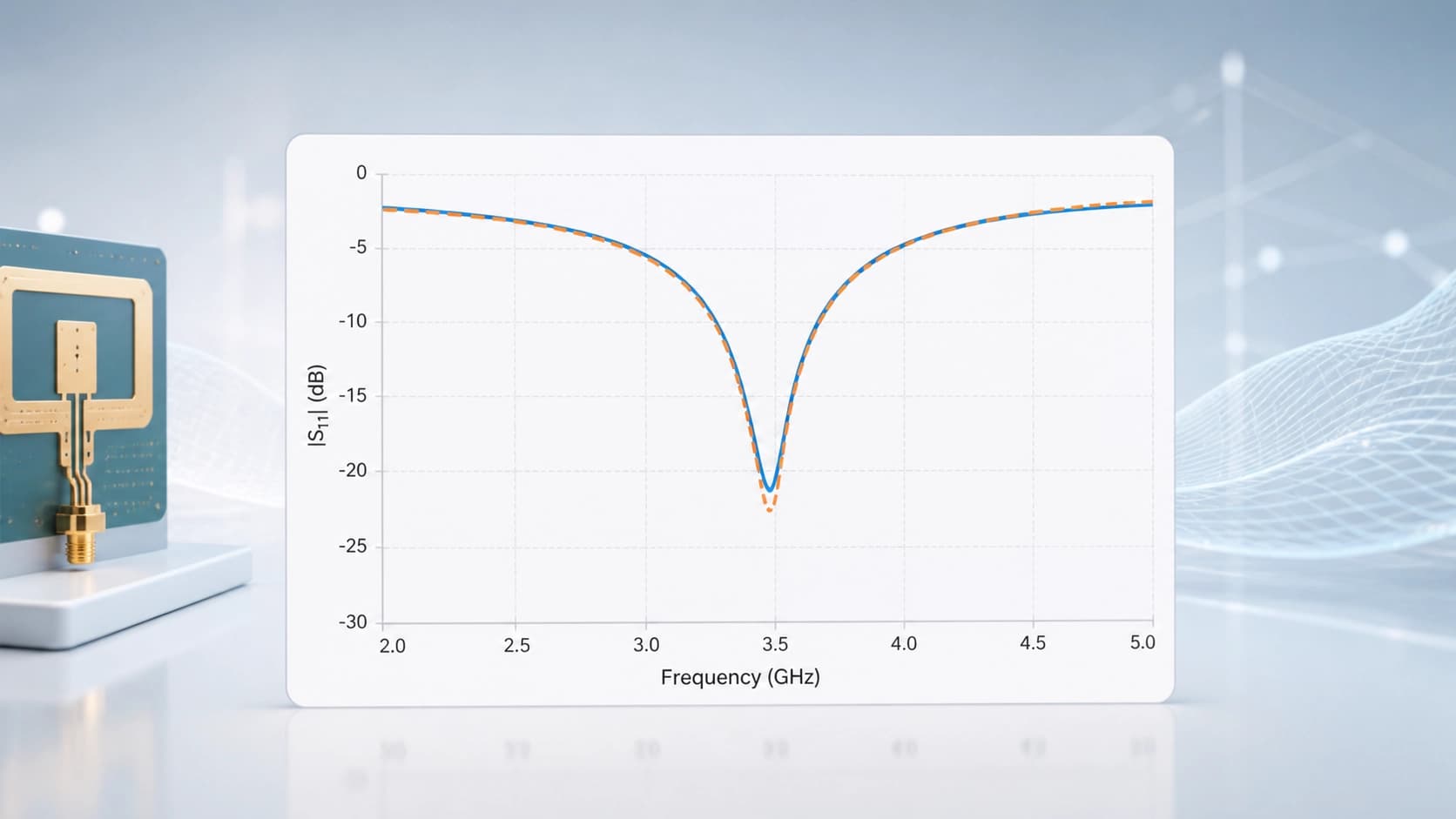
Special emphasis in training is placed on a physically important detail—the depth of the resonance dip. For an antenna, what matters is not just "there is resonance," but how good the matching is at a specific frequency. Therefore, the researchers added a component to the loss function that strictly penalizes the model for inaccurate prediction of the S11 minimum.
Inverse design: drawing an antenna to specification
After the fast surrogate model is mastered, the most interesting stage begins—inverse design. Instead of generating thousands of variants and "running" them through the network, the researchers use gradient descent. Only what is optimized is not the pattern itself—but its hidden representation in a compact latent space of dimension 64.
This technique, familiar from generative models, allows the mask to be changed in smooth steps and each time ask the network: "Does this pattern match the required S11 response?" The gradients indicate which way to tweak the parameters so that the resonant frequency, dip depth, and curve shape match the desired ones. The finished latent vector is then decoded back into a specific pixel pattern.
Verification in CST showed that the surrogate model's predictions and real electromagnetic calculations for the generated antennas agree well. The difference between them is small, meaning the proposed pipeline is indeed suitable for automated design.
What this means in practice
The work demonstrates a closed loop: a small set of simulations → a classifier for selecting useful data → a fast surrogate model → optimization in latent space → a finished antenna pattern. This approach not only speeds up the search but also paves the way for "reconfiguration"—when one system can quickly propose a new pattern for updated requirements, say, for a different operating frequency or band.
For now, this is a laboratory experiment on a specific class of antennas. But the very idea of "passing through AI not the result, but the process of topology search" looks promising for a wide range of microwave design areas—from radars to 6G communication systems. The more complex the electrodynamics, the more valuable the tools that seek non-trivial geometries without manual enumeration.
Frequently asked questions
Related materials
All materials
Checking LLM Hallucinations via SQL-Based Source Representation Without Fine-Tuning
The study examines whether an LLM can apply a basic symbolic skill—building a SQL database from source documents—to ground its outputs in sources without supervision when detecting hallucinations. On RAGTruth and DiaHalu, this neuro-symbolic pipeline proves more accurate than direct prediction and comparable to state-of-the-art methods, without requiring domain-specific fine-tuning.
9 November 2026
MathAdv: What the Final Accuracy of Machine-Generated Proofs Conceals
A diagnostic suite of tasks spanning 13 undergraduate and graduate mathematics topics evaluates machine-proving systems in Lean 4 not only by their final results, but also by their subject-matter mastery, the quality of their informal reasoning, and their robustness to rephrased conditions. A component-by-component analysis shows that translating a problem into formal form remains the main obstacle, and that success depends heavily on the area of mathematics and how the problem is framed.
9 November 2026
AffordanceWAM: Affordances as an intermediary between scene prediction and manipulator control
The work describes a generative model that jointly predicts future RGB observations, scalar fields, affordance heatmaps, and continuous robot commands, using human videos to broaden interaction diversity without action annotations or retargeting. On RoboCasa, CALVIN ABC→D, and real-world tasks, the approach delivers consistent gains over RGB-only and robot-data-only baselines.
9 November 2026