
Intentional disagreement makes code review more effective in large multi-agent teams
A new adversarial review protocol is built on just three agents, where a separate critic checks the reviewer's work through structured debate. This approach improves benchmark results and uncovers a dangerous mode of false consensus.

Why Large Multi-Agent Teams Stall
When LLM agents began to be widely used in development, many teams followed a logical but not always effective path: assembling as many algorithmic "specialists" as possible and assigning them roles. One writes code, another looks for vulnerabilities, a third checks scenarios. The problem is that each new agent yields less and less benefit: on repository-scale tasks, coordination costs quickly outweigh the gains from "extra hands."
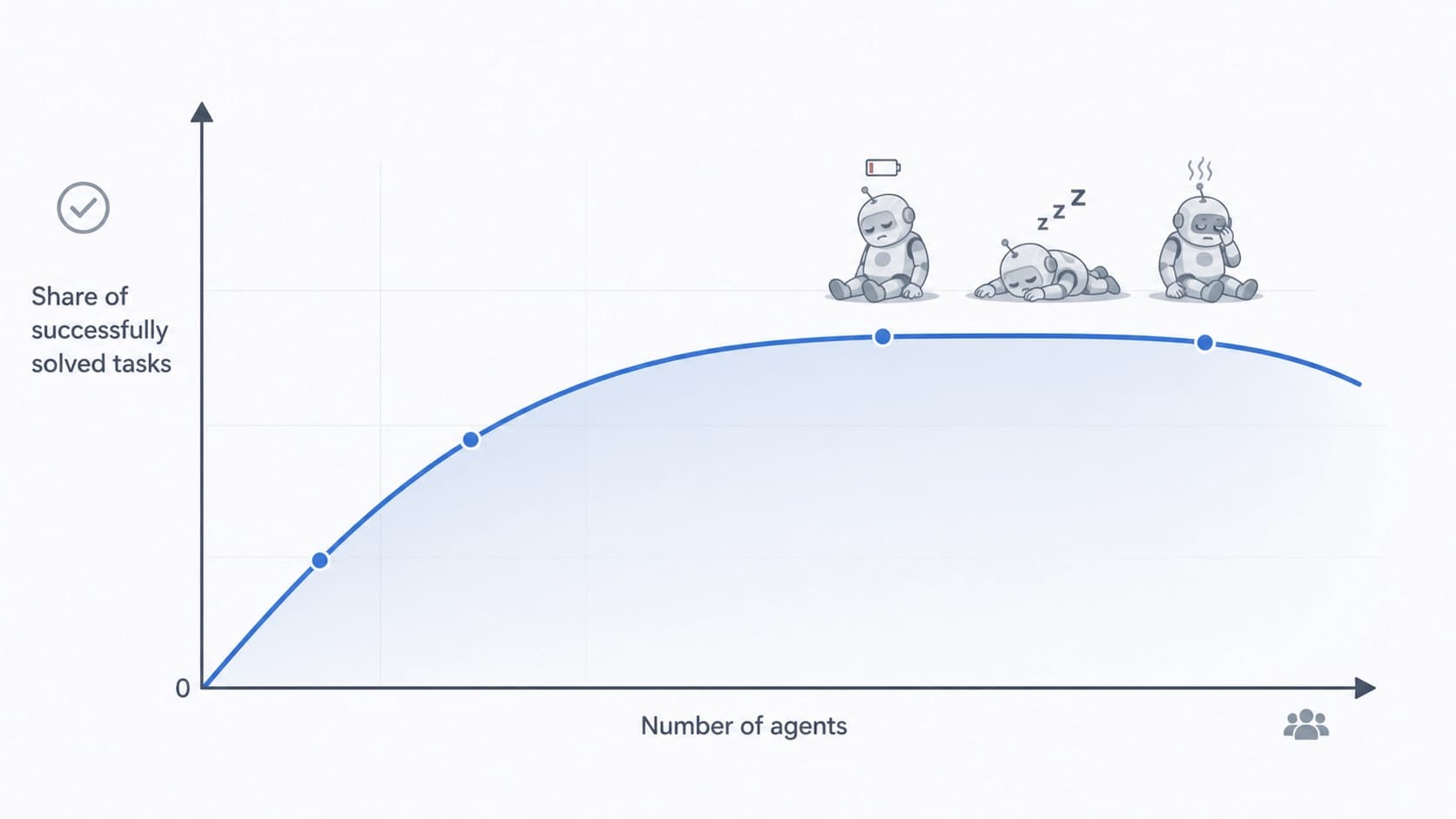
The reaction to this was a move in the opposite direction: agents were turned into sub-agents — obedient tools that are called on demand and do not engage in dialogue. This approach eliminates chaos, but it also destroys the main resource of collective work: no one challenges others' decisions anymore, so mistakes slip through unnoticed.
The Balance Point: Minimal Cooperation
Eric S. Qiu and Joyce Gill set out to find the sweet spot in their paper "Adversarial Review: Structured Disagreement for Grounded Agentic Code Review" (arXiv:2608.18167, categories cs.AI and cs.SE; submitted August 16, 2026, accepted at ICML 2026 Workshop on DL4C). Their hypothesis is simple: you can keep the simplicity of a sub-agent architecture while adding minimal cooperation — a single node where agent opinions are deliberately brought into conflict.
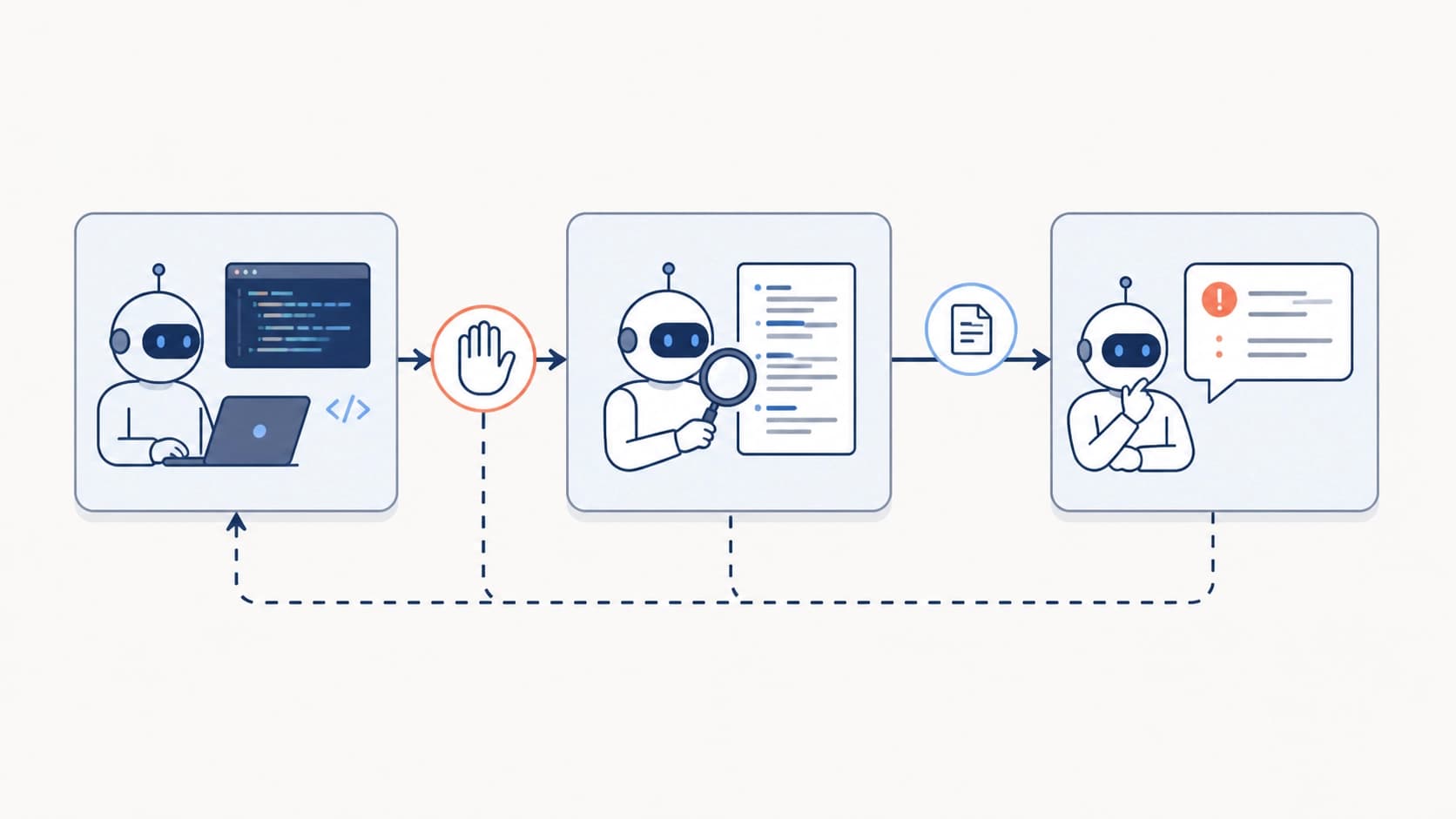
The result is the Adversarial Review (AR) protocol. The authors deliberately avoid building a complex hierarchy or multiplying roles. Instead, three participants work together:
- the coding agent prepares code changes;
- the reviewer assesses how correct those changes are;
- the critic audits not the code, but the review itself, and finds its weak points.
The critic does not simply say "I disagree" — it raises structured disagreement: pointing to specific code fragments that do not support the reviewer's conclusions. Only when this cycle is complete does the main agent get permission to make edits.
What the Trials Showed
The effect of disagreement is clearly visible in benchmark results.
On LiveCodeBench, AR achieved the highest pass rate among all tested methods. An important detail: three agents were enough for this, while the baseline that AR outperformed used five.
On SWE-PRBench, things got more interesting. The naive version of the protocol unexpectedly revealed a failure mode the authors called false consensus: agents converged on a common opinion without sufficient evidence. In other words, even deliberately structured disagreement can degenerate into a formal "agree with everyone." This is fixed with a single prompt iteration where the requirement to argue and justify disagreement is stated explicitly — after this refinement, the method took first place on F1.
Finally, on SWE-bench Verified, AR again improved the results of baseline approaches. This matters because repository-scale tasks are a completely different level of complexity than isolated functions: changes in one module can break dozens of neighboring ones.
Conclusion: Strength Comes Not from the Number of Votes, but from the Right to Object
The authors reach a counterintuitive but experimentally confirmed conclusion: effective code review requires neither a large team nor complex communication schemes. It is enough for disagreement to be:
- minimal — a single point of conflict, not an endless chat;
- structured — each participant has a clear, distinct function;
- evidence-based — objections rely on facts in the code, not on subjective preferences.
The practical lesson for anyone building agentic pipelines: don't try to solve the problem by adding roles. Instead, build a mandatory stage of doubt into the process — and let one agent officially challenge another's conclusions. The value of a review is determined not by the number of votes, but by the presence of someone capable of raising a substantive objection.
Frequently asked questions
Related materials
All materials
Checking LLM Hallucinations via SQL-Based Source Representation Without Fine-Tuning
The study examines whether an LLM can apply a basic symbolic skill—building a SQL database from source documents—to ground its outputs in sources without supervision when detecting hallucinations. On RAGTruth and DiaHalu, this neuro-symbolic pipeline proves more accurate than direct prediction and comparable to state-of-the-art methods, without requiring domain-specific fine-tuning.
9 November 2026
MathAdv: What the Final Accuracy of Machine-Generated Proofs Conceals
A diagnostic suite of tasks spanning 13 undergraduate and graduate mathematics topics evaluates machine-proving systems in Lean 4 not only by their final results, but also by their subject-matter mastery, the quality of their informal reasoning, and their robustness to rephrased conditions. A component-by-component analysis shows that translating a problem into formal form remains the main obstacle, and that success depends heavily on the area of mathematics and how the problem is framed.
9 November 2026
AffordanceWAM: Affordances as an intermediary between scene prediction and manipulator control
The work describes a generative model that jointly predicts future RGB observations, scalar fields, affordance heatmaps, and continuous robot commands, using human videos to broaden interaction diversity without action annotations or retargeting. On RoboCasa, CALVIN ABC→D, and real-world tasks, the approach delivers consistent gains over RGB-only and robot-data-only baselines.
9 November 2026