
Idea: turning compute into a financial instrument
Nvidia, together with major investment players — Apollo, BlackRock, Blackstone, Brookfield, Goldman Sachs and KKR — is working on a financing scheme worth half a trillion dollars. The goal is to make computing power a full-fledged asset class that can be invested in just like real estate or bonds.
Nvidia CEO Jensen Huang calls this the first time technology chips become an investable asset class. In his view, such assets have all the properties of a classic income-generating instrument: they are productive, durable, interchangeable and flexible. Huang draws a direct parallel with the mortgage-backed securities market that emerged in the 1970s — back then, too, it seemed a new formula for profit had been found.
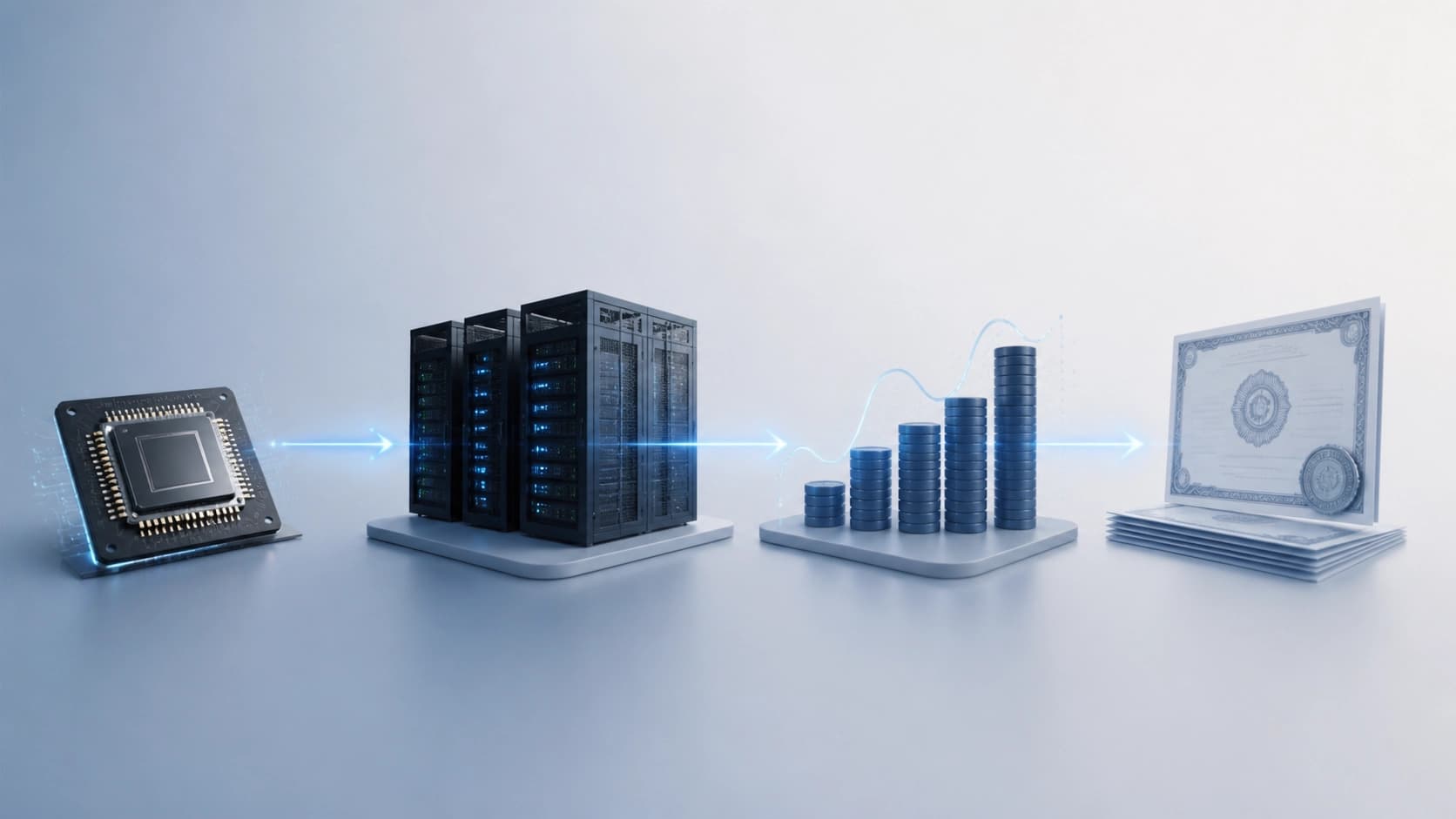
BlackRock CEO Larry Fink echoes the same analogy: he says he sees this as the future of financial engineering and that the industry is at the very beginning of the road. But it is precisely the reference to mortgage-backed securities that gives pause: that story ended in a crash.
Appetite for older chips and words that don't add up
At first glance, the market does show signs of healthy demand. Rental rates for chips of previous generations are rising, and Silicon Data analysts expect this trend to continue through 2028. There is a known case where a cloud provider raised prices on Nvidia Blackwell B200 by nearly double upon contract renewal — an unpleasant surprise for the tenant, but for the owner of computing capacity such dynamics look encouraging.
However, Huang's rhetoric about chip "durability" contradicts his own words from a year ago. Back then, he was talking about the previous-generation Hopper chips: in his words, once mass shipments of the new Blackwell begin, those old accelerators would be impossible to give away for free. In other words, literally a year ago the Nvidia CEO described rapid equipment depreciation, and now he insists chips are a durable asset.
Why the structure could collapse
Mark Rubinstein, a former hedge fund manager, recalls the fate of mortgage-backed securities: they collapsed precisely when mortgages began to be produced in excess. The same could happen with AI infrastructure — the market is already showing signs of saturation.

On top of that comes another factor: Chinese open-source models show that powerful AI can be built with far more modest computing costs. If model efficiency continues to improve, faith in endless demand for chips will be called into serious question. Moreover, it is far from certain that frontier-level labs — such as Anthropic and OpenAI — are even capable of consistently making money from their operations. Yet it is precisely they who are driving the main demand for compute today.
It is also worth remembering that the whole venture currently exists only as memoranda of understanding. Nvidia signed a similar $100 billion memorandum with OpenAI last year — and the deal never materialized. That is an important signal: loud announcements here do not equal real investment.
Nvidia's defense: it's not just about hardware
Huang pushes back against skeptics by noting that Nvidia's computing platform is not just silicon. It is about the CUDA software ecosystem that sets the company's AI factories apart from ordinary chips. In his words, the value of such systems is not fixed at the moment of installation: CUDA continuously improves performance, so already-installed equipment retains productivity well beyond its original depreciation period.

But there is a vulnerability here too. Chips and software by themselves do not create computing power — it exists only as part of large-scale infrastructure with buildings, cooling and power supply. Huang sidesteps these components in his reasoning, yet they account for a significant share of costs. An asset that cannot be operated without expensive infrastructure is not as simple and liquid an instrument as it is being made out to be.
In the end, the concept looks ambitious but contradictory. On one hand, the market is genuinely hungry for computing power. On the other, Nvidia itself recently admitted its equipment becomes obsolete quickly, and the deal underpinning the entire narrative may remain just a memorandum. Turning chips into the "new mortgage" could turn out to be either a brilliant financial move or a repeat of the mistakes of the 1970s — with the same price for excessive optimism.