
Molecular Vector as Infrastructure
In computational chemistry, molecular embedding has long ceased to be a technical detail. It is reusable infrastructure: the same vector representation serves compound property prediction, virtual screening, and similar-molecule search alike. Compute it once — and apply it across a dozen scenarios, from ranking libraries to selecting candidates for the lab.
The Dead End of a Single Representation
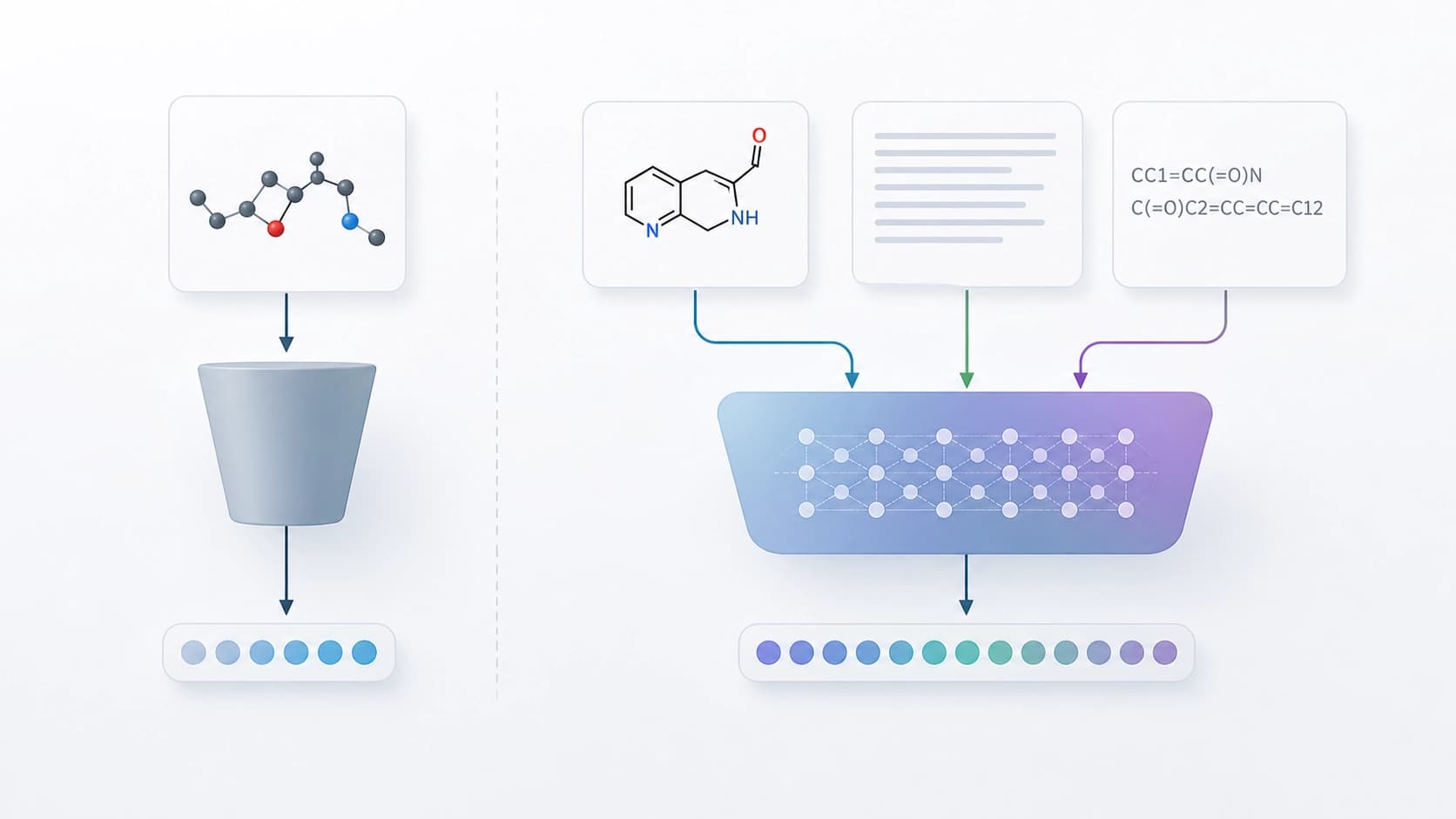
Almost all molecular encoders follow the same pattern: a single modality is chosen — an atom graph, a SMILES string, a set of physicochemical descriptors, or a 3D conformation — and the model is trained strictly on it. The resulting vector is unconditional. There is no interface through which the query could be refined: "I need an analog by mechanism of action, not by carbon skeleton," or "a similar compound, but with an eye toward solubility."
This leads to an unpleasant effect. Different models see the same molecule differently, and their representations cannot be compared directly — the spaces are not aligned. Meanwhile, the chemist is forced to keep in mind which encoder suits which task, instead of simply stating the task in words.
The Question the Authors Posed
The work by Xinjian Zhao, Xiangru Jian, Yaoyao Xu, Xiaozhuang Song, Wei Pang, Lei Bai, and Tianshu Yu (arXiv:2608.23646, August 24, 2026; presented at the FM4LS workshop at ICML 2026, non-archival) begins precisely with this dissatisfaction. The researchers ask: why build a separate encoder for each molecular representation at all, if multimodal LLMs can already natively handle images, text, and symbolic notations?
The logic is simple. If a model already "sees" an image of a structural formula, reads a description, and parses SMILES, it can be turned not into a consulting assistant but into a vector generator. Moreover, a generator of conditioned vectors — ones that depend not only on the molecule itself but also on what is being asked about it in natural language.
How the Framework Is Built
MolEmb is a lightweight add-on, not a new large model. It adapts an existing MLLM so that molecular profiles and their textual descriptions end up in a single shared embedding space. The key element is a bidirectional contrastive objective: it pulls "molecule — text" pairs together while simultaneously pushing mismatched pairs apart.
Why This Matters More Than It Seems
Contrastive learning here solves two problems at once. First, it establishes a common coordinate system: the vector of a molecule and the vector of its description become comparable. Second, it enables cross-modal search in both directions — find text by molecule, find molecule by text — all within the same space, without intermediate translators between modalities.
The reported result is more modest than "we beat all benchmarks," and that makes it more credible: the resulting representations are competitive in molecular property prediction while also supporting cross-modal search. In other words, the language interface is not bought at the cost of degrading classical tasks.
Language as a Control Lever
The main difference from traditional encoders lies in conditioning. A specialized model outputs a single fixed vector per molecule. The framework, however, allows a condition to be stated in words and yields a representation shifted toward that condition. The same molecule can be represented differently depending on whether you care about toxicity, solubility, or proximity to a particular compound class.
Molecular Search That Depends on Context
A separate part of the work is the MolCAR diagnostic benchmark. It was created to test context-dependent search — that is, situations where the correct answer changes depending on how the query is phrased. This is fundamentally harder than classical similar-structure search: there the reference is single, here it depends on the framing of the task.

The Most Interesting Finding
Perhaps the authors' most valuable observation sounds almost mundane: context-dependent molecular embedding is primarily a property of the supervision data, not an architectural trick. In other words, the model starts distinguishing contexts not because a clever module was built into it, but because it was trained on pairs where the context genuinely differs.
The conclusion is sobering and useful at the same time. It shifts the focus from an arms race of architectures to the quality and structure of training data: if the molecule descriptions in a dataset are uniform, no amount of multimodality will give the model sensitivity to the nuances of a query.
What This Changes in Practice
If this approach scales, the payoff looks like this:
- A unified infrastructure instead of a zoo of encoders. A single model covers properties, search, and cross-modal queries.
- Queries in words instead of model selection. The user doesn't need to know which encoder is best for their case.
- Compatible spaces. Molecule and text vectors live together, which means they can be compared and combined.
- Reuse of existing MLLMs. The framework adapts an existing model rather than training from scratch.
Limits and Open Questions
The work is marked as non-archival, which means this is more a direction than a finished product. Plenty of questions remain: how robust the approach is beyond the tested datasets, how it behaves on rare compound classes, whether the language part starts to dominate the chemical part, and whether this turns the vector into a retelling of text rather than a physically meaningful representation.
Nevertheless, the main idea is stated clearly. Multimodal LLMs are not just chemical assistants and not just answer generators. They lay claim to being a general mechanism for molecular embeddings: extensible, controllable through words, and open to fine-tuning for new tasks.