
Google releases Mantis, a toolkit for end-to-end vulnerability testing with AI agents
The skill set helps agents analyze code, confirm defects in an isolated environment, prepare fixes, and verify them by retesting. The article covers Mantis’s architecture, its status as a demo project, and its Apache 2.0 license.
What the toolkit is
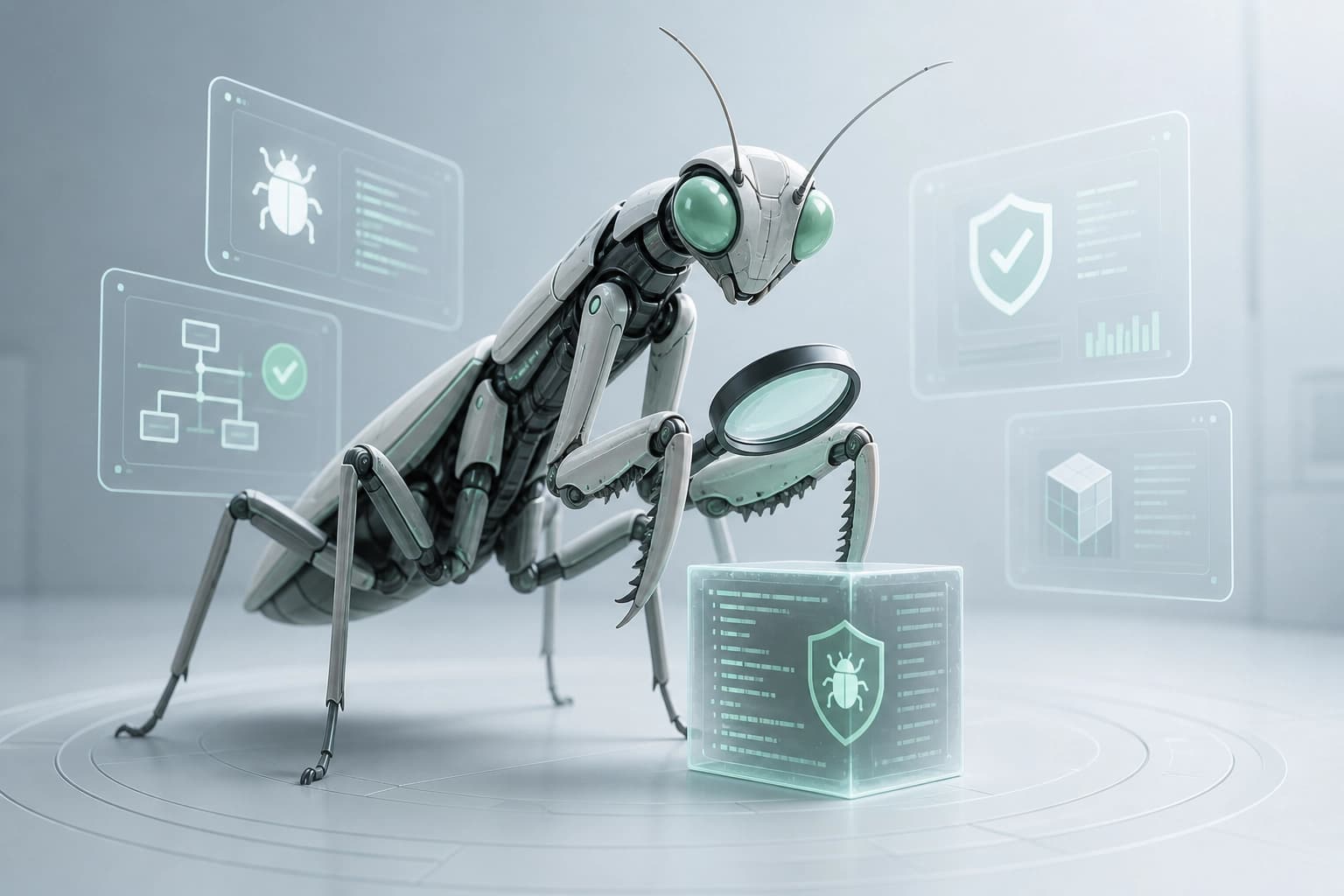
Mantis is an open, stack-agnostic set of skills for checking code security with AI agents. It is not a standalone scanner or a Google-supported product.
The toolkit helps carry a vulnerability through its lifecycle: identify a possible defect, filter out false positives, reproduce the bug, and prepare a patch. It then rechecks the fix and assesses the residual risk.

Skills are stored in separate directories, launched with slash commands, and linked into a pipeline. An existing coding agent loads the commands. The /mantis-meta-agent supervisor skill can manage the entire lifecycle in a long-running session.
How the review cycle works
Mantis starts by preparing context and a plan. The agent then searches for and filters potential issues, verifies them, and creates a report.
/mantis-historysearches version control history for past security fixes./mantis-summarizecreates directory maps, while/mantis-architecturebuilds a Markdown knowledge base./mantis-threat-modeldefines trust boundaries;/mantis-plancreates a targeted review plan./mantis-researcherchecks files against the plan./mantis-dedupe,/mantis-review, and/mantis-criticmerge duplicates, apply exclusion rules, and discard issues that are impossible in a release build.
After filtering, the toolkit moves on to reproduction, remediation, and residual risk assessment. Separately confirmed findings can be combined into an exploit chain.
/mantis-reproduceruns payloads in gVisor or a virtual machine with networking disabled./mantis-chainbuilds exploit chains from confirmed findings./mantis-patchapplies and verifies a fix./mantis-calibrateassigns a risk score from 1 to 10./mantis-reflectsaves takeaways for the next pass, while/mantis-reportcreates a report for people.
How the toolkit verifies findings
Mantis relies on reproducing vulnerabilities in a sandbox and rechecking patches. This approach tests whether a bug occurs and whether the fix resolves it, rather than relying on the model's confidence.
Inter-stage contracts are published. Teams can wrap skills in a deterministic shell instead of delegating shell command management to a language model.
According to Google, a hierarchical summary tree reduces token usage by more than 85 percent. Google also states that naive AI code scanning has a true positive rate of less than 7 percent. The toolkit aims to address this problem.
Where to use it and what to consider
Mantis can be used locally and for internal evaluations. Google does not yet recommend the toolkit for production.
The toolkit is released under the Apache 2.0 license. It can be cloned and run with Gemini CLI, Antigravity CLI, Google ADK, or a comparable agent framework.
The selection criterion is simple: the toolkit is suitable for experimentation and internal reviews if you need a workflow from discovery through patch rechecking. The source itself does not yet recommend this use case for production.
Frequently asked questions
Related materials
All materials
Validating Candidates Costs More Than Generating Them: Honeypots Against LLM Vulnerability Hunting
The study examines the cost asymmetry in agentic vulnerability discovery: generating candidate versions is cheap, while confirming them through reachability analysis, execution, and PoC development consumes most of the budget, making verification a potential standalone target for defense. The proposed RedHerring—repository-adapted decoys with a hidden certificate—reduced the number of real vulnerabilities found by 38.7–60.4% at equal cost across 33 OSS-Fuzz projects; even after the agent was warned, the reduction remained at 37.2%.
9 November 2026
Checking LLM Hallucinations via SQL-Based Source Representation Without Fine-Tuning
The study examines whether an LLM can apply a basic symbolic skill—building a SQL database from source documents—to ground its outputs in sources without supervision when detecting hallucinations. On RAGTruth and DiaHalu, this neuro-symbolic pipeline proves more accurate than direct prediction and comparable to state-of-the-art methods, without requiring domain-specific fine-tuning.
9 November 2026
MathAdv: What the Final Accuracy of Machine-Generated Proofs Conceals
A diagnostic suite of tasks spanning 13 undergraduate and graduate mathematics topics evaluates machine-proving systems in Lean 4 not only by their final results, but also by their subject-matter mastery, the quality of their informal reasoning, and their robustness to rephrased conditions. A component-by-component analysis shows that translating a problem into formal form remains the main obstacle, and that success depends heavily on the area of mathematics and how the problem is framed.
9 November 2026